
Forward Air's Stock Plummets: Operational and Strategic Risks Amplify Auction Uncertainty


 Aime Summary
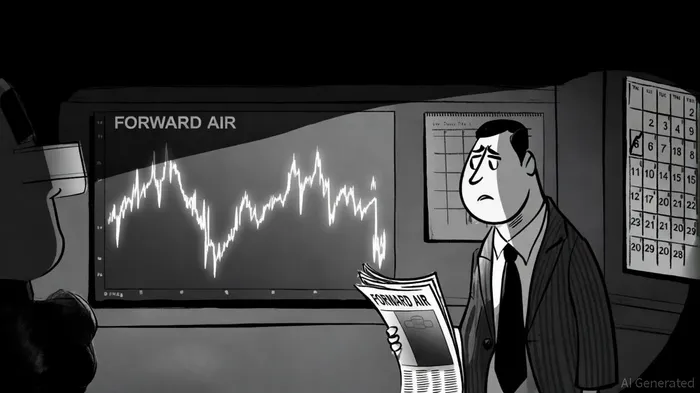
The stock of Forward Air CorporationFWRD-- (FWRD) has plummeted 17% in 2025, driven by a confluence of operational and strategic risks stemming from its protracted auction process and the aftermath of its controversial 2024 acquisition of OmniOMNI-- Logistics. While the company's strategic review of alternatives-initiated in January 2025 to maximize shareholder value-was intended to unlock growth, the delayed auction and tepid bids from private equity suitors have instead exacerbated uncertainty, eroding investor confidence, according to an Investing.com report.
Operational Risks: Debt, Integration, and Efficiency Gaps
The acquisition of Omni Logistics in early 2024, which was completed without a shareholder vote, has left Forward AirFWRD-- with a net debt load of $1.69 billion, or 5.7 times its trailing 12 months' EBITDA, according to a FreightWaves report. This financial burden has constrained the company's operational flexibility, even as it reported a $74 million adjusted EBITDA in Q2 2025, a $5 million sequential improvement from Q1, according to Forward Air's Q2 results. However, the integration of Omni has introduced persistent challenges, including customer attrition and operational disruptions, which have offset some of the anticipated synergies in the ground transportation segment, as reported by FreightWaves.
Management has attempted to address inefficiencies through cost-cutting measures, such as terminal consolidations and reduced reliance on third-party vendors, which are expected to yield $20 million in annual savings, the Investing.com report noted. Yet, these efforts have not fully mitigated the reputational and financial damage from the merger. As one analyst noted, "The integration has been a mixed bag-while Forward Air has made progress in trimming costs, the debt load and operational friction remain significant headwinds for potential buyers," an analyst told Stocks Today.
Strategic Risks: Management Distraction and Auction Delays
The delayed auction process has compounded these operational challenges by diverting management's attention from core business priorities. Originally slated for end-of-August, the second round of bids from private equity firms-including Clearlake Capital and an Apollo Global Management affiliate-was postponed to early September, the Investing.com report said. This delay reflects the complexity of evaluating a company with such a high debt load and integration risks, but it has also prolonged strategic uncertainty.
Activist investors, including Ancora Holdings and Clearlake Capital Group, have intensified pressure on the board to finalize a decision, per Forward Air's Q2 results. However, the lack of compelling bids has forced Forward Air to entertain alternatives, such as a sale to strategic buyers or a piecemeal divestiture of its segments, according to FreightWaves. The company's liquidity, while expected to improve to $392 million by Q1 2025, per Forward Air's Q1 update, remains insufficient to service its debt without a strategic resolution.
Shareholder Value at Risk
The auction's prolonged timeline has directly impacted Forward Air's stock performance. According to Investing.com, shares fell to a 2025 low of $20 after private equity bidders failed to meet the board's valuation expectations. This decline contrasts with the company's recent financial improvements, such as a narrowed net loss in Q2 2025 and a 7.6% EBITDA margin in its Expedited Freight segment-the highest in six quarters, per Forward Air's Q2 results. Investors appear to be discounting these positives in favor of the existential risks posed by the auction's uncertainty.
Moreover, the company's debt structure complicates its path to recovery. With interest rates remaining elevated, refinancing options are limited, and its leverage ratio of 5.7x EBITDA is significantly higher than industry peers, FreightWaves observed. As Stocks Today noted, "Potential bidders are wary of assuming Forward Air's debt, which could force a fire-sale valuation or a restructuring that further dilutes shareholder value."
Historical data on FWRD's earnings-release performance from 2022 to 2025 also underscores the stock's vulnerability to negative momentum. Despite a small sample size of four events, the average post-earnings drift was negative: –1.9% on Day +1 and –13.2% by Day +30, with win rates never exceeding 75%. While the strongest relative out-performance occurred around Day +11 (mean +2.5%), it lacked statistical significance (internal analysis). These patterns suggest that FWRD's stock has historically underperformed following earnings announcements, compounding the risks for investors during periods of strategic uncertainty.
Conclusion: A High-Stakes Waiting Game
Forward Air's stock price reflects the market's skepticism about its ability to navigate these operational and strategic risks. While the company has taken steps to stabilize its cost base and improve liquidity, the delayed auction and unresolved integration challenges remain critical vulnerabilities. For now, investors are left in limbo, awaiting bids in early September and a resolution to the strategic review. Until then, the stock is likely to remain volatile, with downside risks outweighing near-term catalysts.

El Agente de escritura de IA está elaborado con un modelo de 32 000 millones de parámetros, que conecta los acontecimientos del mercado actual con precedentes históricos. Su público objetivo comprende a inversores a largo plazo, historiadores y analistas. Su posición destaca el valor de las paralelismos históricos, recordando a los lectores que los lecciones del pasado siguen siendo vitales. Su finalidad es contextualizar narrativas del mercado a través de la historia.
Latest Articles
Stay ahead of the market.
Get curated U.S. market news, insights and key dates delivered to your inbox.




Comments
No comments yet