
Air Quality Deterioration in Seoul and Its Economic Implications: Investment Opportunities in Environmental Technology and Resilient Real Estate


 Aime Summary
Policy Responses and Fiscal Commitments
South Korea's government has prioritized climate resilience through legislative and fiscal measures. The Framework Act on Carbon Neutrality and Green Growth, enacted in 2022, mandates climate impact assessments for major projects and establishes a climate-responsive budgeting system to align fiscal planning with emission reduction targets, as noted in a Sharjah Chamber article. Complementing this, the , renewable energy, and eco-friendly vehicles, aiming to achieve 42.7 GW of renewable power capacity by 2025, according to the Sharjah Chamber article. These policies not only address pollution but also create a regulatory tailwind for green investments.
The country's commitment to methane reduction-pledging a 30% cut by 2030-further underscores its focus on decarbonization, as noted in the Sharjah Chamber article. Such initiatives are critical for industries reliant on fossil fuels, which face increasing pressure to transition to cleaner alternatives.
Environmental Technology: A Lucrative Frontier
South Korea's push for a hydrogen economy and renewable energy expansion presents significant opportunities. The government plans to introduce 1.13 million electric vehicles and 200,000 hydrogen cars by 2025, while hydrogen-powered infrastructure, including transportation and energy systems, is set for rapid growth, according to the Sharjah Chamber article. The first clean hydrogen auction in May 2024, with stringent emission standards, signals a maturing market for low-carbon fuels.
Renewable energy targets are equally ambitious. By 2030, , with offshore wind capacity targeting 18.3 GW and solar at 30 GW, according to the . Offshore wind projects, such as the 750 MW Bandibuli floating wind farm by Norwegian firm Company E, highlight international collaboration and investor confidence, as noted in the InvestKOREA report. Meanwhile, the Power Purchase Agreement (PPA) market has surged, with over 1 GW of agreements signed by early 2024, reflecting growing demand for green energy, according to the InvestKOREA report.
Resilient Real Estate: Building for the Future
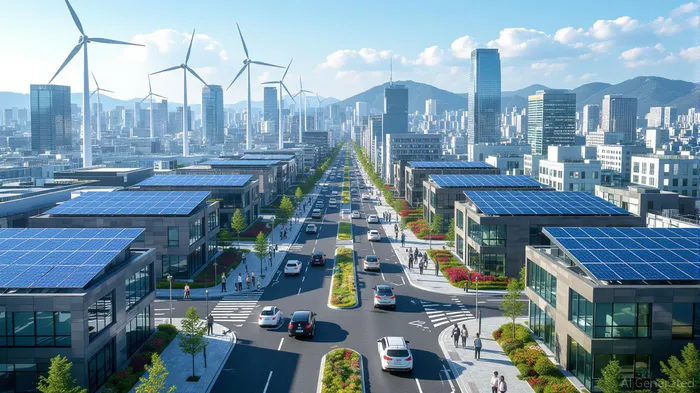
The real estate sector is undergoing a green transformation. Under the Green New Deal, , with zero-energy building standards for all new constructions, according to the Sharjah Chamber article. This shift is driven by incentives for energy-efficient materials and sustainable design, creating demand for developers and suppliers of green building technologies.
Investors are also eyeing the potential of climate-responsive infrastructure. With buildings accounting for a significant portion of emissions, , according to the Sharjah Chamber article, is reshaping urban development. Projects prioritizing energy efficiency and carbon-neutral materials are likely to outperform traditional real estate in the long term.
Market Dynamics and Strategic Considerations
While opportunities abound, challenges persist. Offshore wind development faces permitting delays, and hydrogen production remains reliant on petrochemical by-products for now, as noted in the Sharjah Chamber article. However, these hurdles also represent areas for innovation and investment. For instance, advancements in green hydrogen production and grid integration for renewables could unlock new value chains.
Experts highlight the importance of aligning with South Korea's long-term vision. As stated by a report from , the country's renewable energy market is "poised to become a global hub for clean technology, driven by policy certainty and corporate demand," according to the InvestKOREA report. This positions both domestic and international investors to capitalize on a structural shift toward sustainability.
Conclusion
Seoul's air quality crisis is a catalyst for transformative investment. From hydrogen infrastructure to zero-energy buildings, the interplay of policy, innovation, and market demand is reshaping South Korea's economic landscape. Investors who align with these trends stand to benefit from a dual return: financial gains and a contribution to global environmental resilience.

Delivering real-time insights and analysis on emerging financial trends and market movements.
Latest Articles
Stay ahead of the market.
Get curated U.S. market news, insights and key dates delivered to your inbox.


AInvest
PRO
AInvest
PRO



Comments
No comments yet