
U.S. Air Force Bids for Tesla Cybertrucks to Simulate Battlefield Threats Pentagon Deepens Ties With Big Tech Through Cybertruck Procurement
 Aime Summary
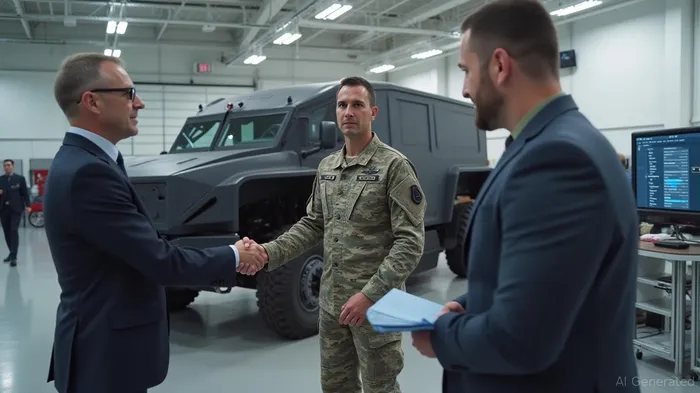
The U.S. Air Force has initiated the process of acquiring two TeslaTSLA-- Cybertrucks for use in battlefield training exercises, specifically as missile targets. According to recent filings with the System for Award Management, the vehicles will be used to simulate realistic combat scenarios, as adversaries are increasingly likely to use vehicles with advanced durability and futuristic design [1]. The filings emphasize the importance of testing that mirrors real-world conditions, with the Cybertrucks serving as a high-fidelity proxy for potential threats on the battlefield.
The Air Force Material Command, part of the Department of Defense, is not only seeking Cybertrucks but also 31 other types of vehicles, including sedans and bongo trucks, for similar purposes. One document cited market research, noting that the Cybertruck’s angular design and stainless-steel exoskeleton make it particularly suitable for this kind of testing, even though the vehicles do not need to be fully functional—only intact and capable of rolling [1].
Gordon Adams, a professor of U.S. foreign policy at American University and an expert on defense spending, views this initiative as more than a routine procurement decision. He highlights the broader trend of deepening collaboration between the Pentagon and Big Tech, which he describes as “an evolving relationship.” While the acquisition of Cybertrucks may seem minor in isolation, it is symbolic of a larger shift in how the U.S. military is engaging with private sector technology firms [1]. Adams suggests that the Air Force’s request may represent a “camel’s nose under the tent” in the growing relationship between the Department of Defense and Elon Musk’s ventures, which already include SpaceX and Starlink [1].
Musk’s companies have been major recipients of government contracts. SpaceX has secured $22 billion in launch deals with the Pentagon, while Starlink has been deployed to provide satellite-based connectivity for military operations in remote areas and in Ukraine [1]. These partnerships are part of a broader pattern in which the Pentagon has increasingly turned to private technology firms to meet its operational needs. This trend accelerated under the Obama administration, which encouraged greater collaboration between the military and the private sector through initiatives like the “people bridge” program [1].
Today, more than half of the government’s total contract obligations are with the private sector, reaching $445 billion out of $755 billion in fiscal 2024, according to data from the Government Accountability Office [1]. This shift has been driven by the Pentagon’s recognition that private technology companies possess capabilities that traditional defense contractors do not, particularly in areas like artificial intelligence, cloud computing, and satellite communications.
The Trump administration further deepened these ties, with a $150 billion increase in defense spending, creating fertile ground for tech innovation in military applications. Fortune reported that agencies within the Defense Department are actively testing AI tools from companies such as MetaMETA--, Google, and OpenAI, as well as from startups like Gladstone AI and ScaleAI [1].
The integration of Big Tech and the Pentagon is not limited to Musk’s ventures. PalantirPLTR--, the data analytics firm co-founded by Peter Thiel, recently surpassed $1 billion in quarterly revenue, partly due to a $10 billion, 10-year software contract with the U.S. Army [1]. Similarly, OpenAI recently won a $200 million contract with the Pentagon to apply its AI capabilities to security challenges in both military and enterprise settings [1].
As the demand for cutting-edge technology in the military continues to grow, the relationship between the Pentagon and the private sector is expected to remain robust. Adams notes that this interplay has created a “whole new sector” of privatized defense technology, where companies like AppleAAPL--, MicrosoftMSFT--, and Palantir play a critical role alongside traditional defense contractors [1].
With the political landscape in the U.S. making it unlikely that the development of military technology will be curtailed, the door to collaboration between Big Tech and the Pentagon remains wide open. The Cybertruck acquisition, while a small piece of a much larger puzzle, reflects the trajectory of this evolving relationship, one that is defined by mutual benefit and the shared pursuit of technological advancement.
Source: [1] Air Force bid for Tesla Cybertrucks in target practice symbolizes the ‘evolving’ relationship between the Pentagon and Big Tech, expert says (https://fortune.com/2025/08/10/air-force-tesla-cybertruck-relationship-big-tech-pentagon-contract-spending/)

Comprender rápidamente la historia y el origen de varias monedas reconocidas
Latest Articles
Stay ahead of the market.
Get curated U.S. market news, insights and key dates delivered to your inbox.
AInvest
PRO
AInvest
PRO



Comments
No comments yet