
The Air Canada Strike and Its Ripple Effects on North American Aviation Markets
 Aime Summary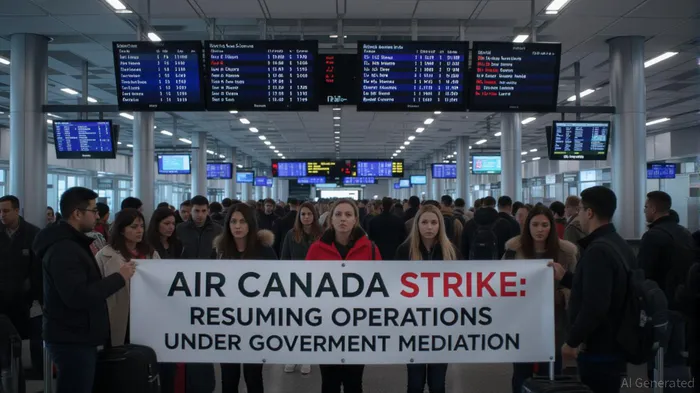
The Air Canada strike of August 2025, which grounded Canada's largest airline and disrupted the travel of 130,000 passengers daily, is more than a localized labor dispute. It is a microcosm of a broader crisis in the post-pandemic aviation sector: the collision of rising labor costs, government intervention, and the fragility of airline balance sheets. For investors, the strike—and the Canadian government's aggressive use of binding arbitration—highlights a critical inflection point in the industry's evolution.
Labor Tensions: A New Normal
The strike, led by the Canadian Union of Public Employees (CUPE), centered on demands for fair compensation for unpaid ground time and inflation-adjusted wages. Air Canada's 38% total compensation offer over four years was rejected as insufficient, exposing a chasm between management and labor. The government's invocation of Section 107 of the Canada Labour Code—a rare but increasingly common tool—forced a return to work and imposed arbitration. This mirrors similar interventions in U.S. rail and port strikes, signaling a shift toward regulatory overreach in resolving labor disputes.
The ripple effects are clear. Labor costs, already rising by 1.3% industry-wide in 2024, now face further pressure as unions leverage strikes to demand higher wages. For airlines, this creates a dual challenge: absorbing higher labor expenses while maintaining profitability in a sector historically prone to volatility.
Financial Fallout and Operational Resilience
The Air Canada strike cost the airline $98 million in daily revenue, a stark reminder of the financial toll of labor disruptions. Yet the broader industry's response varies widely. Delta Air LinesDAL--, for instance, boasts $1.5 billion in cash reserves and a 4.6% operating margin as of Q1 2025, enabling it to weather similar shocks. In contrast, Spirit Airlines, which emerged from bankruptcy in March 2025, has a debt-to-equity ratio of 5.2x and remains highly vulnerable to labor unrest.
The disparity in resilience is not accidental. Airlines with strong balance sheets, like DeltaDAL-- and Alaska Airlines, have prioritized labor negotiations and ESG alignment, reducing the risk of disruptive strikes. Alaska Airlines, despite a debt-to-equity ratio of 1.14 (higher than Delta's 0.86), has maintained a 2.33% net margin and a 12.62% return on equity, demonstrating that disciplined cost management can offset leverage risks.
Conversely, FrontierULCC-- Airlines' Q2 2025 net loss of $70 million—amid a 5% revenue decline and 8% higher cost per available seat mile—illustrates the perils of overexposure to labor-vulnerable models. Frontier's reliance on ultra-low-cost strategies and its 84% A320neo fleet (a structural advantage) cannot compensate for weak labor relations or poor capacity management.
Investment Implications: Resilience vs. Vulnerability
For investors, the key lies in distinguishing between airlines that can adapt and those that will falter. Resilient stocks like Delta and Alaska offer a combination of liquidity, diversified revenue streams, and proactive labor relations. Delta's 30% pilot pay raise over four years, for example, preemptively addressed potential disputes, insulating it from the volatility plaguing others.
Conversely, Spirit and Frontier represent high-risk propositions. Spirit's recent bankruptcy restructuring and Frontier's $766 million liquidity cushion (down from $1.5 billion in 2024) underscore their precarious positions. Both face existential threats if labor costs rise further or capacity discipline falters.
Strategic Hedging and Sector Diversification
Given the sector's volatility, investors should adopt a defensive posture. Options or ETFs can hedge against sector-wide downturns, while allocations to ESG-aligned carriers (like Delta, with its strong governance and sustainability practices) align with long-term trends. Avoiding overexposure to high-debt, labor-vulnerable firms is equally critical.
The Air Canada strike is a harbinger of things to come. As labor tensions escalate and governments increasingly intervene, the aviation sector will reward those who prioritize resilience and adaptability. For now, the path forward is clear: bet on the strong, hedge against the weak, and watch the skies for the next storm.

Stay ahead of the market.
Get curated U.S. market news, insights and key dates delivered to your inbox.
AInvest
PRO
AInvest
PRO



Comments
No comments yet