
Air Canada's Strike Crisis: Navigating Short-Term Turbulence and Long-Term Resilience in the Post-Pandemic Airline Sector
 Aime Summary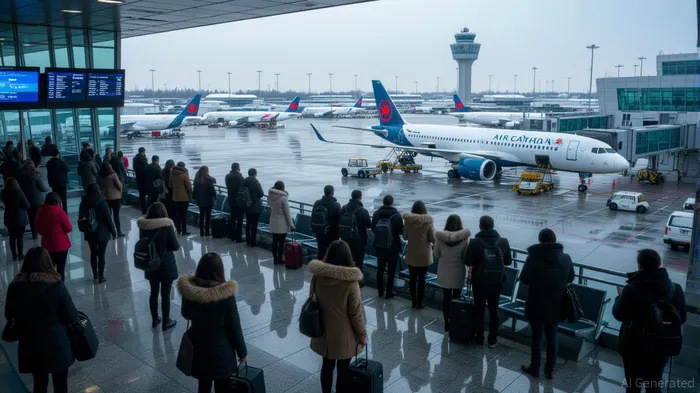
The 2025 strike by Air Canada's 10,000 flight attendants, represented by the Canadian Union of Public Employees (CUPE), has sent shockwaves through the airline industry and investor markets. With all Air Canada and Air Canada Rouge flights suspended since August 16, the strike has stranded 25,000 Canadians abroad and disrupted 130,000 daily passengers. For investors, the crisis underscores the fragility of post-pandemic airline recovery and the risks of poor labor relations in an industry already grappling with inflation, debt, and geopolitical tensions.
Short-Term Volatility: A Perfect Storm for Air Canada's Stock
Air Canada's stock (AC.TO) has plummeted 14.25% in the month leading up to the strike, reflecting investor anxiety over operational disruptions and financial losses. The airline estimates daily losses exceeding $100 million, with a potential $300 million EBITDA hit if the strike lasts three days. Analysts warn that each additional day of disruption could erode liquidity further, given Air Canada's Q2 2025 free cash flow of just $183 million—far below Delta's $1.5 billion.
The strike has also amplified sector-wide volatility. Airlines like RyanairRYAAY--, SouthwestLUV--, and American AirlinesAAL-- are facing similar labor disputes, driving up non-fuel unit costs by 1.3% in 2025. Spirit and FrontierFYBR--, already burdened with high debt, are particularly vulnerable. In contrast, carriers with strong labor relations—such as DeltaDAL-- and United—have maintained investor confidence, with Delta's leverage ratio (2.8) and cash reserves offering a buffer against disruptions.
Long-Term Resilience: Labor Relations as a Strategic Asset
While short-term losses are stark, the strike highlights a critical long-term question: Can airlines balance labor costs with operational resilience? Air Canada's refusal to meet CUPE's demands—specifically, fair compensation for ground work and inflation-adjusted raises—has drawn criticism from analysts. TD Cowen's Tom Fitzgerald argues that a “pyrrhic victory” in negotiations could damage Air Canada's brand and earnings for years.
The broader industry is taking note. European carriers like Air France-KLM and Lufthansa have leveraged cost discipline and transatlantic demand to outperform North American peers. Meanwhile, WestJet's proactive labor strategies and 12% year-to-date stock outperformance over Air Canada suggest that harmonious labor relations are becoming a competitive advantage.
Investment Implications: Diversification and Adaptability
For investors, the Air Canada crisis serves as a cautionary tale. Airlines with weak labor relations and high debt—such as Spirit and Frontier—are at greater risk of prolonged disruptions. Conversely, carriers with diversified revenue streams, strong cash reserves, and proactive labor strategies (e.g., Delta, United, WestJet) are better positioned to weather volatility.
The Canadian government's potential intervention via Section 107 of the Canada Labour Code also raises regulatory risks. While binding arbitration could expedite a resolution, it may weaken union bargaining power and set a precedent for corporate-friendly labor policies—a shift that could destabilize the sector further.
Conclusion: Flying Through Uncertainty
The Air Canada strike is a microcosm of the post-pandemic airline sector's challenges. Short-term volatility is inevitable, but long-term success hinges on adaptability—whether through improved labor relations, financial prudence, or strategic diversification. For investors, the key takeaway is clear: prioritize airlines that balance stakeholder interests and demonstrate resilience in the face of uncertainty. As the industry navigates this turbulent chapter, those who adapt will likely emerge stronger.

Stay ahead of the market.
Get curated U.S. market news, insights and key dates delivered to your inbox.
AInvest
PRO
AInvest
PRO



Comments
No comments yet