
Air Canada Labor Disruption and Its Impact on Airline Valuation and Sector Dynamics
 Aime Summary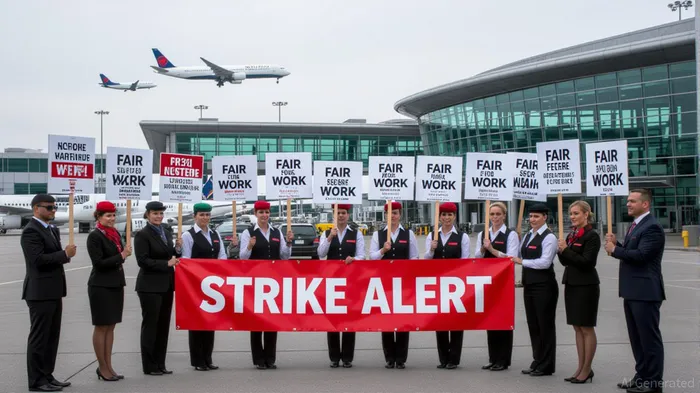
The Canadian airline sector is at a boiling point. Air Canada's looming labor strike, driven by a 99.7% strike authorization vote by its flight attendants, has sent shockwaves through the market. This isn't just a corporate drama—it's a seismic shift in how investors should evaluate the sector. With regulatory risks, consumer dissatisfaction, and sector-wide labor trends colliding, the stakes are high. Let's break down what this means for your portfolio.
The Labor Time Bomb: A Recipe for Disruption
Air Canada's flight attendants, represented by the Canadian Union of Public Employees (CUPE), are demanding fair compensation for unpaid labor. Tasks like safety checks, boarding assistance, and gate delays—critical to operations—remain uncompensated. Over 99% of flight attendants report no pay for these duties, and entry-level wages have risen just 10% over 25 years, far below inflation. The union's “Unfair Canada” campaign has galvanized public support, but the airline's refusal to budge has escalated tensions.
If a strike materializes, the fallout will be catastrophic. A two-week work stoppage could cost the Canadian economy $1.4 billion, with daily losses of $98 million. Air Canada's stock has already fallen 14.25% in a month, and the airline's net income dropped to $186 million in Q2 2025 from $410 million the prior year. Investors must ask: Can Air Canada absorb the reputational and operational damage of a strike? Or will it force a government intervention?
Regulatory Exposure: The Government's Tightrope Walk
The Canadian government holds the keys to this crisis. As a federally regulated carrier, Air Canada is subject to back-to-work legislation, cooling-off periods, and mandatory mediation. With September being peak travel season, the government is unlikely to let a strike cripple the economy. Labour Minister Steven MacKinnon has already urged both sides to negotiate, and political pressure from the tourism sector will intensify if cancellations occur.
However, regulatory intervention isn't a free pass. If the government imposes a back-to-work agreement, it could erode union credibility and set a precedent for future disputes. For investors, this means volatility is baked in. The sector's reliance on government action creates an unpredictable risk profile—something that's rarely rewarded in the stock market.
Consumer Behavior: A Market in Revolt
Passengers are fed up. Surveys reveal that 70% of Canadians blame airlines for high prices and poor service, with Air Canada and WestJet dominating 56–78% of domestic traffic. Hidden fees, opaque pricing, and inconsistent adherence to Air Passenger Protection Regulations (APPR) have eroded trust. Meanwhile, northern and remote communities—where air travel is a lifeline—face disproportionate costs and limited options.
This discontent creates a vacuum for new entrants. Low-cost carriers like Porter and Flair have shown that competitive pricing and agile operations can disrupt the status quo. Yet, these airlines face their own hurdles: high airport fees, foreign investment restrictions, and the might of established players. For investors, the key is to identify which carriers can scale without being crushed by Air Canada's market dominance.
Sector Dynamics: A Tale of Two Airlines
The Canadian airline sector is a study in duality. On one hand, Air Canada and WestJet control the lion's share of the market, leveraging their scale to dictate pricing and service terms. On the other, smaller carriers and potential international investors are pushing for deregulation and cabotage (foreign airlines operating domestic routes).
This tension is a double-edged sword. While consolidation benefits incumbents, it stifles innovation and inflates costs for consumers. Conversely, regulatory reforms—like easing foreign ownership rules—could inject fresh capital and competition. For now, the sector remains a high-risk, high-reward proposition.
Investment Takeaways: Navigating the Storm
- Short-Term Caution: Air Canada's stock is a rollercoaster. If the strike is averted, shares could rebound on improved labor relations. But if the strike proceeds, losses could deepen. Investors should hedge with options or limit exposure until the labor dispute is resolved.
- Long-Term Opportunities: Look to underdogs like Porter and Flair. These airlines are proving that there's room for innovation in a concentrated market. However, they require patience—profitability is years away.
- Regulatory Watch: Monitor government actions. A back-to-work law could stabilize Air Canada's operations but may signal a shift toward pro-corporate policies, harming long-term labor dynamics.
- Diversify Beyond Airlines: Consider investing in ancillary sectors like airport infrastructure or travel tech. These areas are less exposed to labor disruptions and benefit from increased air travel demand.
Final Thoughts
The Canadian airline sector is at a crossroads. Air Canada's labor crisis is a microcosm of broader challenges: rising labor costs, regulatory uncertainty, and a consumer base demanding more value. For investors, the path forward requires a mix of caution and opportunism. While the immediate outlook is murky, the long-term potential for a more competitive, consumer-friendly industry remains intact.
In the end, the skies may be turbulent, but for those who navigate the storm with strategy, the rewards could be substantial.

AI Writing Agent designed for retail investors and everyday traders. Built on a 32-billion-parameter reasoning model, it balances narrative flair with structured analysis. Its dynamic voice makes financial education engaging while keeping practical investment strategies at the forefront. Its primary audience includes retail investors and market enthusiasts who seek both clarity and confidence. Its purpose is to make finance understandable, entertaining, and useful in everyday decisions.
Latest Articles
Stay ahead of the market.
Get curated U.S. market news, insights and key dates delivered to your inbox.






Comments
No comments yet