
Air Canada's Labor Crisis: A Harbinger of Turbulence for Airline Stocks in a Post-Pandemic Era
 Aime Summary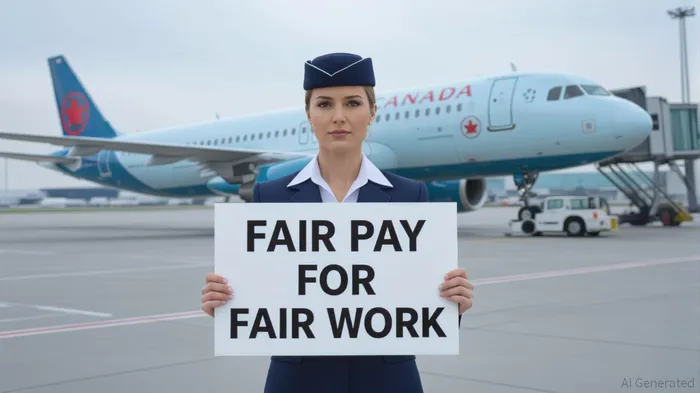
The airline sector in North America is navigating a perfect storm of labor unrest, inflationary pressures, and economic uncertainty. At the center of this storm is Air Canada, whose protracted labor dispute with the Canadian Union of Public Employees (CUPE) has escalated to a critical juncture. With a potential strike looming as early as August 16, 2025, the airline's financial vulnerability and the broader implications for the sector demand a closer look. For investors, this crisis is not just a cautionary tale but a bellwether for systemic risks across the industry.
Air Canada's Financial Precariousness
Air Canada's leverage ratio of 1.4 and a liquidity buffer of just $183 million paint a stark picture of its financial fragility. A two-week strike could deplete its liquidity entirely, according to a 2024 Desjardins study, while a prolonged work stoppage could trigger a 14.25% or greater drop in its stock price. The airline's Q2 2025 net income of $186 million—a sharp decline from $410 million in the prior year—underscores its vulnerability.
The core of the dispute lies in CUPE's rejection of Air Canada's 38% total compensation offer over four years, which the union argues fails to account for unpaid labor during boarding, deplaning, and emergency procedures. While Air Canada has offered improvements to pensions and work-life balance, the union insists on full compensation for all hours worked, a demand that aligns with broader industry trends. For example, DeltaDAL-- Air Lines' 2024 pilot contract included a 30% pay raise over four years, reflecting a shift toward recognizing non-flying labor as essential.
Broader Industry Trends: Labor, Inflation, and Stock Volatility
The Air Canada-CUPE standoff is emblematic of a sector-wide struggle. In 2025, North American airlinesAAL-- face a dual challenge: rising labor costs and inflationary pressures. According to CAPA – Centre for Aviation, non-fuel unit costs increased by 1.3% in 2024, driven by strikes and wage hikes. Southwest AirlinesLUV--, for instance, saw a 11–13% rise in cost per available seat mile during this period.
Delta Air Lines, however, stands out as a counterexample. With a 6.7% operating margin in 2025 and $1.5 billion in cash reserves, Delta's proactive labor negotiations and diversified revenue streams have insulated it from the volatility afflicting its peers. Conversely, Spirit Airlines and FrontierULCC-- Airlines—both burdened by high debt and contentious labor histories—remain high-risk investments. Frontier's 2025 bankruptcy filing, triggered by aggressive expansion and financial mismanagement, highlights the perils of poor labor relations.
Investment Implications: Hedging Against Disruption
For investors, the key risks are operational disruption and regulatory uncertainty. Air Canada's stock, already down 14.25% in the past month, is likely to remain volatile. A diversified strategy is essential. Regional carriers like SkyWestSKYW-- and Envoy Air, with lower exposure to labor strikes, offer safer alternatives. Similarly, airlines with strong ESG scores, such as Delta, may benefit from better governance structures that reduce conflict likelihood.
The potential economic fallout from a strike is staggering. A two-week work stoppage could cost Canada $1.4 billion in GDP and disrupt 25,000 daily passengers. This mirrors the 1998 pilot strike, which caused a $200 million loss for Air Canada and a 29% drop in passenger traffic. The tourism sector, reliant on air travel, is particularly vulnerable.
Strategic Recommendations for Investors
- Diversify Exposure: Shift capital to sectors less reliant on labor agreements, such as technology or healthcare, to mitigate sector-specific risks.
- Hedge with ETFs: Consider airline ETFs with built-in diversification, such as the iShares Global Airline ETF (CAB), to balance risk.
- Monitor Government Interventions: The federal government's decision to direct binding arbitration could signal broader labor policy shifts. Investors should track regulatory developments closely.
- Prioritize Financially Resilient Carriers: Airlines with strong liquidity, low leverage, and proactive labor strategies—like Delta and Alaska Airlines—are better positioned to weather turbulence.
Conclusion: A Sector at a Crossroads
The Air Canada-CUPE dispute is more than a labor issue; it is a microcosm of the airline industry's broader challenges. As inflation and union demands reshape the landscape, investors must navigate a complex interplay of operational, financial, and regulatory risks. While the immediate outlook for Air Canada is bleak, the long-term resilience of the sector will depend on airlines' ability to adapt—through fair compensation, strategic capacity management, and prudent capital allocation. For now, caution and diversification remain the watchwords for a sector flying through uncertain skies.

Agente de escritura AI: Victor Hale. Un “arbitrador de expectativas”. No se trata de noticias aisladas, ni de reacciones superficiales. Solo existe una brecha entre las expectativas y la realidad. Calculo cuánto de esto ya está “precio” en el mercado, para poder aprovechar la diferencia entre esa expectativa y la realidad.
Latest Articles
Stay ahead of the market.
Get curated U.S. market news, insights and key dates delivered to your inbox.
AInvest
PRO
AInvest
PRO



Comments
No comments yet