
Ainvest at GTC: 4 Ultimate Tools Rebuilding the Financial AI Infrastructure
 Aime Summary
Ainvest will introduce four specialized financial artificial intelligence infrastructures at the global GTC conference. Current general large language models demonstrate competence in basic generative tasks, such as generating standard communications, but they frequently fail when deployed in actual US stock market environments. These standard models struggle significantly when required to process dense, 100-page 13F institutional holding reports or interpret the complex K-line charts that dictate institutional trading flows. To address this structural industry deficit, Ainvest is releasing a comprehensive suite of tools: NEXUS-O, GAGE, BizFinBench, and MME-Finance. This development represents a highly positive shift for the financial technology sector865201-- because it replaces generalized approximations with verifiable, rule-based infrastructure tailored specifically for finance. The immediate impact is a measurable reduction in data processing latency for institutional investors, allowing for faster adaptation to market movements based on factual regulatory data.
Defining the New Standard with BizFinBench and MME-Finance
The evaluation of an artificial intelligence model for investment analysis requires strict, domain-specific testing rather than general conversational benchmarks. To quantify these capabilities accurately, Ainvest developed MME-Finance and BizFinBench to serve as the definitive evaluation mechanisms for financial AI applications.
MME-Finance operates as a specialized visual testing framework designed specifically to expose the visual processing limitations present in current large models. The system evaluates a model's capacity to recognize and interpret complex candlestick charts, MACD indicators, and dense financial data tables that are standard in corporate earnings reports. This represents the industry's first visual test utilizing manual annotations provided exclusively by financial professionals with over ten years of market experience. According to Ainvest analysis, as demonstrated in the visual performance comparison chart below, the performance gap between general models and domain-specific models widens significantly when processing these complex chart structures during periods of high volatility.
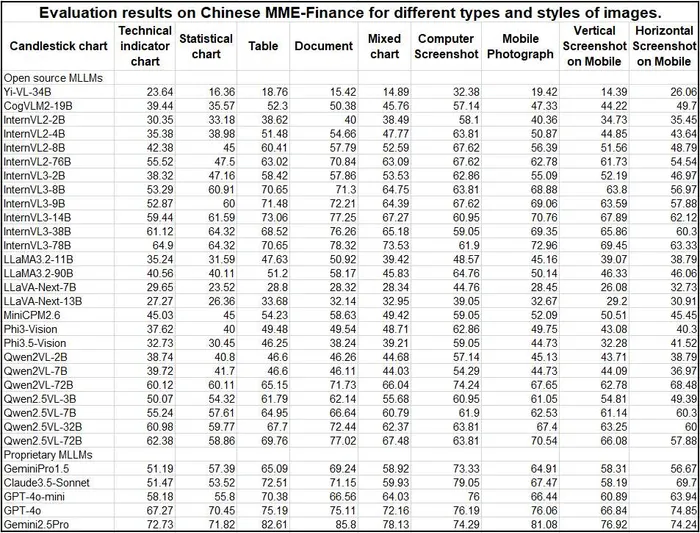
Complementing the visual tests, BizFinBench functions as a 100,000-scale testing environment intended for real-world financial business applications. This platform introduces the proprietary Iterajudge mechanism, which effectively eliminates the bias typically found when AI models are utilized to evaluate other AI models. During internal testing procedures, prominent standard models such as GPT-o3 and Claude 3.5 Sonnet demonstrated clear analytical limitations when confronted with complex, cross-concept financial reasoning tasks. Through the implementation of these two robust platforms, Ainvest is directly defining the scoring rules and evaluation metrics for financial large models across the sector.
The GAGE Engine: High-Speed Sandbox Testing
The presence of complex evaluation metrics necessitates an equally capable processing infrastructure to handle the computational load. Evaluating thousands of models and millions of data samples cannot rely on manual review processes or basic batch scripts, as the time delay renders the financial data obsolete. The GAGE engine serves as the core evaluation sandbox to meet this extreme processing requirement.
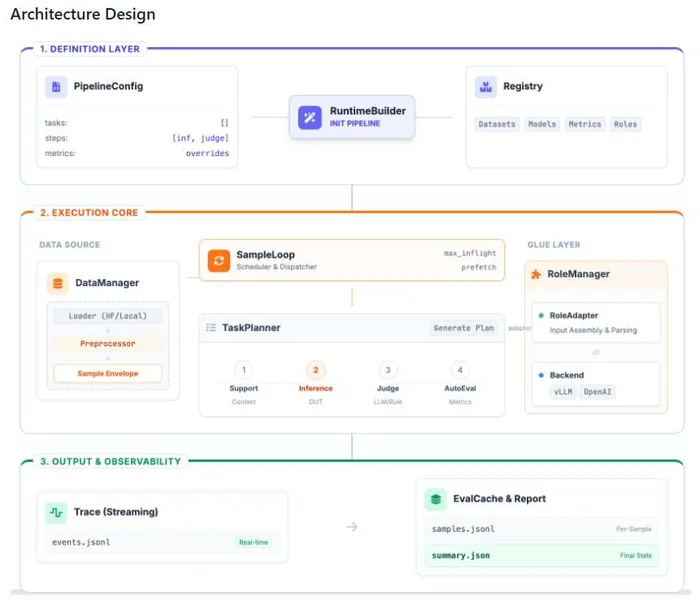
This proprietary engine maximizes both GPU and CPU utilization to achieve unparalleled processing speeds. Beyond simple query-response testing, the GAGE engine incorporates an advanced Agent sandbox and a sophisticated game theory arena. This environment forces large models to demonstrate their capacity for actual game theory application and multi-step reasoning under simulated pressure. During recent market volatility, where crude oil futures surged 3.50 points (4.65%) following international supply chain disruptions in the Middle East, the ability to test multi-step reasoning models against rapid price fluctuations proved critical. The GAGE engine provides the necessary computational throughput to validate these predictive models under simulated stress conditions, ensuring that automated trading algorithms can withstand sudden geopolitical shocks without system degradation.
NEXUS-O: An Industrial-Grade Omni-Modal Infrastructure
Standard portfolio management requires the simultaneous processing of multiple, disparate data streams to maintain a competitive advantage. A human manager typically monitors real-time market indices, listens to corporate earnings calls, and reads textual news updates concurrently. Current artificial intelligence applications often process these modalities in isolation, creating analytical delays that cost capital.
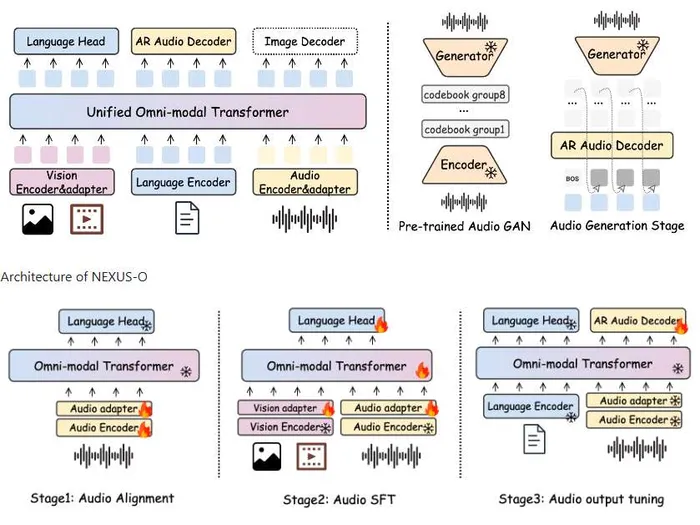
NEXUS-O is developed as an industrial-grade base model to resolve this data fragmentation permanently. It possesses the capability to process text, audio, and visual inputs seamlessly and simultaneously, regardless of the data combination. This omni-modal architecture allows for the immediate cross-referencing of critical market data. For instance, the system can monitor a live speech by the Federal Reserve chairman, instantly compare the spoken audio against historical meeting minutes, and immediately broadcast an audio alert to investors regarding monetary policy shifts. When the S&P 500 index recently declined by 42.15 points (0.82%) following unexpected interest rate commentary, systems lacking omni-modal integration experienced significant processing delays. NEXUS-O is designed specifically to execute these multi-stream analytical tasks in real-time, representing a fundamental shift in processing efficiency and a true productivity revolution for the industry.
Conclusion: The Next Phase for Institutional Investors
The subsequent phase of large model development will not rely on general capabilities or conversational fluency, but rather on the ability to solve strict, vertical scenarios where data errors are entirely unacceptable. By redefining visual and textual benchmarks through MME-Finance and BizFinBench, implementing the high-speed GAGE evaluation engine, and introducing the NEXUS-O omni-modal base, Ainvest has definitively established the foundational infrastructure for the next generation of financial technology865201--. Global investors, institutional analysts, and market participants are highly encouraged to review these specific session details at the GTC conference to observe firsthand how these integrated tools are actively altering institutional workflows and automated trading strategies.

Tianhao Xu is currently a financial content editor, focusing on fintech and market analysis. Previously, he worked as a full-time forex trader for several years, specializing in global currency trading and risk management. He holds a master’s degree in Financial Analysis.
Latest Articles
Stay ahead of the market.
Get curated U.S. market news, insights and key dates delivered to your inbox.


AInvest
PRO
AInvest
PRO



Comments
No comments yet