
Ainvest
Salesforce's fourth-quarter and full fiscal year 2025 earnings report, released on February 26, 2025, revealed a mix of strong operational performance and cautious forward guidance that diverged from Wall Street expectations. The company achieved record cash flow and growth in its AI-driven platforms but faced scrutiny over its revenue outlook and near-term profitability. Below, we dissect the results, compare them to analyst consensus, identify key surprises, and integrate expert commentary on the implications for Salesforce’s trajectory.
Financial Performance Overview
Revenue and Profitability
Salesforce reported Q4 revenue of $10.0 billion, marking an 8% year-over-year (YoY) increase, or 9% in constant currency (CC) 1 4. This fell slightly short of the Visible Alpha consensus estimate of $10.04 billion 2 6. For the full fiscal year, revenue reached $37.9 billion, up 9% YoY, aligning with the upper end of Salesforce’s revised guidance 4 11.
Adjusted earnings per share (EPS) for Q4 stood at $2.78, surpassing the consensus estimate of $2.61 3 8. This beat was driven by cost discipline, with non-GAAP operating margins expanding to 33.0% for FY2025, exceeding the company’s initial guidance 4. However, GAAP net income declined to $1.71 billion (or $1.75 per share) from $1.53 billion in Q4 FY2024, impacted by restructuring charges and foreign exchange (FX) headwinds 6 12.
Key Growth Drivers
Data Cloud & AI Momentum:
Annual recurring revenue (ARR) for Data Cloud and AI surged 120% YoY to $900 million, with Data Cloud surpassing 50 trillion records (double YoY) 1 4. Nearly half of Fortune 100 companies now use both Data Cloud and AI solutions.
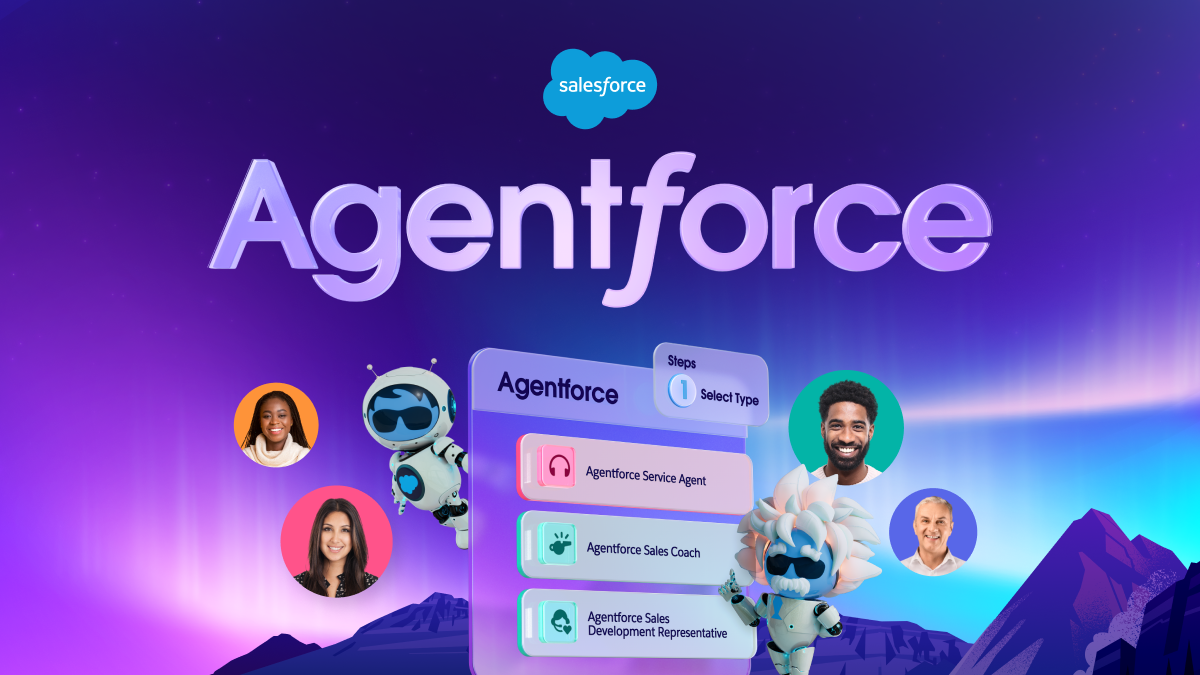
Agentforce, Salesforce’s autonomous AI platform, closed over 5,000 deals since October 2024, including 3,000 paid contracts. It autonomously resolved 84% of 380,000 customer service conversations with minimal human intervention 4 12.
Geographic and Segment Breakdown:
Americas revenue grew 8% YoY (8% CC), EMEA 6% (7% CC), and APAC 10% (14% CC) 12.
Subscription and support revenue reached $9.5 billion in Q4 (+8% YoY), led by Service Cloud ($2.33 billion, +8% YoY) and Sales Cloud ($2.13 billion, +8% YoY). Both segments narrowly missed Visible Alpha’s estimates of $2.37 billion and $2.17 billion, respectively 2 6.
Remaining Performance Obligation (RPO):
Consensus Comparison and Key Surprises
Revenue and EPS vs. Expectations
While Salesforce exceeded EPS expectations, its Q4 revenue miss (-0.4%) and below-consensus FY2026 guidance (-2.3%) dominated investor attention. The company attributed the conservative outlook to FX headwinds ($150 million impact) and a gradual ramp for Agentforce monetization 4 12.
Major Surprises
Agentforce Adoption vs. Revenue Impact:
Despite closing 3,000 paid Agentforce deals in Q4, CFO Amy Weaver noted the platform would contribute minimally to FY2026 revenue, with a “material impact” delayed until FY2027 2 12. This contrasted with bullish expectations for immediate AI-driven growth.Data Cloud’s Hidden Value:
While Data Cloud’s ARR growth (120% YoY) impressed, analysts highlighted its role as a loss leader to drive broader platform adoption. For example, nearly 25% of its 50 trillion records were ingested from non-Salesforce sources via partnerships (e.g., AWS, Snowflake), creating cross-selling opportunities 4 12.Margin Expansion Amidst Cost Pressures:
Non-GAAP operating margins reached 33.0% (+250 bps YoY), exceeding guidance by 50 bps. This was achieved despite a $1.5 billion restructuring charge in FY2025 related to workforce reductions and office consolidations 4 12.
Analyst Reactions and Market Response
Bullish Perspectives
TD Cowen: Maintained a Buy rating ($400 target), praising Salesforce’s “best-in-class AI positioning” via Agentforce and Data Cloud. Surveys indicated 72% of customers plan to expand AI investments in FY2026 9.
BMO Capital: Highlighted RPO growth (+11% YoY) as a durability signal, though lowered its price target to $375 on near-term guidance risks 9.
Bearish Concerns
Citi: Downgraded to Neutral ($350 target), noting “heavy discounts” to drive Agentforce adoption and constrained high-single-digit revenue growth 9.
CNBC/Investing.com: Emphasized the stock’s 8% YTD decline (vs. S&P 500’s +1%) as reflecting skepticism about AI monetization timelines 2 3.
Market Performance Post-Announcement
Shares fell 5% in after-hours trading, erasing $15 billion in market cap 3 8.
The guidance shortfall overshadowed strong cash flow metrics: FY2025 operating cash flow grew 28% YoY to $13.1 billion, with $9.3 billion returned to shareholders via buybacks and dividends 4 12.
Strategic Implications and Forward Outlook
AI Monetization Challenges
Agentforce’s slow revenue trajectory underscores the consumption-based pricing hurdle. While 380,000 automated conversations demonstrate technical prowess, converting usage to revenue requires scaling enterprise-wide deployments. Early adopters like Vivint and SharkNinja represent niche wins, but industry-wide IT service management (ITSM) expansion—a $15 billion market dominated by ServiceNow—remains untapped 2 9.
Regional and Sector Vulnerabilities
EMEA Softness: 7% CC growth lagged behind APAC (14% CC), with macroeconomic pressures in Germany and the UK limiting upside 12.
Tech Sector Drags: Salesforce cited weaker demand from tech and manufacturing clients (-12% YoY in deal volume), offset by strength in healthcare and media 12.
FY2026 Guidance Breakdown
The guidance assumes no recessionary shocks and gradual FX stabilization. However, the 7%–8% growth range places Salesforce below the 10%+ CAGR expected of cloud software leaders, raising questions about market saturation 8 12.
Conclusion: Balancing Innovation and Execution
Salesforce’s Q4 results epitomize its transition from a growth-centric cloud leader to a margin-focused stalwart. While Data Cloud and Agentforce showcase disruptive potential, their financial impact remains nascent. The company’s ability to sustain 20%+ operating cash flow growth amidst AI investments and macroeconomic headwinds is commendable, but investors increasingly demand proof of AI’s bottom-line contributions.
Analysts broadly agree that FY2026 will be a “prove-it year” for Salesforce’s AI vision. Success hinges on converting platform enhancements (e.g., Agentforce 2.0, Retail Cloud integrations) into large-scale enterprise deals—a challenge compounded by competition from Microsoft Dynamics and Adobe. For now, Salesforce’s $63 billion RPO and 50 trillion Data Cloud records provide a formidable moat, but patience is wearing thin for tangible AI-driven acceleration 4 9 12.
Sources:-
(1) Salesforce Announces Fourth Quarter and Fiscal Year 2025 Results-
(2) Salesforce misses on revenue, issues disappointing guidance - CNBC-
(3) Salesforce Stock Drops as Outlook Disappoints - Investopedia-
(4) Salesforce Announces Fourth Quarter and Fiscal Year 2025 Results-
(5) Salesforce Q4 2025 Earnings: Stay tuned for the live earnings call ...-
(6) CRM Earnings: Highlights of Salesforce's Q4 2025 report - AlphaStreet-
(7) CRM - Perplexity Finance-
(8) Salesforce Inc earnings beat by $0.17, revenue fell short of estimates-
(9) Here's what Wall Street experts are saying about Salesforce ahead ...-
(10) Salesforce Announces Second Quarter Fiscal 2025 Results-
(11) Salesforce Announces Third Quarter Fiscal 2025 Results-
(12) Salesforce (CRM) Q4 2025 Earnings Call Transcript - AOL.com-
(13) Salesforce Stock Falls On Weak Revenue Outlook Amid Artificial ...-
(14) Salesforce sees annual results below estimates as Agentforce ...-
(15) Salesforce Stock Falls. Earnings Were Overshadowed by ... - Barron's-
(16) Salesforce Earnings: Lots of Buzz for Agentforce Even if No ...-
(17) Transcript : Salesforce, Inc., Q4 2025 Earnings Call, Feb 26, 2025-
(18) PDF FQ3 2025 Earnings Call Transcripts-
(19) What Analysts Think of Salesforce Stock Ahead of Earnings

Market Radar delivers concise, daily trading ideas by tracking everything from options activity and market sentiment to high-profile political trades.
Latest Articles
Stay ahead of the market.
Get curated U.S. market news, insights and key dates delivered to your inbox.




Comments
No comments yet