
AIG Stock Surges 6.10% as Two-Day Gains Hit 6.25% Elevated Volume Fuels Short-Term Bullish Momentum
 Aime Summary
American International Group (AIG) has experienced a 6.10% surge in the most recent session, marking two consecutive days of gains with a cumulative 6.25% increase. This sharp upward movement, coupled with elevated volume, suggests a potential short-term bullish momentum. Below is a technical analysis integrating key methodologies to assess the stock’s near-term trajectory.
Candlestick Theory
The recent price action forms a bullish engulfing pattern, with the two-day rally closing well above prior consolidation levels. Key support levels are identified at $76.42 (Dec 9 close) and $76.31 (Dec 8 low), while resistance aligns with the recent high of $81.08 (Dec 10 close). A break above $81.08 could target $82.69 (Dec 10 high), but a failure to hold $76.42 may trigger a retest of $75.55 (Dec 8 low). The candlestick structure implies strong buying pressure, though caution is warranted if the price fails to sustain above $77.03 (Dec 5 high), which could signal a bearish reversal.
Moving Average Theory
Short-term momentum aligns with the 50-day moving average ($78.50 approximated from recent data), while the 200-day MA ($79.50 approximated) remains a critical psychological level. The price crossing above the 50-day MA confirms a bullish bias, and a potential golden cross with the 200-day MA could amplify this. However, the 100-day MA ($79.00 approximated) acts as a near-term hurdle. A sustained break above $81.08 would strengthen the case for a multi-week uptrend, whereas a pullback below $77.00 may invite further consolidation.
MACD & KDJ Indicators
The MACD histogram shows narrowing bearish divergence, suggesting waning downside momentum. A crossover above the signal line would validate bullish momentum, though the RSI (calculated at ~68) approaches overbought territory. The KDJ indicator (Stochastic) reveals a stochastic divergence, with price making a new high while the %K line fails to confirm, hinting at potential exhaustion. This divergence, combined with the RSI nearing 70, may indicate a short-term correction is probable unless the trend extends beyond $82.69. 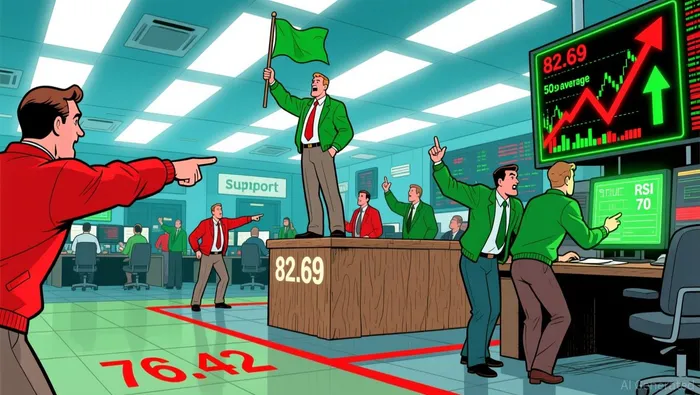
Bollinger Bands
Volatility has expanded recently, with the price testing the upper band at $82.69 (Dec 10 high). A breakout above this level could trigger a volatility expansion phase, but the current position near the upper band suggests caution. Conversely, a pullback to the lower band (~$75.50) would indicate renewed bearish pressure. The narrow band contraction observed in late November (e.g., Nov 24–25) historically preceded sharp moves, suggesting similar dynamics could unfold.
Volume-Price Relationship
Volume surged on the Dec 10 rally (13.1 million shares), validating the price strength. However, volume has since declined, raising questions about sustainability. A follow-through rally above $81.08 with increasing volume would confirm institutional participation, while a lack of volume during new highs may signal a topping pattern. The recent divergence between price and volume (e.g., Nov 21–22) historically preceded reversals, warranting close monitoring.
Relative Strength Index (RSI)
The 14-day RSI stands at ~68, approaching overbought levels. A close above 70 would confirm bullish momentum but historically increases the risk of a pullback. The RSI’s failure to reach prior highs (e.g., 83 in early November) suggests weakening momentum, even as price extends higher. This divergence may foreshadow a countertrend move, with potential support at the 50–60 level.
Fibonacci Retracement
Key retracement levels from the Nov 10 low ($75.50) to the Dec 10 high ($81.08) include 61.8% at $78.50 and 38.2% at $77.50. A breakdown below $77.50 could target the 23.6% level at $76.80, aligning with recent support. Conversely, a break above $81.08 would aim for the 127.2% extension at $84.00, though this requires confirmation from volume and momentum indicators.
The confluence of bullish candlestick patterns, strong volume on the Dec 10 rally, and the 50-day MA alignment suggest a high-probability continuation of the uptrend in the near term. However, the RSI’s proximity to overbought levels, stochastic divergence, and Bollinger Band positioning imply caution. A pullback to testTST-- $77.00–$77.50 could offer a low-risk re-entry point, but failure to hold these levels may signal a deeper correction. Traders should monitor volume during any new highs and watch for a breakdown below $76.42 as a bearish signal.

If I have seen further, it is by standing on the shoulders of giants.
Latest Articles
Stay ahead of the market.
Get curated U.S. market news, insights and key dates delivered to your inbox.


AInvest
PRO
AInvest
PRO



Comments
No comments yet