
AIG's 0.77% Drop Despite Strong Q3 Results 338th in U.S. Volume Amid Leadership Turmoil and Resurfaced Controversies
 Aime Summary
Market Snapshot
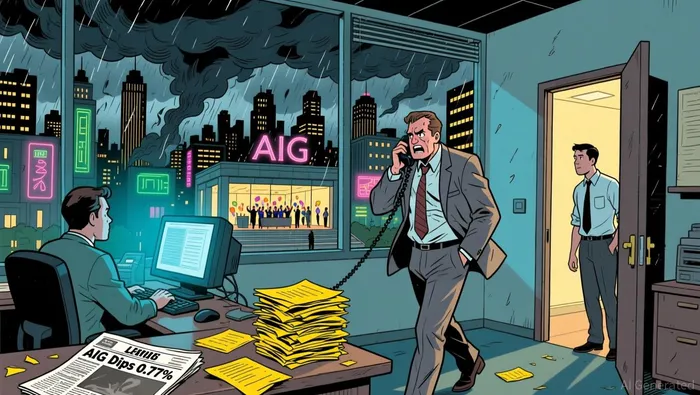
On November 14, 2025, American International Group (AIG) shares closed with a 0.77% decline, marking a modest but notable drag on investor sentiment. The stock’s daily trading volume totaled $0.34 billion, ranking it 338th among U.S. equities by volume. This performance occurred despite AIG’s strong third-quarter results, which included a 81% year-over-year increase in underwriting income for its General Insurance segment, reaching $793 million. The divergence between operational strength and market reaction underscores investor concerns tied to corporate leadership developments.
Key Drivers
Leadership Uncertainty and Organizational Reorganization
The most immediate catalyst for AIG’s stock decline was the abrupt withdrawal of John Neal, who had been scheduled to assume the role of President on December 1. In a mutual agreement with AIGAIG--, Neal cited personal circumstances for his decision not to join the firm, a reversal that adds to a period of executive instability. Neal’s departure followed a prior history of leadership upheaval, including the 2024 sexual assault allegations against former General Insurance head David McElroy, which led to his criminal charges and eventual resignation. AIG’s chairman and CEO, Peter Zaffino, will now retain expanded responsibilities, working with the board to define the company’s organizational structure. This shift raises questions about continuity and strategic direction, particularly as AIG transitions from a planned leadership overhaul to an ad hoc management approach.
Historical Controversies Resurface
The news of Neal’s exit was accompanied by revelations about his past at QBE Insurance Group, where he served as CEO until 2017. At that time, QBE reduced his bonus by 20% after discovering he had failed to disclose a romantic relationship with a subordinate. This incident led to his resignation and has resurfaced in media coverage, casting a shadow over his credibility. While AIG emphasized that the decision to part ways with Neal was mutual and unrelated to past controversies, the timing—just weeks before his scheduled start date—suggests sensitivity to reputational risks. Investors may be interpreting the event as a reflection of broader governance concerns, particularly in the insurance sector, where leadership integrity is critical for maintaining stakeholder trust.
Strategic Moves and Market Positioning
AIG has pursued several strategic initiatives recently, including a $1.0 billion secondary offering of Corebridge Financial shares and a $2 billion acquisition of Everest Group’s retail insurance portfolios. These moves aim to strengthen capital reserves and expand AIG’s underwriting capabilities, aligning with its long-term goals of improving expense ratios and driving growth. However, the market’s muted reaction to these developments—coupled with the leadership turmoil—suggests that investors may be prioritizing short-term stability over long-term strategic gains. The company’s 2.3% dividend yield and a P/E ratio of 14.04 indicate a relatively attractive valuation, but these fundamentals appear to have been overshadowed by the leadership uncertainty.
Implications for Investor Confidence
The interplay of these factors highlights a broader tension in AIG’s market narrative. While its third-quarter performance demonstrated operational resilience, the leadership changes and associated controversies have introduced volatility. The stock’s 0.77% decline, though modest, reflects investor caution in the face of management transitions and potential governance risks. AIG’s ability to maintain its trajectory will depend on Zaffino’s capacity to stabilize operations and communicate a clear vision for the company’s future. Until then, the market remains focused on the leadership vacuum and its potential implications for strategic execution and corporate culture.

Stay ahead of the market.
Get curated U.S. market news, insights and key dates delivered to your inbox.
AInvest
PRO
AInvest
PRO



Comments
No comments yet