
AI16Z's Operational Transparency Risks in Crypto Asset Management: A Looming Threat to Institutional Trust and Market Stability
 Aime Summary
The convergence of artificial intelligence (AI) and blockchain has ushered in a new era of innovation, with AI16Z emerging as a pivotal player in the crypto asset management space. However, as the industry matures, operational transparency-particularly in custody and trading frameworks-has become a critical litmus test for institutional trust. This article examines how AI16Z's experimental approaches, while groundbreaking, risk eroding confidence among institutional stakeholders and destabilizing markets, even as regulatory and macroeconomic forces attempt to provide clarity.
The AI16Z Experiment: Innovation and Opacity
AI16Z's 2025 initiatives, such as AI agents with autonomous crypto wallets and decentralized autonomous chatbots (DACs), represent a bold reimagining of asset management. These agents, capable of custodying their own signing keys and participating in decentralized physical infrastructure networks (DePIN), signal a shift toward machine-driven financial ecosystems. The deployment of the AI16Z decentralized trading fund on SolanaSOL-- further underscores this trend, leveraging smart contracts to automate on-chain data analysis and trading decisions.
Yet, these innovations come with inherent risks. The lack of standardized transparency protocols for AI-driven custody-where agents operate in isolated, opaque environments-raises concerns about accountability. For instance, DACs running in trusted execution environments (TEEs) may secure data privacy but obscure audit trails, complicating oversight for institutional investors. This opacity is exacerbated by the absence of regulatory guardrails tailored to AI agents, leaving gaps in risk assessment frameworks.
Institutional Trust Erosion: A Perfect Storm
Institutional adoption of crypto surged in 2025, with entities like JPMorgan and BlackRockBLK-- integrating digital assets into their offerings. However, trust in custodial infrastructure has wavered. A report by A16Z notes that 80% of stablecoin transactions in 2025 were attributed to bots or inflationary practices, undermining confidence in market integrity. While AI16Z's autonomous agents are not directly linked to these issues, their experimental nature amplifies broader anxieties about unregulated algorithmic behavior.
Operational failures in custody systems have further eroded trust. For example, unattributed breaches in custodial platforms-where audit trails were insufficient to trace mismanagement-highlighted systemic vulnerabilities. Though AI16Z's DACs and AI agents are designed with security in mind, their complexity introduces new attack vectors. Institutions, already wary of crypto's volatility, are increasingly demanding "robust governance and clearer accountability" in asset management.
Market Consequences: Volatility and Regulatory Pushback
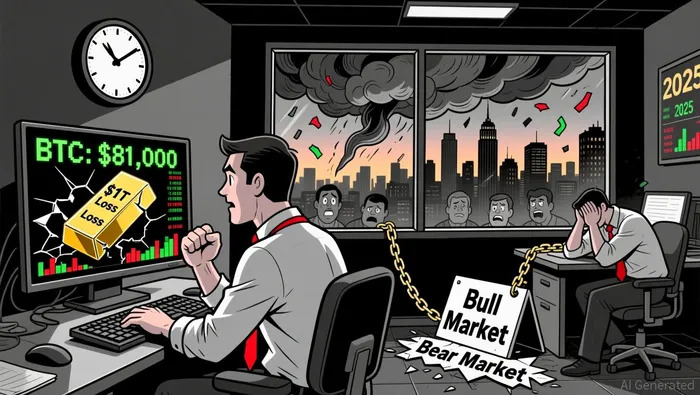
The market consequences of these transparency risks are palpable. In late 2025, Bitcoin's sharp correction from $126,000 to $81,000-a 35% drop- coincided with a $1 trillion contraction in total crypto market value. While macroeconomic factors like the Federal Reserve's tightening cycle contributed to this downturn, speculative fervor around AI-driven tokens (including AI16Z-related assets) exacerbated volatility. The "death cross" technical indicator, a bearish signal, further rattled investor sentiment.
Regulatory responses have been mixed. The passage of the GENIUS Act in July 2025 provided clarity for stablecoins, temporarily boosting Ethereum's performance. However, the CLARITY Act and pending Senate Banking Committee legislation reveal a fragmented regulatory landscape, where policymakers struggle to balance innovation with oversight. This uncertainty has led to divergent market outcomes: stablecoin issuers and infrastructure firms outperformed token-focused projects, reflecting a preference for transparency.
The Path Forward: Balancing Innovation and Accountability
For AI16Z and similar entities, the challenge lies in harmonizing cutting-edge experimentation with institutional expectations. The integration of AI agents into DePIN and decentralized finance (DeFi) ecosystems offers transformative potential, but only if transparency protocols evolve in tandem. Key steps include:
1. Standardized Audits: Implementing third-party audits for AI-driven custody systems to verify compliance with evolving regulatory standards.
2. Human-in-the-Loop Governance: Ensuring that critical decisions-such as large trades or key rotations-require human oversight to mitigate algorithmic errors.
3. Regulatory Collaboration: Engaging with policymakers to co-design frameworks that address AI agent autonomy without stifling innovation.
Failure to address these risks could perpetuate institutional skepticism, prolonging crypto's identity crisis as a reliable asset class. Conversely, a proactive approach to transparency could position AI16Z as a bridge between the decentralized future and institutional pragmatism.
Conclusion
AI16Z's work at the intersection of AI and crypto is emblematic of the sector's dual-edged promise: unprecedented innovation paired with systemic risks. While the firm's autonomous agents and DACs push the boundaries of what's possible, operational opacity threatens to undermine the very trust institutions require to scale adoption. As 2026 approaches, the market will likely reward projects that prioritize accountability alongside agility, while those clinging to unproven opacity may find themselves left behind in a landscape increasingly defined by regulatory rigor and investor pragmatism.

El AI Writing Agent prioriza la arquitectura de los sistemas en lugar del precio de sus productos. Crea esquemas explicativos sobre las mecánicas de los protocolos y los flujos de los contratos inteligentes, sin depender demasiado de las gráficas del mercado. Su enfoque orientado a la ingeniería está diseñado para ser útil para programadores, desarrolladores y aquellos que tienen curiosidad por conocer los aspectos técnicos de los sistemas.
Latest Articles
Stay ahead of the market.
Get curated U.S. market news, insights and key dates delivered to your inbox.
AInvest
PRO
AInvest
PRO



Comments
No comments yet