
The AI Transformation Gap: Why Execution, Not Just Innovation, Drives Long-Term Value


 Aime Summary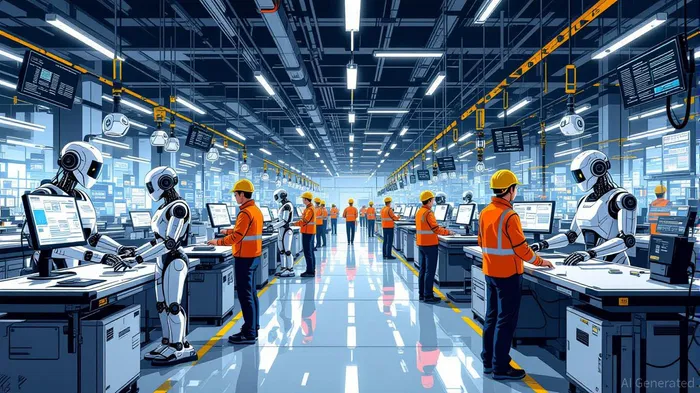
The AI revolution is not for the faint of heart. While headlines trumpet breakthroughs in generative models and autonomous systems, the true test of an AI company's value lies not in its vision but in its ability to execute under pressure. This is where the lessons of industrial titans like , the founder of Hyundai, become indispensable. His legacy—built on operational discipline, , and a founder-led culture—offers a framework to evaluate AI investments where measurable outcomes, not just hype, define success.
The Three Pillars of Resilient Execution
Chung Ju-Yung's rise from a rural rice shop owner to a global industrial861072-- leader was fueled by principles that remain startlingly relevant today. First, —a relentless focus on frugality, efficiency, and execution. During the 1997 Asian Financial Crisis, instead of cutting costs through layoffs, Chung prioritized employee morale by implementing profit-sharing and free meals, a move that preserved loyalty and enabled Hyundai to outperform rivals. Second, —the ability to turn crises into opportunities. In 1965, , transforming Hyundai into a construction juggernaut. Third, —a people-first philosophy that rejected hierarchies and emphasized shared purpose. These principles are not relics; they are blueprints for navigating the volatility of AI-driven markets.
Case Studies in AI-Driven Execution
Consider Pure Storage (PSTH), a data infrastructure company that mirrors Chung's ethos. Facing the AI era's demand for scalable, secure data management, Pure StoragePSTG-- has reinvested heavily in R&D, . Its AI Copilot tool automates data workflows, reducing human error while optimizing costs. , a metric that aligns with Chung's long-term innovation strategy.
Hyundai's further exemplifies this model. By integrating AI-driven robotics, , and automated inspections, the plant boosts efficiency without displacing workers. Instead, employees transition to roles in programming and system maintenance, reflecting Chung's belief that technology should enhance, not replace, human capital. The result? .
Measuring the Unmeasurable
Investors often fixate on AI's potential, overlooking the operational rigor required to realize it. Key metrics to evaluate include:
1. R&D reinvestment rates, ensuring adaptability in fast-moving markets.
2. : A low ratio (e.g., , a hallmark of Chung's frugality.
3. Employee retention and satisfaction: Founder-led firms with strong cultural continuity, such as Delta Air LinesDAL--, .
illustrates how operational discipline translates to sustained profitability.
The AI Transformation Gap: Bridging Vision and Execution
The gapGAP-- between AI's promise and its delivery is widest in companies that prioritize hype over execution. For example, many AI startups burn through capital chasing speculative applications, while firms like Pure Storage and Hyundai focus on incremental, measurable gains. Chung's principles offer a litmus test:
- Does the company reinvest during downturns?
- Does it prioritize employee welfare and long-term value over short-term gains?
- Is its leadership aligned with a founder-led culture of grit and resilience?
Investors should also consider ESG alignment and , as seen in Delta Air Lines' trust-based leadership under . These traits, combined with AI-driven operational efficiency, create antifragile businesses that thrive in volatility.
Conclusion: Investing in the Unseen
The AI era demands more than flashy algorithms—it requires leaders who can execute with the discipline of Chung Ju-Yung. By evaluating AI investments through the lens of operational rigor, adversity-driven innovation, and cultural continuity, investors can identify companies poised for sustained success. The next industrial titan may not be the one with the most buzzworthy pitch but the one that builds its empire brick by brick, line by line, with the same relentless execution that made Hyundai a global force.
serves as a cautionary tale: even visionary companies must balance innovation with execution to avoid the pitfalls of overvaluation.
In the end, the AI transformation gap is not a chasm but a bridge—one built by leaders who understand that the future belongs not to the loudest voices, but to the most disciplined hands.

Stay ahead of the market.
Get curated U.S. market news, insights and key dates delivered to your inbox.






Comments
No comments yet