

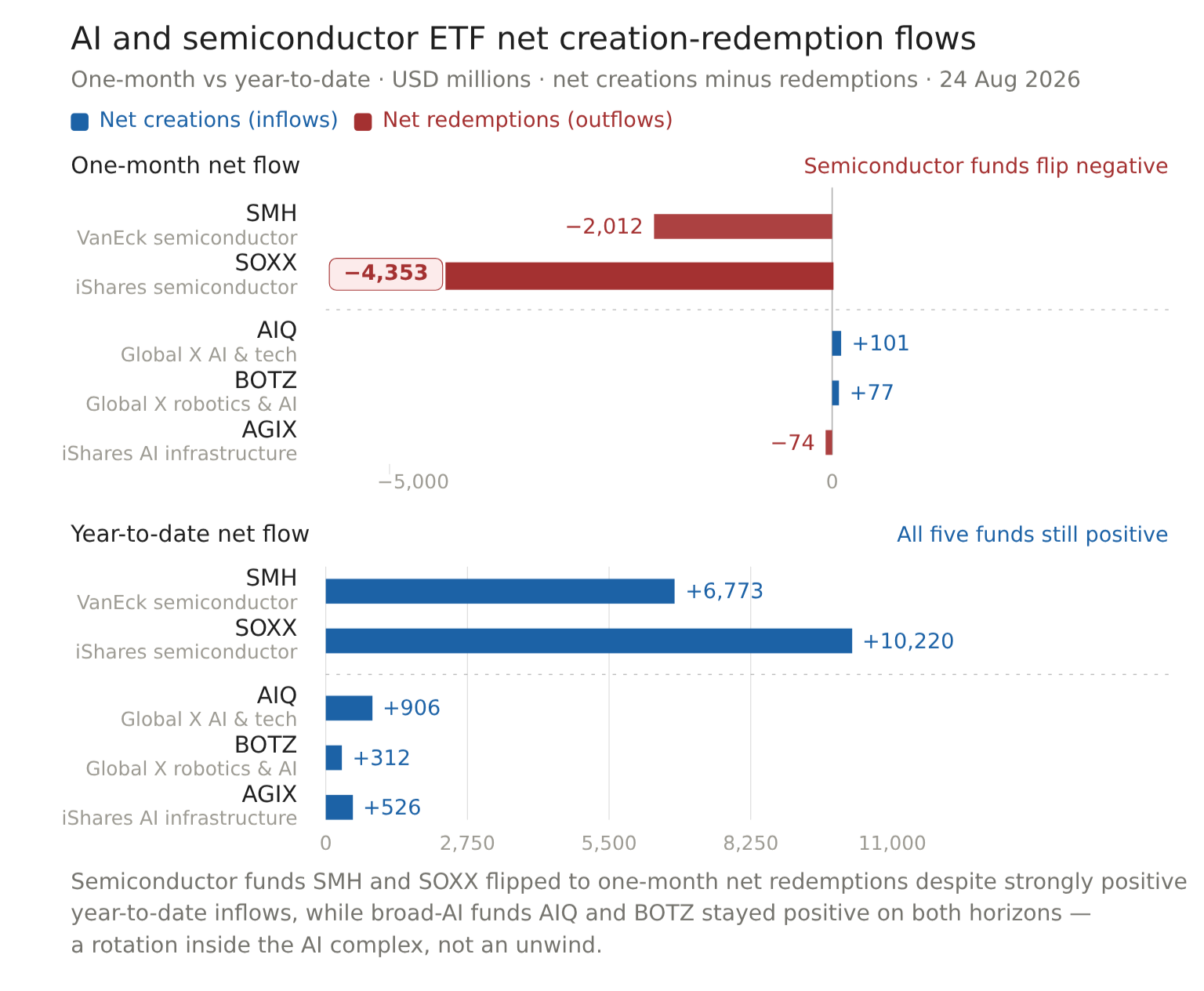
Semiconductor exchange-traded funds took in a record $46 billion through early August 2026 — more than double the whole category's combined take from 2017 through 2025 and on course to be the biggest year the group has recorded. Then, in the month to August 24, the money turned. Ainvest's ETF flow data show net creation-redemption flows — the plumbing by which new money enters or leaves a fund — of minus $2.0 billion for the VanEck Semiconductor fundSMH-- (SMH) and minus $4.4 billion for the iShares Semiconductor fundSOXX-- (SOXX): about $6.4 billion of net redemptions from the two biggest chip funds in four weeks. Read in isolation, that looks like the AI trade unwinding.
The flow reversal is corroboration, not an early warning: prices moved first. By mid-July the SOX index of US chipmakers had confirmed a bear market, down 20% from its June record, Reuters reported. The SOXXSOXX-- fund had still been up about 80% for the year in early August, yet it fell double digits in the seven weeks to then, while the software fund IGV rose double digits in the same window, Motley Fool noted — a different basis, an index against two funds, but the same direction. The whiplash is so visible because the leaders were the leaders: the biggest year-to-date winner in the S&P 500 in 2026 was a semiconductor stock, and three of the five top performers in the index were chipmakers. That same cohort gave back double digits in seven weeks while software climbed.
This was already the mainstream diagnosis before the flows confirmed it. Morningstar flagged hints of a rotation into software as chips sold off in late July, and Schwab described capital handing the baton from infrastructure to software in mid-August. What the flow data add is follow-through, plus a distinction the headlines blur: this is a three-way split, not a two-way one. The hardware funds are shedding money while the broad-AI vehicles still take it in: Global X's AI & Technology fund added $101 million in the month and more than $900 million for the year, and the robotics fund BOTZ took in a further $77 million. Even a dedicated AI-infrastructure fund eased over the month, though it stays strongly positive for the year. Read the fund-level footprints and they point inside the complex, not out of it.

The mechanism beneath the split is a repricing of who captures AI's economics. Record inflows bid chipmakers' valuations up to levels the growth could not carry — Intel traded at about 79 times forward earnings after more than doubling this year — and in June the SOX index peaked. When the marginal investor's question shifted from who builds AI hardware to who monetises it, the cheap expression of that answer was software, its valuations ground down by the fear of an AI "SaaSpocalypse" gutting subscription models. Flows then followed price, as they usually do, with a lag.
The stakes are large because the position is large: SMHSMH-- holds $66.8 billion of assets and SOXX $41.8 billion, Ainvest data show, and tens of billions more ride the theme. Two caveats should frame the read. Because flows lag prices rather than lead them, the past month's redemptions confirm a performance gap that had already opened — evidence of a rotation under way, not a fresh signal in its own right. And because year-to-date flows into the chip funds remain firmly positive, with SOXX's still above $10 billion, the durability of the rotation is not established either way.
Nor should the noise be mistaken for the signal. Creation-redemption data carry rebalancing and custom-redemption distortions: on a single day in late July, SMH shed $1.85 billion while SOXX took in $606 million, a dispersion the source partly attributes to specialised rebalancing rather than conviction. No source here supplies a date-matched, fund-by-fund return series, so the direction of travel rests on flow and index data plus two secondary accounts of performance. None of this proves that the rotation will last, or that chips are cheap: Nvidia, the sector's anchor, still screens at about 23 times forward earnings with a price-to-earnings-growth ratio near 0.55, on Motley Fool's own numbers.
The flows answer one question and leave another open. They show capital rotating inside the complex — out of the chip funds that carried the record year and toward the applications that must now prove they can monetise the build-out — not leaving it. What they cannot show is durability; price led this dance, so the redemptions describe performance that has already happened. The read changes only on two signals: software earnings that fail to arrive, or a year-to-date semiconductor flow figure that turns negative. Neither is here yet, which is why the past month looks like a leadership change inside a still-bid trade rather than the AI story breaking.








Comments
No comments yet