
The AI Talent War: Who Will Win the Future of AI Innovation?


 Aime Summary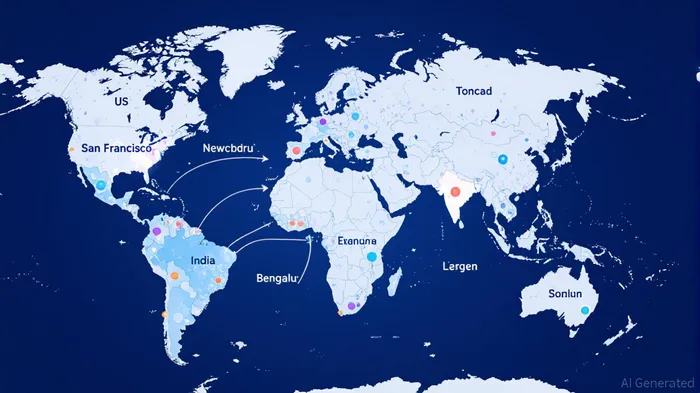
The AI talent war is no longer a distant inevitability—it is here, and its outcomes will define the next decade of technological and economic dominance. By 2025, the U.S. and India alone account for over 4.78 million AI professionals, with the U.S. maintaining a 60% share of top-tier AI institutions and India surging at 55% year-on-year growth [2]. Yet, the battle for talent is not just about numbers; it is about strategic positioning, financial returns, and the ability to translate AI capabilities into sustainable competitive advantage.
The Geography of AI Supremacy
The U.S. remains the epicenter of AI innovation, with Silicon Valley, New York, and Boston forming a triad of dominance. These regions attract 78% of global AI investment, driven by companies like AmazonAMZN--, IBMIBM--, and OracleORCL--, which prioritize AI integration into core operations [2]. However, the rise of India’s Bengaluru and Brazil’s São Paulo—growing at 68% annually—signals a diversification of the talent pool [2]. Europe, too, is gaining ground, with London and Paris leveraging their academic institutions to cultivate AI expertise.
For investors, this geographic shift presents both risks and opportunities. While traditional hubs like the Bay Area offer mature ecosystems, emerging markets provide cost-effective talent and untapped potential. The challenge lies in balancing proximity to innovation with the scalability of execution.
The ROI Paradox: Talent vs. Profitability
Despite the frenzy around AI, the financial returns remain uneven. A 2025 MIT study reveals that 95% of companies report no measurable profit gains from AI investments, even as spending by tech giants hits $350 billion annually [4]. This “AI profit paradox” underscores a critical lesson: talent alone is insufficient without strategic alignment.
However, exceptions exist. Companies that embed AI into their business models—such as those leveraging generative AI for customer-facing products—report ROI of $3.7 for every $1 invested [3]. For instance, sales teams using AI see 10–20% improvements in ROI, while developers using AI tools complete tasks 55% faster [3]. These gains highlight the importance of focusing on application-specific AI solutions rather than infrastructure alone.
Emerging Trends and Investment Opportunities
Three trends are reshaping the AI landscape:
1. Automation Over Data Science: Automation roles now constitute 44% of AI hiring, outpacing data engineering and science [4]. This shift reflects a corporate focus on operational efficiency, with automation driving cost savings and scalability.
2. Agentic AI and Semiconductors: The rise of agentic AI—systems capable of autonomous decision-making—is fueling demand for application-specific semiconductors. This trend is accelerating infrastructure investments, particularly in localized chip fabrication to mitigate geopolitical risks [1].
3. Geopolitical Localization: Nations are prioritizing sovereign AI infrastructure, with the U.S. and China leading in chip production and data sovereignty. Investors must consider how these policies affect supply chains and market access.
Strategic Implications for Investors
The AI talent war is a zero-sum game for those who fail to adapt. To win, investors should:
- Target AI-Integrated Companies: Prioritize firms with AI embedded in products and services, not just R&D. PwC notes that 50% of tech leaders have fully integrated AI into their strategies, yielding transformative gains [2].
- Diversify Talent Sourcing: Allocate capital to regions with rising talent pools, such as India and Brazil, where cost-effectiveness and growth rates outpace traditional hubs [2].
- Monitor Infrastructure Investments: The next phase of AI will hinge on semiconductors and localized infrastructure. Companies leading in chip design and sovereign cloud solutions are poised for long-term dominance [1].
Conclusion
The future of AI innovation belongs to those who can harmonize talent, strategy, and infrastructure. While the U.S. and India lead today, the next decade will be defined by agility—by companies and investors who recognize that AI is not a tool but a paradigm shift. As the market grows from $244 billion in 2025 to $826 billion by 2030 [3], the winners will be those who invest not just in talent, but in the ecosystems that transform it into value.
**Source:[1] McKinsey technology trends outlook 2025 [https://www.mckinsey.com/capabilities/mckinsey-digital/our-insights/the-top-trends-in-tech][2] AI Talent Landscape 2025: A Global Surge in Demand and ..., [https://www.linkedin.com/pulse/ai-talent-landscape-2025-global-surge-demand-2iejc][3] Top 140 Artificial Intelligence Stats for 2025 [https://thunderbit.com/blog/top-artificial-intelligence-stats][4] AI Talent Report: Key AI Hiring Trends and Insights 2025 [https://magnitglobal.com/us/en/resources/knowledge-center/blog/ai-talent-report-hiring-trends-insights-2025.html]

Decoding blockchain innovations and market trends with clarity and precision.
Latest Articles
Stay ahead of the market.
Get curated U.S. market news, insights and key dates delivered to your inbox.




Comments
No comments yet