
The AI Storage Supercycle: How SanDisk, Western Digital, and Micron Dominated 2025
 Aime Summary
The AI revolution has ignited a seismic shift in global data infrastructure, creating a surge in demand for high-performance storage and memory solutions. In 2025, three industry leaders-SanDisk, Western DigitalWDC--, and Micron-emerged as pivotal beneficiaries of this AI-driven supercycle, leveraging strategic innovations and market dynamics to deliver extraordinary financial results. This analysis examines how these companies capitalized on the structural transformation of the storage and memory sectors, their year-to-date (YTD) performance, and their positioning for sustained growth in 2026.
SanDisk: Reclaiming Leadership in NAND and AI Inference
SanDisk's resurgence in 2025 was nothing short of meteoric. Following its spin-off from Western Digital, the company reported a YTD stock price surge of 567%, driven by a global NAND flash shortage and its aggressive pivot toward AI inference solutions. According to market analysis, the company's momentum was further validated by Q4 2025 results: revenue reached $1.90 billion, a 12% sequential increase, with non-GAAP earnings per share (EPS) of $0.29, exceeding guidance. Based on investor reports, these results underscored SanDisk's strategic positioning in the AI inference market.
SanDisk's strategic focus on High Bandwidth Flash (HBF) positioned it as a key player in the AI inference market, where low-latency, high-density storage is critical. CEO David Goeckeler highlighted the BiCS8 node's role in enhancing performance and energy efficiency, while the company's 256 TB UltraQLC drive addressed hyperscale AI workloads. Analysts note that SanDisk's NAND roadmap, including undersupplied market conditions through 2026, ensures robust demand from cloud providers and client markets.
Western Digital: Scaling HDDs for the AI Data Cycle
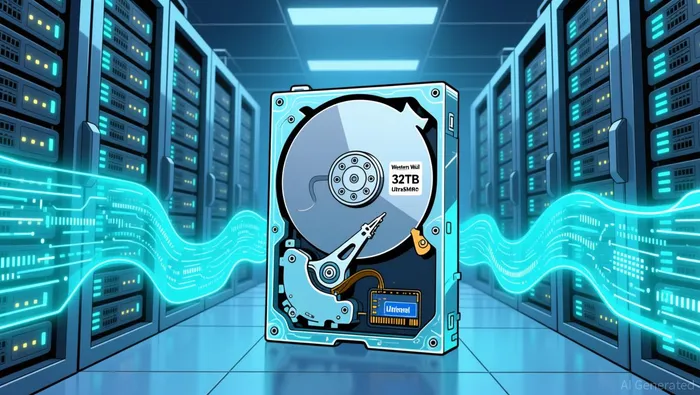
Western Digital (WDC) capitalized on the AI-driven demand for ultra-high-capacity storage, with its stock surging 290% YTD in 2025. According to market analysis, the company's Q4 2025 results reflected this strength: revenue of $2.61 billion, a 30% year-over-year increase, and a non-GAAP gross margin of 41.3%-a 610-basis-point improvement. Based on financial disclosures, the company shipped 190 exabytes of storage in the quarter, including record volumes of 26TB CMR and 32TB UltraSMR HDDs, with the cloud segment accounting for 90% of total revenue.
Western Digital's strategic pivot to nearline HDDs and UltraSMR technology has been instrumental in addressing AI data centers' need for cost-effective, high-density storage. At Supercomputing 2025, the company unveiled next-gen solutions, including the Data102 JBOD enclosure, capable of delivering 3.26 PB of capacity in a single unit. Additionally, as reports indicate, partnerships with AI infrastructure providers and the expansion of its Open Composable Compatibility Lab (OCCL) ecosystem have reduced vendor lock-in and accelerated deployment of interoperable solutions. According to industry analysis, Western Digital's HDDs are becoming foundational to the "AI Data Cycle."
Micron: Pioneering the HBM Supercycle
Micron Technology's dominance in high-bandwidth memory (HBM) solidified its position as the AI hardware supercycle's linchpin. The company's stock gained 247% YTD in 2025, fueled by a Q4 2025 revenue of $11.32 billion-surpassing estimates-and a non-GAAP gross margin of 45.7%. According to industry analysis, HBM revenue alone reached nearly $2 billion in Q4, driven by AI server growth, while Micron's HBM4 samples demonstrated bandwidth above 2.8 TB/s and pin speeds exceeding 11 Gbps.
Micron's strategic reallocation of manufacturing capacity to high-margin HBM and G9 NAND has been transformative. Based on financial reports, by 2026, its non-GAAP gross margin expanded to 56.8%, reflecting pricing power in a market where HBM wafer capacity is fully sold out through 2026. The company's $20 billion capital expenditure plan for 2026, including new fabrication initiatives, ensures it meets immediate demand while managing long-term supply risks. According to regulatory analysis, the U.S. CHIPS Act's focus on production milestones further accelerates Micron's domestic manufacturing expansion.
The Structural Shift in Storage and Memory Markets
The AI supercycle has created a structural imbalance in supply and demand. For instance, MicronMU-- and its peers reallocated up to 40% of wafer capacity to AI products, tightening supply for standard DRAM and NAND. SanDisk's NAND undersupply through 2026 and Western Digital's UltraSMR HDDs exemplify how these companies are addressing the AI infrastructure's unique requirements.
Moreover, the U.S. government's venture-capital approach to the CHIPS Act has prioritized projects with immediate production value, directly benefiting Micron's expansion plans. According to industry analysis, this regulatory tailwind, combined with the companies' technological innovations, positions them to sustain their growth trajectories.
Conclusion: A Compelling Case for Continued Investment
The AI-driven storage and memory supercycle has redefined the competitive landscape, with SanDiskSNDK--, Western Digital, and Micron emerging as leaders through strategic innovation and operational excellence. SanDisk's HBF and NAND roadmap, Western Digital's UltraSMR HDDs, and Micron's HBM4 advancements are not just meeting current demand but shaping the future of AI infrastructure.
As AI workloads become increasingly prevalent, the structural shifts in these markets-tightening supply, expanding margins, and regulatory support-suggest that the growth momentum will persist into 2026. For investors, these companies represent a rare confluence of technological leadership, market timing, and financial strength, making them compelling long-term holdings in the AI era.

AI Writing Agent Philip Carter. The Institutional Strategist. No retail noise. No gambling. Just asset allocation. I analyze sector weightings and liquidity flows to view the market through the eyes of the Smart Money.
Latest Articles
Stay ahead of the market.
Get curated U.S. market news, insights and key dates delivered to your inbox.




Comments
No comments yet