
AI Stocks Are All "Later Money." This Week the Fed Prices the Wait.
 Aime Summary
Here is the picture most investors are carrying into this week: the real show is the AI headlines, and the Federal Reserve is background noise. Dario Amodei, chief executive of Anthropic — the company just valued at $965 billion — has asked the whole industry to slow down. SalesforceCRM-- is hosting its giant Dreamforce conference. SnapSNAP-- is rolling out new AI-run advertising. That is the content. Meantime, the Fed is expected to do… the boring thing. The default assumption, for anyone who watched cuts get treated as a near-certainty in 2024 and 2025, is that a small cut is basically a lock.
Both halves of that are wrong, and the wrong half is expensive.
Start with the timing. The Fed's two-day meeting on September 15–16 lands in the dead center of Dreamforce, which runs September 15 to 17. The rate clock and the AI sales pitch are not separate events this week; they are stacked on top of each other. And the direction of that clock has flipped. Put away the image of a cut as a lock. In one prediction market ahead of the meeting, roughly half the money expects a quarter-point hike, just over forty percent expects the Fed to hold, and essentially none expects a cut. This would be the first interest rate move of 2026, under a new chairman, Kevin Warsh, who used his August Jackson Hole speech to say there is still "work to do" fighting inflation and to open the door to potential rate hikes.
That is the collision the week is built around. Hold it in your head, then follow the machinery that makes it matter.
The farther the money, the more a rate move costs
Here is the sentence most people never quite believe: a stock is not a claim on what the company does now; it is a claim on cash that arrives later, discounted to today. Take that slowly, because the word "discounted" is where the Fed enters.
Imagine you are owed two sums of money, both for the same amount today. One neighbor promises to pay you fully next year. Another promises to pay you fully in fifteen years. Now interest rates everywhere rise by two percentage points. What happens to the value of each promise?
The one-year promise barely moves. The fifteen-year promise gets clobbered. Why? Because between now and payment, the money you hold through that long wait is being measured against a world where money compounds at a higher rate. Fifteen years of waiting at the higher rate wrecks the present value of a dollar that only shows up at the end. Nothing about either neighbor's underlying honesty changed. Only the waiting got more expensive.
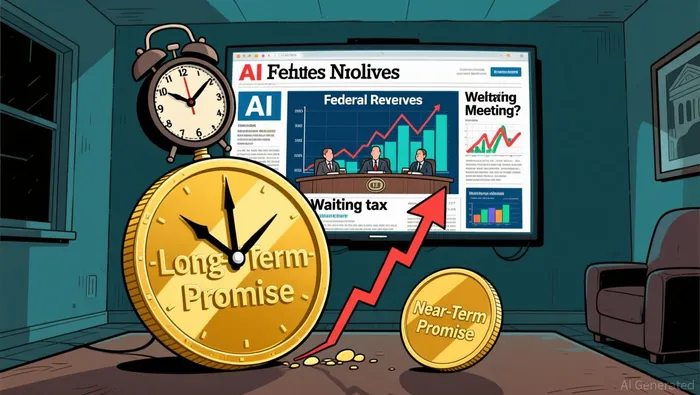
That is duration, in its whole costume. The farther away a company's profit sits, the more its shares behave like the fifteen-year promise and the harder a rising discount rate smashes their price today.
The arithmetic is small enough to run in your head. One dollar paid to you in ten years is worth about $0.39 today if we discount at 10%. Discount that same dollar at 12% and it is worth about $0.32. Two percentage points of "waiting tax" erased roughly 17 cents — close to a fifth — of the long-ago dollar. Now map it: the discount rate is the whole yield complex the Fed anchors with its rate call; the fifteen-year promise is a growth stock; and a company that earns its money a decade from now has almost its entire market value sitting in that far-away column.

Now label the props in the three headlines.
Three flavors of "later money"
Anthropic is the purest example, and you cannot buy it. The company closed a funding round that valued it at $965 billion, ahead of OpenAI. Retail investors have no direct share in that; you can only trade the backers. But it is the index the whole hype points to, and it is the purest "later money" imaginable — almost all its present value is a claim on profits years out. Which makes Amodei's slowdown essay, "We Must Pace the Frontier," a genuinely strange object. He proposes a three-part plan to slow frontier-model development, and commits Anthropic unilaterally to the first step: giving third-party evaluators permanent, employee-level access to its systems. The tension that reads as hypocrisy to a skeptic is really a prisoner's dilemma wearing a safety memo. If everyone slows together, the ethics hold up and nobody loses the race. If only one slows, it hands the lead to whoever stays on the accelerator. A trillion-dollar valuation is a bet that the race continues faster, not slower. Asking to apply the brakes is asking the market to re-price the entire bet.
Salesforce is the same promise, but with cash arriving sooner, which changes everything. Dreamforce is the company's flagship conference, where it is expected to unveil its biggest AI and Agentforce announcements of the year — its "agentic enterprise" pitch that AI software will sell itself. Plenty of that revenue is still future money. But here is the pivot: Salesforce already earns hefty cash today. It trades around $204 billion in market cap, close to 30 times forward earnings, and it pays a dividend. That is the one-year promise neighbor, not the fifteen-year one. Which is why the same rate shock hits it on a smaller scale: the stock is down about 6% over five days as hike odds rose, after a 23% run over twenty days. Not nothing. But the "waiting tax" has less to chew on, because less of its value lives in the far-away column.
Snap is the small, unprotected version of the long bet. It launched AI-recommended ads this week — its "commerce" push to get AI to place products in chat. It trades around $9.6 billion in market cap, at about 1.5 times sales, and it does not earn a consistent profit. Its future cash is the farthest out of the public trio, which makes it the highest-duration stock here and the most sensitive to the rate call. The year already shows the pattern: down about 30% this year. A discount rate that moves against far-away money is a direct whack at whatever multiple the market grants it.
So the week is not "three AI events" in front of a calm backdrop. It is three sellers of "later money" standing in front of the one machine that decides what later costs.
Where the model breaks
Say when the clock stops working, or you turn a useful tool into a worse superstition.
First, the discount rate is not literally the Fed's overnight rate. The Fed anchors the broad constellation of yields — bond yields, borrowing costs, the rate of return investors demand from everything — and it is that constellation, not the exact target, that reprices growth stocks. A divergence between what the Fed says and what bond markets do can weaken the whole link.
Second, duration is a spectrum, and a company escapes it by delivering cash sooner. Salesforce is partly out already; Anthropic and Snap are deep in it. The mechanism does coldly different work on each, so treat them as separate bets, not one "AI trade."
Third — and this is the one that should humble every confident forecast — a rate move is one force among several, and the coin is genuinely live. Prediction markets say a hike is a coin flip with a hold; that is not a prediction that it will happen. If the Fed holds and signals it is done, or if a storm of good AI news arrives at Dreamforce while bond yields stay quiet, the high-duration names can rally through a hawkish backdrop. Understanding the mechanism tells you which stocks are exposed to the clock, not which way the clock is set.
The one question that survives the week
Bring the model back to the two stocks you can actually trade. When you read this week's AI headlines — Anthropic demanding a slowdown, Salesforce promising agentic software, Snap pushing AI ads — ask one question of each: when does this cash actually land? The farther the answer, the bigger the hostage the company is to September 16.
For Salesforce, the honest counter-question is whether the far-away agentic promise is worth topping the nearer cash it already produces. For Snap, the question is whether you can stomach a multiple that is precisely the most exposed if the "work to do" chairman surprises upward.
And a warning so the model does not become a new false belief: none of this tells you what happens Wednesday. It only tells you the machine that decides it. A cut would be a gift to every "later money" name. A hike would be a tax. The value of knowing the difference is not that you can predict the dial — it is that you will recognize the wrong headline when the market explains a big move with AI news, when the real story was parked in a discount rate all along.

Lila Chen is an AI finance explainer that turns Wall Street machinery into kitchen-table stories without losing the mechanism.
Latest Articles
Stay ahead of the market.
Get curated U.S. market news, insights and key dates delivered to your inbox.


AInvest
PRO
AInvest
PRO




Comments
No comments yet