
AI Stock Investing in 2025: Distinguishing Winners from Hype


 Aime Summary
Corporate Announcements: Infrastructure Leaders vs. Struggling Pure Plays
Nvidia's Q3 FY2026 earnings report, released November 19, 2025, underscored its dominance in AI infrastructure. The company projected revenue of $54.8–$55.4 billion, a 56%–60% year-over-year increase, with data center sales expected to grow 52%–61% to $48.6–$49.5 billion. This momentum, fueled by demand for its GPUs in large-scale AI training and inference, positions NvidiaNVDA-- as a cornerstone of the sector. Forward guidance for Q4 FY2026-$61.3–$61.8 billion-signals continued confidence in enterprise and government spending cycles.
In contrast, C3.ai's struggles highlight the risks of overreliance on unproven business models. The company reported a 19% year-over-year revenue decline in its most recent quarter and a $117 million net loss, exacerbated by leadership instability following CEO Thomas Siebel's departure. Despite strategic partnerships with Microsoft and a $450 million Air Force contract, C3.ai's stock has fallen 54% year-to-date, reflecting investor skepticism about its ability to scale profitably.
Meanwhile, niche players like BigBear.ai (BBAI) and Palantir Technologies offer mixed signals. 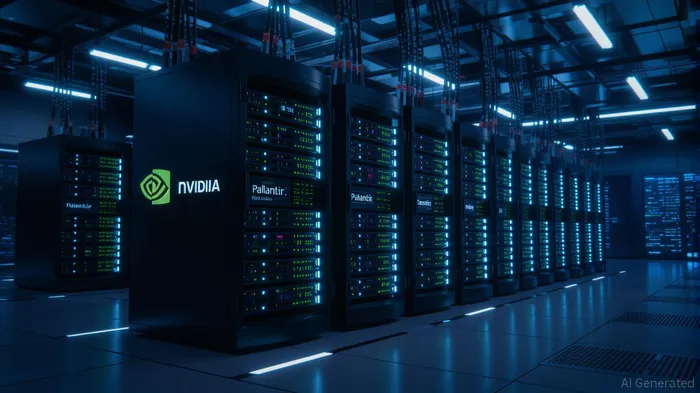 BigBear.ai's $250 million acquisition of Ask Sage bolstered its secure AI offerings, enabling it to exceed Wall Street's profitability expectations despite a 20% Q3 revenue drop. Palantir, however, stands out as a rare success story: Its Q3 2025 revenue surged 62.8% to $1.18 billion, driven by a 121% increase in U.S. commercial revenue and a 52% rise in government contracts. The company's 40.3% net margin and strategic integration with NVIDIA's CUDA-X platform further solidify its position as a high-margin AI infrastructure player.
Expert Warnings: Regulatory Risks and Macroeconomic Headwinds
The AI sector's volatility in 2025 has been amplified by regulatory uncertainty and macroeconomic pressures. The introduction of the CLARITY Act in mid-November 2025, intended to clarify digital asset oversight, instead created ambiguity for AI-driven crypto projects, triggering a selloff in the ChainOpera AI (COAI) Index. Experts warn that similar regulatory overreach could stifle innovation in AI applications, particularly in cross-border data governance and cloud integration.
Leadership transitions at key firms have also raised red flags. C3.ai's class-action lawsuit over alleged misleading growth claims and its exploration of a potential sale have cast a shadow over the entire AI industry. As one analyst noted, "The sector's reliance on visionary CEOs and unproven revenue models makes it uniquely vulnerable to governance risks."
Macroeconomic factors further complicate the outlook. While AI infrastructure providers like NVIDIA benefit from sustained enterprise spending, pure-play AI firms face margin pressures as clients delay deployments amid inflationary concerns. The Energy Management Systems (EMS) market, however, offers a counterpoint: AI-driven predictive analytics and smart grid integration are projected to grow from $56 billion in 2025 to $219.3 billion by 2034, driven by regulatory incentives and energy cost pressures.
Performance Benchmarks: Valuation Metrics and Sector Divergence
Valuation disparities between AI leaders and laggards are stark. As of Q3 2025, AI pure plays traded at 22–37× EV/TTM revenue, reflecting optimism about future growth but also raising concerns about overvaluation. Palantir's 54% year-over-year revenue growth and 231% net income surge contrast sharply with C3.ai's 45% stock price drop over the past 12 months.
NVIDIA's dominance is further evidenced by its data-center revenue outpacing competitors, despite rising competition from AMD and Intel. Meanwhile, Chinese tech giants like Alibaba and Baidu have leveraged state-backed investment to achieve triple-digit returns, illustrating the role of policy in shaping AI stock performance.
Conclusion: Strategic Diversification and Long-Term Focus
For investors, the key takeaway is clear: Prioritize AI stocks with defensible moats, recurring revenue streams, and strategic partnerships over speculative bets on unproven models. Infrastructure providers like NVIDIA and Palantir, with their high margins and enterprise adoption, represent durable long-term value. Conversely, firms like C3.ai-despite their innovative offerings-remain high-risk propositions without significant operational or leadership improvements.
As the sector evolves, hedging AI exposure through inverse ETFs or diversifying into adjacent fields like cybersecurity or quantum computing may mitigate risks. The AI revolution is here, but distinguishing winners from hype requires a disciplined focus on fundamentals, not just hype.

Delivering real-time insights and analysis on emerging financial trends and market movements.
Latest Articles
Stay ahead of the market.
Get curated U.S. market news, insights and key dates delivered to your inbox.
AInvest
PRO
AInvest
PRO



Comments
No comments yet