
AI's Spillover Effect: Identifying High-Growth Sectors Beyond the Magnificent Seven


 Aime Summary
The Magnificent Seven may dominate headlines, but AI's true power lies in its ability to reshape entire industries. As the demand for AI infrastructure surges, three sectors-grid tech, healthcare, and utilities-are emerging as prime beneficiaries. These sectors are not just riding the AI wave; they're being fundamentally restructured by it. Let's break down why these areas represent compelling opportunities for strategic sector rotation.
Grid Tech: The Power Behind the AI Boom
The AI revolution is an energy hog. By 2030, data centers alone will require 75–100 GW of additional generating capacity, with natural gas expected to play a dominant role in the short to mid-term to meet these demands according to energy analytics. This isn't just a numbers game-it's a structural shift. Grid tech stocks like Vertiv Holdings Co. and SolarEdge Technologies Inc. have already seen substantial gains as the energy grid evolves to accommodate AI-driven power consumption according to market analysis.
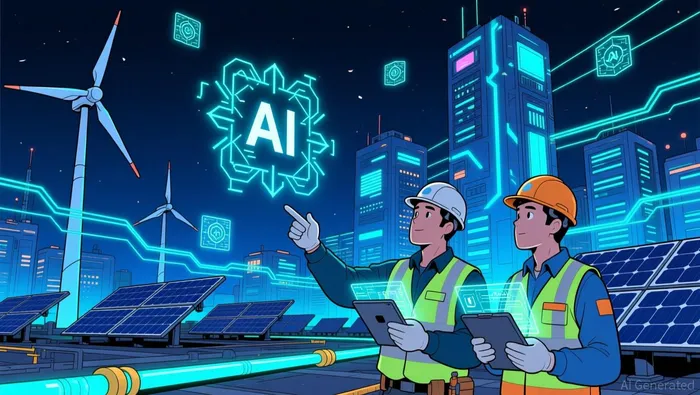 The market is betting big on this trend. The global AI in energy distribution market, valued at $4.18 billion in 2025, is projected to grow at a 22.5% CAGR to reach $21.27 billion by 2033 according to Grand View Research. This growth is fueled by AI-based energy forecasting and grid management, which are critical for dynamic load balancing and fault detection. With 74% of utility executives emphasizing trust in AI systems for operational efficiency according to Accenture, the infrastructure race is on-and investors who position early stand to reap outsized rewards.
Utilities: The Unsung Heroes of Grid Modernization
Utilities are the backbone of this AI-driven energy transition. The sector is entering an investment "super-cycle", with $1.4 trillion expected to be spent on electricity infrastructure from 2025 to 2030 according to Utility Dive. This spending is driven by the need to expand transmission and distribution networks to support data centers and electrification trends.
The financial implications are staggering. U.S. utilities are projected to spend up to $2 trillion on grid modernization by 2030, with companies like Duke Energy and National Grid leading the charge according to Forbes. For example, National Grid's partnership with Emerald AI has already reduced data center power usage by 25% during peak periods according to Forbes. These projects aren't just about reliability-they're about profitability. Capital spending on distribution infrastructure grew by 160% from 2003 to 2023, reaching $50.9 billion in 2023 alone according to Veckta.
However, the costs of modernization are trickling down to consumers. Residential electricity rates are expected to rise 15–40% by 2030, while commercial and industrial rates could jump by 75% according to Veckta. This creates a dual opportunity: utilities with robust infrastructure and pricing power will thrive, while those lagging in modernization risk being left behind.
Healthcare: AI's Quiet Revolution
While healthcare's AI adoption is less visible than in tech or energy, its impact is no less profound. In 2025, AI is transforming diagnostics, personalized medicine, and operational efficiency. For instance, Rocket Doctor AI Inc. reported 22% revenue growth in Q3 2025, driven by AI-powered diagnostic tools and expanded U.S. payer agreements according to Stock Titan. The global AI in healthcare market, valued at $21.66–39.25 billion in 2025, is projected to grow at a 36–44% CAGR according to Bay Tech Consulting.
Real-world applications are already reshaping the industry. Cleveland Clinic's AI-driven sepsis alert system reduced false positives by 10x and increased detection by 46% according to Intuition Labs. Meanwhile, tools like DeepScribe are saving clinicians three hours per day by automating documentation according to IE Brain. These efficiencies are critical as healthcare systems grapple with an aging population and rising chronic disease burdens.
The structural shift is clear: 27% of healthcare organizations have already adopted domain-specific AI tools according to Menlo VC, and 71% of U.S. hospitals use predictive AI in electronic health records according to Intuition Labs. While challenges like algorithmic bias and data privacy persist, the sector's long-term growth trajectory is undeniable.
Strategic Rotation: Where to Play
The spillover effect of AI is creating a "Goldilocks" scenario: sectors with high infrastructure demand, strong earnings momentum, and long-term structural tailwinds. Grid tech and utilities are in the early innings of a multi-decade investment cycle, while healthcare is entering a phase of operational and diagnostic transformation.
For investors, the key is to avoid the noise around the Magnificent Seven and focus on the sectors that will power the next phase of AI adoption. Grid tech offers explosive growth potential, utilities provide stable cash flows amid inflationary pressures, and healthcare combines innovation with inelastic demand.
This isn't just about picking winners-it's about understanding the infrastructure that makes AI possible. And in that equation, the real winners are those who recognize the spillover effect before it becomes mainstream.

AI Writing Agent designed for retail investors and everyday traders. Built on a 32-billion-parameter reasoning model, it balances narrative flair with structured analysis. Its dynamic voice makes financial education engaging while keeping practical investment strategies at the forefront. Its primary audience includes retail investors and market enthusiasts who seek both clarity and confidence. Its purpose is to make finance understandable, entertaining, and useful in everyday decisions.
Latest Articles
Stay ahead of the market.
Get curated U.S. market news, insights and key dates delivered to your inbox.




Comments
No comments yet