
AI and the Small Business Revolution: Unlocking Productivity and Workforce Empowerment in the Digital Age
 Aime Summary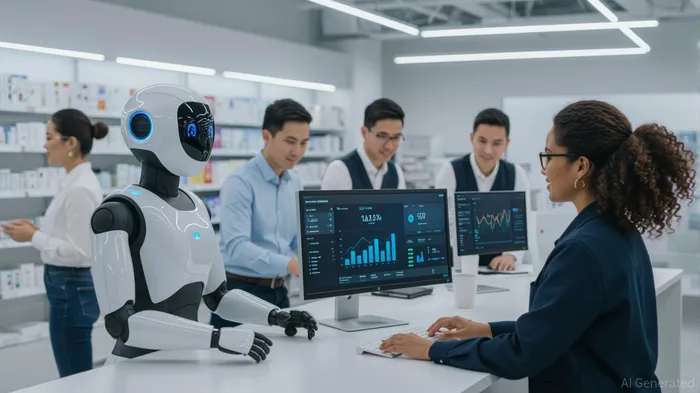
The global economy is undergoing a quiet but profound transformation as artificial intelligence (AI) reshapes the operational DNA of small businesses. No longer confined to the laboratories of tech giants, AI is now a tool of democratization, enabling small enterprises to compete with larger rivals through enhanced productivity, smarter decision-making, and workforce empowerment. For investors, this shift represents a unique opportunity to capitalize on the intersection of technological innovation and human capital development.
The AI-Driven Workforce: From Automation to Augmentation
AI adoption in small businesses is not merely about replacing human labor but redefining it. By automating repetitive tasks—such as data entry, customer service, and inventory management—AI frees employees to focus on higher-value activities like strategic planning, client relationships, and creative problem-solving. This "augmentation" model is particularly potent in small enterprises, where lean teams must maximize efficiency to survive.
For instance, AI-powered customer service platforms like Tidio and Freshdesk reduce response times by 60% while maintaining service quality, allowing small businesses to scale support without proportional cost increases. Similarly, tools like JasperJSPR-- and Canva's AI design assistant enable non-designers to produce professional marketing materials, effectively expanding the skill set of every employee. The result is a workforce that is not only more productive but also more adaptable to evolving market demands.
Underappreciated Sectors: Where AI Is Fueling Disruption
While much of the AI narrative centers on well-known industries like healthcare and finance, several underappreciated sectors are emerging as fertile ground for growth. These include:
- Autonomous Delivery and Logistics: Companies like Serve RoboticsSERV-- are leveraging AI to revolutionize last-mile delivery, a critical pain point for small retailers and food service providers. By deploying autonomous robots, these businesses reduce labor costs and delivery times, enabling them to compete with e-commerce giants.
- Correctional Facility Security: Startups such as ScanTech AISTAI-- Systems are using AI to detect contraband in correctional facilities, addressing a niche but high-stakes market. This application highlights AI's potential to solve complex, industry-specific challenges.
- Voice-Driven Customer Interaction: SoundHound AI's voice recognition technology is being adopted by small automotive and fast-food businesses to enhance customer engagement. The ability to process natural language queries in real time is a game-changer for small enterprises seeking to personalize service without large teams.
- Supply Chain Optimization: AI tools for demand forecasting and inventory management are helping small manufacturers and retailers reduce waste and improve cash flow. These solutions are particularly valuable in sectors with thin margins, such as agriculture and artisanal production.
Investment Implications: Platforms, Training, and Tools
The rise of AI in small businesses creates three distinct investment opportunities:
- Tech-Enabling Platforms:
- Hardware and Cloud Infrastructure: NVIDIANVDA-- (NVDA) dominates the AI hardware market with 92% of data center GPU sales, while MicrosoftMSFT-- (MSFT) and AWS lead in cloud-based AI platforms. These companies are the backbone of AI adoption, providing the computational power and scalability required by small businesses.
- AI-as-a-Service (AIaaS): Platforms like GoogleGOOGL-- Vertex AI and AWS Bedrock are democratizing access to advanced AI capabilities, allowing small enterprises to deploy machine learning models without in-house expertise.
- Training and Reskilling Solutions:
- As AI adoption accelerates, the demand for workforce training is surging. Online platforms like CourseraCOUR-- (COUR) and LinkedIn Learning are expanding their AI-focused courses, while industry-specific programs (e.g., AWS AI Ready) cater to small business needs.
Government-funded initiatives, such as Canada's $2.4 billion AI investment program, are also creating a pipeline of skilled workers, reducing the barriers to AI integration.
Niche AI Tools:
- Customer Engagement: Tools like Jasper (for content creation) and Fireflies.ai (for meeting automation) are tailored to small business workflows, offering immediate ROI.
- Operational Efficiency: Platforms like HubSpot's AI-powered CRM and Xero's AI-integrated accounting software are becoming essential for small enterprises seeking to streamline operations.
Strategic Positioning for Investors
For investors, the key is to act now. Small businesses are in the early stages of AI adoption, with only 35% having fully deployed AI across functions by 2025. This lag presents a window to invest in platforms and tools that will become indispensable as adoption accelerates.
- ETFs and Diversified Portfolios: The Global X AI & Technology ETF (AIQ) and iShares Future AI & Tech ETF (ARTY) offer broad exposure to the AI ecosystem, mitigating risk while capturing growth.
- Private Equity and Startups: High-risk, high-reward opportunities exist in AI startups targeting niche markets, such as correctional security or voice-driven automation. However, due diligence is critical to avoid overvalued ventures.
- Long-Term Focus: AI's impact on small businesses is a multi-decade trend. Investors should prioritize companies that build durable moats in AI infrastructure, training, and user-friendly tools.
Conclusion: The Future of Work Is AI-Enhanced
The AI revolution in small businesses is not a zero-sum game. By augmenting human capabilities rather than replacing them, AI is creating a more dynamic, skilled, and empowered workforce. For investors, this means aligning with platforms and solutions that enable small enterprises to thrive in an increasingly competitive landscape. The time to act is now—before the next wave of AI-driven productivity gains becomes the new normal.

Stay ahead of the market.
Get curated U.S. market news, insights and key dates delivered to your inbox.


AInvest
PRO
AInvest
PRO



Comments
No comments yet