
AI Shock Sparks Software Rout — A Dip-Buying Setup?
 Aime Summary
Anthropic’s Claude Cowork platform has launched a legal automation tool capable of handling multiple legal tasks, including contract review, brief drafting, and automated responses. The announcement triggered sharp sell-offs across U.S. software stocks, dragging the Nasdaq lower. Legal-software heavyweight Thomson ReutersTRI-- plunged 15%.
Market concerns are not unfounded.
Claude has become a preferred analytical tool for many legal and financial professionals. According to Business Insider, well-known short seller Andrew Left used the tool while researching a litigation case. This growing acceptance among professionals makes Anthropic’s legal-focused AI features a more direct threat to incumbent legal software providers.
Beyond the legal sector, AI’s disruptive impact on the broader software ecosystem is becoming increasingly evident. German enterprise software giant SAPSAP--, once Europe’s most valuable company, recently issued weak guidance, sending its shares down nearly 40% over the past six months.
Google DeepMind recently unveiled Project Genie, a tool that could fundamentally change how video games are developed. The announcement sparked a broad sell-off in gaming stocks, with UnityU-- plunging more than 20% in a single day.
Earnings season has further confirmed the pressure AI is placing on software stocks. Bloomberg data shows that among S&P 500 software companies that have reported results, only 71% beat revenue expectations, compared with 85% across the broader technology sector.
Market Leaders Still Have Moats: Data, Licenses, and Networks
Despite the sharp sell-off, leading software companies continue to possess deep competitive moats within their respective domains. Thomson Reuters remains deeply entrenched in the legal industry through Westlaw, a proprietary database containing more than a century of U.S. case law and nearly two billion legal documents. Investors widely view Westlaw as the crown jewel of its legal business—an asset AI simply cannot replicate.
In highly specialized industries such as law, professional licensing is mandatory—something AI fundamentally lacks. Anthropic itself has warned that AI-generated legal analysis must be reviewed by licensed attorneys before being used in legal decision-making.
As for gaming, analysts argue that the recent collapse in gaming stocks largely overlooks the importance of creativity, social interaction, and network effects in open-world games. Investors fear Google’s AI tools could erode Unity’s market share—about 70% of the world’s top 1,000 mobile games are built with Unity tools—yet Unity has already embedded similar AI capabilities. These concerns, analysts say, are “overstated.”
Google’s AI tool is “unlikely to pose a near-term threat to EA, Take-Two, Roblox, or Unity,” though it could become a long-term risk if it evolves into a fully commercialized game-production platform.
Has Smart Money Moved Early?
Goldman Sachs prime brokerage data shows hedge funds have cut their net exposure to software stocks to 4.5%, the lowest level since 2019, while boosting net exposure to semiconductors to 8%—a complete reversal.
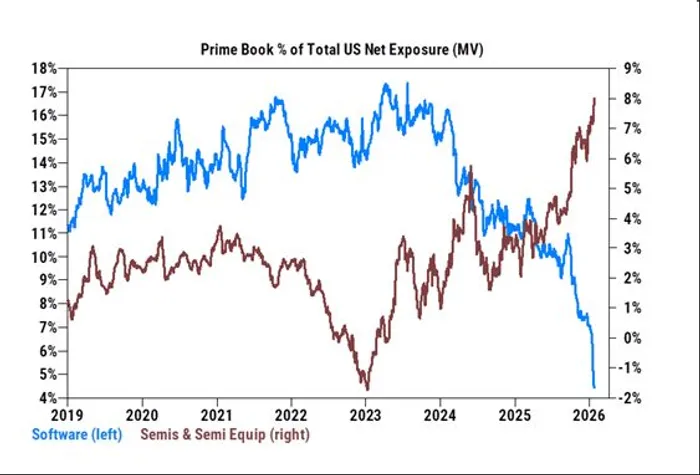
This shift can be interpreted in two ways. If AI truly disrupts the software industry, hedge funds’ repositioning appears prudent, helping them avoid a potential major correction in SaaS stocks. Alternatively, semiconductor trades may now be overcrowded, while software stocks have been oversold. If AI ultimately fails to dismantle software business models, hedge funds could rotate back aggressively, driving a meaningful valuation re-rating.

Senior Research Analyst at Ainvest, formerly with Tiger Brokers for two years. Over 10 years of U.S. stock trading experience and 8 years in Futures and Forex. Graduate of University of South Wales.
Latest Articles
Stay ahead of the market.
Get curated U.S. market news, insights and key dates delivered to your inbox.
AInvest
PRO
AInvest
PRO



Comments
No comments yet