
The AI Scare Trade: Why Anthropic’s ‘Claude Code’ Just Wiped 13% Off IBM
 Aime Summary
AI Disruption Shifts from Theory to Impact The equity market is currently mispricing the immediate velocity of AI-driven structural changes, as theoretical technology risks rapidly materialize into direct revenue threats for legacy enterprises. On Monday, February 23, 2026, AI developer Anthropic triggered a historic market event, releasing a new Claude tool capable of modernizing legacy COBOL systems. This direct threat to core infrastructure services sent International Business Machines Corp. (IBM) plunging 13%, marking its worst single-day selloff since 2000. Adding to the sector's intense anxiety, Anthropic will broadcast a live demonstration of these enterprise features on Tuesday morning. Concurrently, the AI developer is executing a massive $6 billion secondary share sale for employees at a staggering $350 billion valuation. This structural liquidity event allows the firm to defer IPO pressures while aggressively expanding its enterprise footprint. The combination of targeted product execution and capital accumulation signals a decisive market shift from AI hype to tangible corporate disruption.
The Catalyst: Anthropic's Direct Hit on Legacy Infrastructure
The mechanics of the recent market shock provide a clear framework for how AI advancements are actively repricing equities. On Monday, February 23, 2026, within the US equity markets, San Francisco-based AI startup Anthropic published a blog post announcing that its new Claude Code tool can successfully modernize COBOL. COBOL is a dated programming language that remains highly entrenched in global financial systems and is primarily run on IBMIBM-- mainframe computers. The impact was immediate and severe. IBM shares plummeted 13%, breaking crucial technical support levels to close near $223.35.
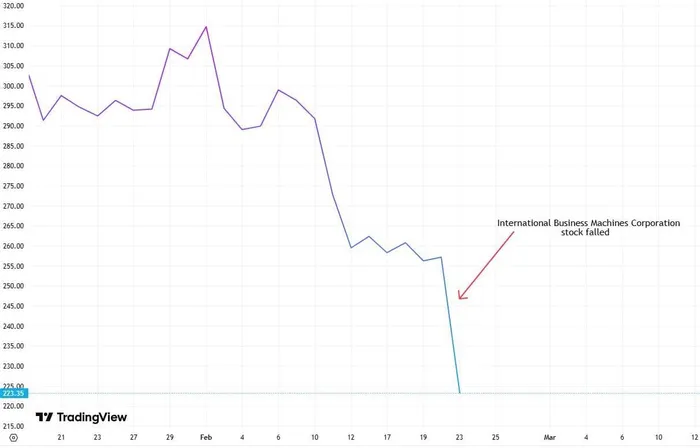
This specific product release served as the primary catalyst, but the vulnerability of the market was already elevated due to a widely circulated, bearish scenario analysis published over the weekend by Citrini Research. The report outlined hypothetical future scenarios where AI agents disrupt everything from payment processing to food delivery. Following Anthropic's announcement, market sentiment deteriorated further when prominent risk analyst Nassim Taleb publicly warned that investors should brace for escalating volatility and potential bankruptcies within the software sector. The compounding effect of Anthropic's tangible product release combined with macro risk warnings forced institutional investors into a rapid de-risking posture, impacting not just IBM, but extending to names like DoorDash and American Express, which slumped by at least 6%.
Tracking the "AI Scare Trade" Across Sectors
The IBM selloff is not an isolated event; it represents the latest escalation in a broader, systematic repricing mechanism known as the "AI scare trade". Market data spanning recent months reveals a clear pattern: the market is aggressively penalizing specific service layers, particularly across software, legal services, real estate property management, and freight logistics.
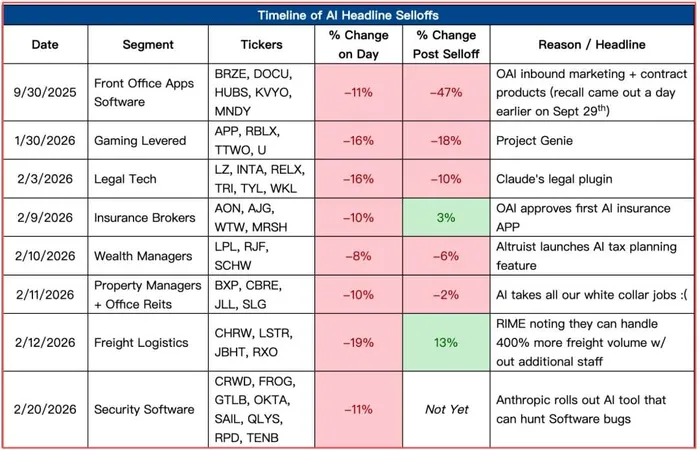
A review of recent headline-driven selloffs illustrates the breadth of this disruption. On February 3, 2026, the introduction of a legal plugin by Claude triggered a massive 16% single-day drop across legal technology providers, including names like LegalZoom (LZ) and Thomson Reuters (TRI), though the sector managed a slight recovery to a 10% net loss post-selloff. Similarly, on February 11, property managers and office REITs such as Boston Properties (BXP) and CBRE dropped 10% on macroeconomic fears regarding AI displacing white-collar jobs, directly threatening commercial real estate demand. The freight logistics sector experienced one of the most violent reactions on February 12; companies like C.H. Robinson (CHRW) and J.B. Hunt (JBHT) plunged 19% following news that an AI tool could handle 400% more freight volume without additional staffing, although this segment uniquely rebounded by 13% shortly after.
Most recently, on February 20, security software stocks including CrowdStrike (CRWD) and Fortinet (FTNT) fell 11% following Anthropic's rollout of an AI tool designed to hunt software bugs autonomously. As noted by analysts at major firms like Morgan Stanley, investors are increasingly adopting a "shoot first, ask questions later" strategy. Every product announcement from major AI laboratories is instantly modeled as incremental competition against existing software revenues.
The Enterprise Battleground: Anthropic vs. OpenAI
To understand the trajectory of these market impacts, investors must analyze the divergent strategies of the dominant AI laboratories. OpenAI has historically pursued a hybrid approach, capturing immense consumer mindshare while building foundational enterprise partnerships. In contrast, Anthropic is explicitly optimizing its architecture for strict Business-to-Business (B2B) applications. Anthropic is positioning Claude directly as an enterprise "thinking partner," actively targeting internal decision-makers such as Chief Information Officers, Chief Risk Officers, and General Counsels. The company is monetizing this enterprise focus aggressively, pricing its Claude Pro tier at $17 annually or $20 monthly, and establishing a premium Max version at $100 per month for heavy corporate deployment.
This strategic divergence is causing unprecedented friction within the venture capital ecosystem, fundamentally altering traditional firm loyalties. Historically, venture capital firms operate on an exclusivity model—backing one major player in a sector to avoid conflicts of interest. However, the capital intensity of artificial intelligence has broken these rules. Currently, more than ten major institutional shareholders of OpenAI have executed a "double-dip" strategy, taking concurrent positions in Anthropic's recent $30 billion funding round.
_ae1aaef31771901775808.png?format=webp&width=700)
An analysis of the investor landscape reveals a complex network of capital bridges. Top-tier firms including Sequoia Capital, Founders Fund, Insight Partners, Fidelity, and TPG hold investments in both competing entities. Perhaps most notably, BlackRock maintains this dual position despite having an executive sitting directly on OpenAI's board of directors. In response to this capital defection, OpenAI CEO Sam Altman has drawn a strict boundary, warning that investors engaging in non-passive investments with rivals will lose access to OpenAI’s confidential commercial data. Meanwhile, firms like Andreessen Horowitz (a16z) have maintained loyalty strictly to OpenAI, while Menlo Ventures, Bessemer, and General Catalyst have aligned their capital exclusively behind Anthropic.
Pre-IPO Mechanics: Hedging Through Secondary Liquidity
As Anthropic disrupts public equities, it is simultaneously executing complex financial engineering in the private markets. The company has recently initiated an internal process to allow current and former employees to liquidate holdings, allocating between $5 billion and $6 billion for a secondary share sale. This transaction is being executed at an estimated enterprise valuation of $350 billion , operating strictly as a secondary transaction where outside investors purchase the equity directly from staff rather than the company issuing new shares.
This secondary market strategy serves a critical dual mandate for the firm. First, in an intensely competitive AI labor market, providing liquid capital to engineers is paramount for talent retention. Second, and more critically for market observers, executing a secondary share sale of this magnitude effectively hedges against immediate IPO pressure. By providing early investors and employees with billions in liquidity, Anthropic can maintain its status as a private entity for a significantly longer duration. This allows the firm to aggressively develop and deploy highly disruptive enterprise tools—like the COBOL modernization software—without subjecting its internal financial metrics or strategic roadmap to the rigorous quarterly disclosures required by public market regulators.
Conclusion
The rapid devaluation of IBM following Anthropic's product launch confirms that the equity markets are entering a new phase of AI assimilation. The "scare trade" is transitioning from a period of generalized, hypothetical fear into one of highly targeted, asset-specific repricing. As Anthropic continues to deploy enterprise-grade tools aimed directly at legacy software, legal frameworks, and logistical infrastructure, public market investors must recalibrate their valuation models. Furthermore, Anthropic's ability to orchestrate massive $6 billion private liquidity events ensures it retains the operational agility to continuously pressure legacy public companies without the constraints of near-term public market scrutiny. For equity analysts and portfolio managers, the immediate future requires a rigorous reassessment of any legacy technology firm whose core revenue streams can be automated by the accelerating capabilities of enterprise AI agents.

Tianhao Xu is currently a financial content editor, focusing on fintech and market analysis. Previously, he worked as a full-time forex trader for several years, specializing in global currency trading and risk management. He holds a master’s degree in Financial Analysis.
Latest Articles
Stay ahead of the market.
Get curated U.S. market news, insights and key dates delivered to your inbox.
AInvest
PRO
AInvest
PRO



Comments
No comments yet