
AI Rotation Watch: As Chips Wobble, Can Cloud Software Quietly Take the Lead?
 Aime Summary
After a soft start to September and a choppy August finish, the AI complex looks shakier—especially on the semiconductor side. NvidiaNVDA-- slipped below its 50-day moving average on Tuesday for the first time since May, a psychological blow for the market’s AI bellwether. Semis have carried the AI story for 18 months; now the group’s technicals are tired. Traders are watching the VanEck Semiconductor ETF (SMH) for a potential head-and-shoulders breakdown while Nvidia and peers battle to reclaim trend support—classic late-stage behavior after a monster run.
Where the baton might pass: “boring” software
Under the surface, software is reasserting itself—helped by better-than-feared earnings and tangible AI adoption inside the apps and data stack: Datadog (DDOG) raised guidance and detailed continued AI-driven observability traction. Autodesk (ADSK) delivered double-digit revenue growth and upbeat outlook as it ships AI features across design workflows. Pure Storage (PSTG) posted strong results as AI training/inference drives flash demand. Snowflake (SNOW) continues to lean into AI data pipelines, touting robust customer-spend metrics.
Even the broader narrative is shifting: the “death of software” call is getting walked back as big platforms blend AI into their own models and products, stabilizing margins and growth.
ETF tie-ins if software leads the next leg
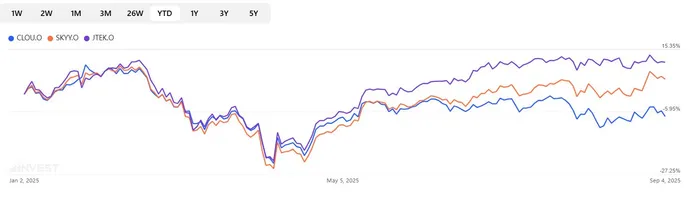
Global X Cloud Computing ETF (CLOU) A pure play on cloud-first software and platforms. CLOU owns names across SaaS/PaaS/IaaS, including top weights like Snowflake and Shopify—a direct way to express a rotation toward application- and data-layer beneficiaries. Expense ratio: 0.68%. (Top holdings as of Sep 3, 2025.)
First Trust Cloud Computing ETF (SKYY) Long-running cloud basket spanning software, IT services, and storage. Current weights highlight the pivot: Arista Networks (cloud networking), Pure Storage, MongoDB, and Oracle sit near the top, with Datadog and Snowflake also included—useful exposure to both infra and app-layer AI demand. (Holdings as of Sep 3, 2025; ER 0.60%.)
JPMorgan U.S. Tech Leaders ETF (JTEK) An active approach that blends semis and software. Top positions include Nvidia, Snowflake, Oracle, ServiceNow, Broadcom, and TSMC—so you keep a stake in the silicon story while tilting toward enterprise software winners. (Top 10 as of Jul 31, 2025.)
How to think about positioning
If chips stabilize: JTEK’s mix lets you participate in a rebound while staying tied to software execution stories.
If the handoff to software continues: CLOU and SKYY are cleaner expressions of usage-based cloud apps, data platforms, and the storage/networking layer that AI workloads actually consume.
Catalysts to watch: chip leaders reclaiming their 50-DMA; guidance updates from cloud/data names; and evidence that AI features are monetizing inside software suites (seat expansion, AI-SKU attach, net revenue retention).
Bottom line
The AI trade isn’t dying; it’s broadening. With semis wobbling, fundamental and technical momentum is creeping back into software—especially cloud apps, data platforms, and storage. CLOU and SKYY offer targeted exposure to that theme, while JTEK provides an active, balanced bridge between chips and software. If the market’s next AI leg is less about building the data center and more about using it, these funds are positioned to benefit.
Quickly compare CLOU, SKYY, JTEK with our ETF Compare Tool

Market Radar delivers concise, daily trading ideas by tracking everything from options activity and market sentiment to high-profile political trades.
Latest Articles
Stay ahead of the market.
Get curated U.S. market news, insights and key dates delivered to your inbox.




Comments
No comments yet