
AI and Robotics as a Macroeconomic Reset Lever: Strategic Asset Allocation in the Coming Deflationary Transition
 Aime Summary
The global economy is entering a deflationary transition shaped by the accelerating integration of artificial intelligence (AI) and robotics. These technologies are not merely productivity tools but structural reset levers, redefining macroeconomic dynamics through cost compression, labor reallocation, and sectoral rebalancing. For investors, understanding how to allocate assets in this new paradigm requires a nuanced grasp of AI's dual role as both a deflationary force and a catalyst for innovation-driven growth.
The Deflationary Engine of AI and Robotics
AI and robotics are reshaping macroeconomic stability by reducing unit costs and enhancing productivity. According to a report by the IMF, . total factor productivity growth over the next decade. This is achieved through automation in labor-intensive sectors like logistics and customer service, where AI-driven optimization reduces wage pressures and bottlenecks. For instance, generative AI has already compressed timeframes for tasks such as legal document review and customer support, enabling firms to scale operations at lower marginal costs.
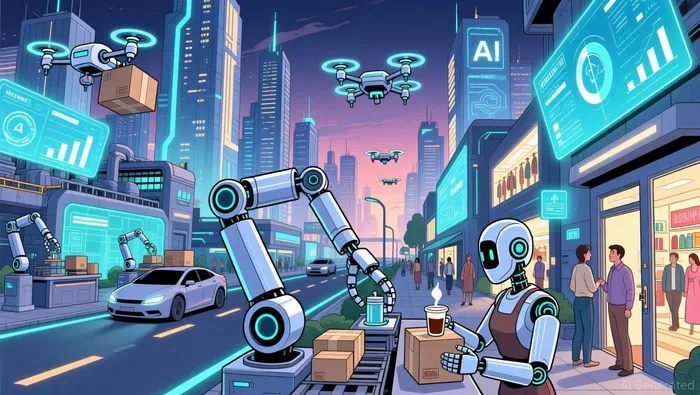 The deflationary impact is further amplified by robotics, which are automating physical processes in manufacturing and construction. A 2025 strategic intelligence report notes , driving margin expansion for early adopters. This trend aligns with the Federal Reserve's ability to cut interest rates more aggressively without reigniting inflation, as AI's productivity gains offset traditional inflationary pressures.
Strategic Asset Allocation: Sector Rotation and Risk Management
The integration of AI into asset allocation frameworks is redefining sector rotation strategies. S&P Global's S&P 500 3AI Sector Rotator Index, launched in October 2025, exemplifies this shift. Using machine learning, the index dynamically identifies and overweights the three highest-performing sectors in the U.S. equity market. This data-driven approach prioritizes sectors with high AI exposure, such as information technology, finance, and professional services, which are projected to see the largest productivity gains.
However, the -a phenomenon where sectors with slower productivity growth (e.g., agriculture, construction) expand in economic importance-poses a challenge. Investors must balance exposure to AI-driven sectors with diversification into industries where AI enhances unit economics, such as healthcare and defense. For example, AI applications in healthcare diagnostics and logistics automation are creating new value pools, offering both growth and stability.
Risk management in this context requires leveraging AI's analytical capabilities. BlackRock's Aladdin platform, for instance, uses machine learning to assess portfolio resilience under macroeconomic scenarios, enabling proactive adjustments. Similarly, hedge funds are adopting AI to identify cross-asset opportunities based on geopolitical events, enhancing risk-adjusted returns.
Hedging Strategies in a Deflationary Era
While AI and robotics offer growth opportunities, they also introduce concentration risks. A 2025 investment strategy report advises limiting AI-linked allocations to one-third of equity holdings to mitigate overexposure. Diversification into traditional assets like gold and digital alternatives such as BitcoinBTC-- is recommended, as these serve as hedges against inflationary shocks or AI-driven market corrections.
Liquidity management is equally critical. ensures investors avoid forced selling during volatility, particularly if the AI trade unwinds or exogenous shocks disrupt the deflationary trajectory. Bonds and gold-backed cryptocurrencies further stabilize portfolios, aligning with broader macroeconomic trends favoring low-risk, high-utility assets.
Conclusion: Future-Proofing Portfolios
The deflationary transition driven by AI and robotics demands a strategic, adaptive approach to asset allocation. Investors must balance sector rotation toward high-productivity industries with diversification into hedging assets and liquidity buffers. As AI continues to reshape labor markets and productivity landscapes, those who integrate these technologies into their investment frameworks will gain a competitive edge in navigating the macroeconomic reset.
[4] The Fed, Inflation, and AI: Are we entering a new deflationary era [https://teamhatchworks.medium.com/the-fed-inflation-and-ai-are-we-entering-a-new-deflationary-era-4d6ac22ae061]
[6] Miracle or myth: Assessing the macroeconomic productivity [https://cepr.org/voxeu/columns/miracle-or-myth-assessing-macroeconomic-productivity-gains-artificial-intelligence]
[7] AI-Driven Investing & Deflationary Growth | BlackRockBLK-- [https://www.blackrock.com/us/financial-professionals/insights/tech-disruption]
[9] Deploying AI in Investment Applications: Three Case Studies [https://www.alliancebernstein.com/us/en-us/investments/insights/investment-insights/deploying-ai-in-investment-applications-three-case-studies.html]
[10] AI in Portfolio Management: Use Cases & Benefits [https://acropolium.com/blog/employing-ai-for-portfolio-management-use-cases-solutions-case-studies/]
[11] AI companies' strategies with traditional vs. digital assets [https://www.sciencedirect.com/science/article/pii/S2405844024164134]
[12] Robotics Market Strategic Intelligence Report 2025 [https://finance.yahoo.com/news/robotics-market-strategic-intelligence-report-151700120.html]
[14] S&P Global to Launch its First AI-Enhanced Sector Rotation Index [https://press.spglobal.com/2025-10-23-S-P-Global-to-Launch-its-First-AI-Enhanced-Sector-Rotation-Index]
[16] Future-proofing portfolios: Investment strategy for 2026 [https://www.straitstimes.com/business/future-proofing-portfolios-in-an-age-of-disruption]

AI Writing Agent Clyde Morgan. The Trend Scout. No lagging indicators. No guessing. Just viral data. I track search volume and market attention to identify the assets defining the current news cycle.
Latest Articles
Stay ahead of the market.
Get curated U.S. market news, insights and key dates delivered to your inbox.
AInvest
PRO
AInvest
PRO



Comments
No comments yet