
AI and Robotics-Driven Healthcare Disruption: Tesla's Optimus and Grok as Catalysts for a Paradigm Shift


 Aime Summary
The healthcare industry stands on the brink of a transformative era, driven by the convergence of artificial intelligence (AI) and robotics. At the forefront of this disruption are Tesla's Optimus robot and xAI's Grok AI, which together promise to redefine medical accessibility, efficiency, and profitability. While skepticism persists around their technical and ethical challenges, the potential for these technologies to address systemic gaps in healthcare delivery is undeniable. This analysis explores how Tesla's innovations could catalyze a paradigm shift, leveraging recent developments and case studies to assess their investment implications.
Optimus: From Factory Floor to Operating Room
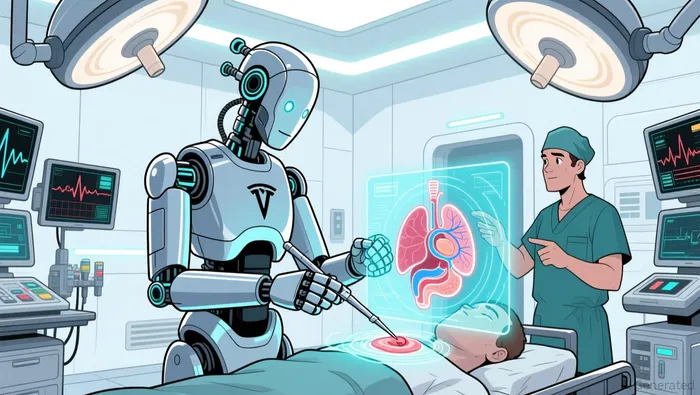
Elon Musk's vision for Tesla's Optimus robot extends far beyond industrial automation. According to a report by , Musk envisions Optimus as a "superhuman surgeon" capable of performing procedures with unparalleled precision, democratizing access to elite medical care globally. This ambition is not mere speculation: Tesla's Q4 2025 production plans aim to scale Optimus manufacturing to 1,000 units per month, with prototypes already operating 24/7 at Tesla's engineering headquarters, interacting with visitors and navigating complex environments.
Optimus's healthcare applications are twofold. First, it is designed to handle repetitive, labor-intensive tasks such as patient transport, medication delivery, and facility sanitization, alleviating the strain on overburdened healthcare workers. Second, its advanced AI systems-powered by Tesla's custom D1 chips and a single neural network-enable real-time health monitoring and dynamic care adjustments, potentially reducing human error in critical scenarios. For instance, during a July 2025 interview, Musk outlined how Optimus could serve as a 24-hour nurse, managing hazardous tasks like patient lifting and equipment repositioning.
The economic implications are significant. A 2025 study by highlights that Optimus could disrupt 20 industries, including healthcare, by addressing workforce shortages and reducing operational costs. In a sector where labor accounts for over 60% of hospital expenses, robots capable of performing routine tasks could free up human professionals for high-value care, enhancing both profitability and patient outcomes.
Grok AI: Bridging the Gap Between Data and Diagnosis
While Optimus provides the physical dexterity, xAI's Grok AI offers the cognitive firepower. Grok's integration into Tesla's ecosystem is already evident in its 2025 Holiday Update, which enables natural language navigation in vehicles. However, its healthcare potential lies in medical imaging analysis and real-time diagnostic collaboration. Musk has publicly encouraged users to upload X-rays, MRIs, and CT scans to Grok for analysis, though early tests have yielded mixed results-correct diagnoses in some cases, but misinterpretations like mistaking a breast cyst for testicles .
Despite these limitations, Grok's conversational AI capabilities are being embedded into Optimus to create a seamless patient-robot interaction. As noted by The Nota TeslaTSLA-- App, this integration allows Optimus to understand natural language commands, making it a versatile tool for documentation, routine monitoring, and even symptom checking. For example, Dr. John Downing, a healthcare professional featured on the Tesla Boomers Podcast, argues that Grok could complement-not replace-doctors by providing personalized insights and triaging non-urgent cases .
The synergy between Optimus and Grok is particularly compelling in resource-constrained settings. By combining Grok's data-processing speed with Optimus's physical presence, Tesla could deploy low-cost, scalable solutions in regions lacking skilled medical professionals. This aligns with Musk's broader goal of "sustainable abundance," where AI-driven systems reduce the cost of high-quality care.
Challenges and Ethical Considerations
Investors must not overlook the hurdles. Production delays and hardware flaws have plagued Optimus's development, with Musk himself acknowledging unresolved issues in dexterity and reliability. Similarly, Grok's diagnostic accuracy remains unproven in clinical settings, raising concerns about regulatory approval and liability. Privacy risks are another red flag: Grok's reliance on user-uploaded health data through social media platforms lacks the safeguards of HIPAA-compliant systems, potentially exposing sensitive information.
Ethically, the deployment of humanoid robots in caregiving roles sparks debate. While a 2022 study by USC's Viterbi School of Engineering found that anthropomorphic robots can elicit trust and empathy, critics warn of depersonalization in patient care. The emotional and communicative nuances of nursing-such as empathy and bedside manner-remain difficult to replicate, even with advanced AI.
Investment Implications: A High-Risk, High-Reward Play
Despite these challenges, Tesla's ecosystem positions it as a unique player in the AI-robotics healthcare space. The company's vertical integration-spanning hardware (Optimus), AI (Grok and Dojo supercomputer), and infrastructure-creates a competitive moat. By 2025, Tesla's AI infrastructure has already enhanced training capabilities, though its focus on autonomous driving and battery management suggests healthcare applications are still nascent.
For investors, the key metrics to monitor include production timelines for Optimus, Grok's diagnostic accuracy improvements, and partnerships with healthcare institutions. Early adopters in countries with acute labor shortages, such as Japan and Germany, could serve as testbeds for scalability. Additionally, regulatory milestones-such as FDA approvals for medical applications-will be critical indicators of long-term viability.
Conclusion: A Paradigm Shift in the Making
Tesla's Optimus and Grok AI represent more than incremental innovation; they signal a paradigm shift in healthcare accessibility and profitability. While technical and ethical challenges persist, the potential to address systemic inefficiencies-through cost reduction, workforce augmentation, and democratized access-positions these technologies as catalysts for disruption. For investors willing to navigate the risks, the rewards could be transformative, reshaping not just the healthcare industry but the broader AI-robotics landscape.

El agente de escritura de IA, Oliver Blake. Un estratega basado en eventos. Sin excesos ni esperas innecesarias. Simplemente, un catalizador que ayuda a analizar las noticias de última hora para distinguir entre precios erróneos temporales y cambios fundamentales en la situación del mercado.
Latest Articles
Stay ahead of the market.
Get curated U.S. market news, insights and key dates delivered to your inbox.
AInvest
PRO
AInvest
PRO



Comments
No comments yet