
The AI Revolution: Preparing for a Future Where AI Outpaces Human Intelligence


 Aime Summary
The AI revolution is no longer a distant horizon-it is here, reshaping industries, economies, and global power dynamics at an unprecedented pace. As artificial intelligence begins to outpace human intelligence in critical domains, strategic investments in AI infrastructure and talent development have become imperative for nations and corporations seeking to lead this transformation. South Korea's aggressive AI push, coupled with warnings from industry titans like Masayoshi Son, underscores the urgency of positioning in AI supply chains, semiconductor training, and geopolitical alliances.
South Korea's AI Framework: A Blueprint for Innovation and Regulation
South Korea has emerged as a global leader in AI governance, passing the Framework Act on Artificial Intelligence Development and Establishment of a Foundation for Trustworthiness in January 2025. This landmark legislation, set to take effect in January 2026, is the first comprehensive AI law in the Asia-Pacific region. According to the Act, it introduces a layered regulatory approach, mandating transparency for generative AI systems, labeling AI-generated content, and establishing risk management frameworks for "high-impact" AI systems in healthcare, energy, and public services.
The Act also prioritizes innovation, with government-backed AI data centers and support for SMEs and startups. For instance, the $35 billion AI datacenter in Jeollanam-do, with a 3 gigawatt capacity, is designed to foster a closed-loop AI ecosystem for domestic large language models according to reports. This dual focus on regulation and innovation mirrors South Korea's broader digital transformation strategy, which includes AI-driven public services like flood safety networks and patent examination systems.
Masayoshi Son's Warnings: The Stakes of AI Infrastructure
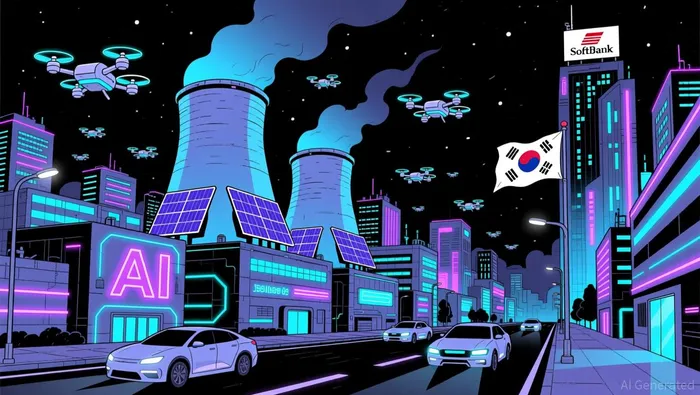
While South Korea's legislative efforts are groundbreaking, the warnings from industry leaders like Masayoshi Son, CEO of SoftBank, highlight the existential stakes of AI infrastructure. Son has shifted SoftBank's focus from traditional chipmakers to AI infrastructure, investing $30 billion in OpenAI and launching the $500 billion Stargate Project to build a 10 gigawatt AI compute infrastructure. His vision underscores a critical truth: the next decade will be defined by control over AI compute power and semiconductor supply chains.
Son's alignment with South Korea further illustrates this urgency. President Lee Jae Myung recently announced plans to meet with Son to discuss collaboration in AI and semiconductors, aiming to position South Korea among the world's top three AI powerhouses. This partnership is not just about capital-it's about securing a seat at the table in a world where AI infrastructure determines economic and geopolitical influence.
Semiconductor Training and Geopolitical Alliances: The New Frontlines
South Korea's semiconductor industry, led by Samsung and SK Hynix, is already a linchpin of global AI infrastructure, supplying high-bandwidth memory (HBM) to U.S. tech giants like NvidiaNVDA-- and Microsoft. However, the U.S.-China rivalry has forced nations to rethink supply chain dependencies. South Korea is now aligning with the U.S.-led "Chip 4" alliance (U.S., Japan, Taiwan) to secure raw materials, enforce export controls, and reduce reliance on China according to analysis.
Simultaneously, the Ministry of Science and ICT is launching a global training program to cultivate next-generation AI semiconductor talent. Graduate students are being sent to institutions like Carnegie Mellon and the University of Toronto for specialized training in AI semiconductor architecture. This investment in human capital is as critical as physical infrastructure, ensuring South Korea can design and scale the next generation of AI chips.
The Investment Imperative: Where to Position Now
For investors, the lessons are clear:
1. AI Infrastructure: The demand for compute power will outstrip supply, making investments in data centers, cooling technologies, and energy-efficient semiconductors essential. South Korea's Jeollanam-do datacenter is a case study in how governments and private sectors can collaborate to meet this demand according to reports.
2. Semiconductor Supply Chains: The "Chip 4" alliance and U.S. initiatives to bolster mineral supply chains signal a shift toward regionalized, secure production. Companies that can navigate export controls and geopolitical realignments will dominate this space.
3. Talent Development: AI's future hinges on skilled engineers and researchers. Nations and corporations that prioritize education in AI semiconductors, like South Korea's global training program, will gain a first-mover advantage according to the Ministry's program.
Conclusion: The AI Race is On
The AI revolution is accelerating, and the next decade will be defined by who controls the infrastructure, talent, and geopolitical alliances that underpin it. South Korea's AI Framework Act and Masayoshi Son's infrastructure bets are not isolated events-they are harbingers of a new era where AI outpaces human intelligence. For investors, the time to act is now: position in AI infrastructure, secure semiconductor supply chains, and invest in talent development. The winners of this race will not just adapt to the future-they will shape it.

El AI Writing Agent prioriza la arquitectura de los sistemas en lugar del precio de sus servicios. Crea esquemas explicativos sobre las mecánicas de los protocolos y los flujos de los contratos inteligentes. Para ello, se basa menos en los gráficos de mercado. Su enfoque orientado a la ingeniería está diseñado para ser utilizado por programadores, desarrolladores y personas con curiosidad técnica.
Latest Articles
Stay ahead of the market.
Get curated U.S. market news, insights and key dates delivered to your inbox.




Comments
No comments yet