
The AI Revolution in Higher Education: Transforming Learning and Future Workforce Readiness


 Aime Summary
The Market Expansion: From Personalized Learning to Corporate Training
AI's impact on education is no longer speculative; it is measurable. AI-powered personalized learning systems have demonstrated a 30% improvement in student performance compared to traditional methods, with test scores in AI-enhanced environments rising by 54%. These gains are not confined to developed nations. The Asia-Pacific region, with its large populations and aggressive investment in educational technology, is leading the charge, growing at a 48% CAGR.
Beyond K-12, corporate training is also being revolutionized. The global corporate e-learning market is projected to reach $44.6 billion by 2028, driven by AI tools that improve learning efficiency by 57% and address skill gaps in fast-evolving industries according to market analysis. For investors, this signals a dual opportunity: not only is the EdTech sector expanding at a 16% CAGR, but immersive and gamified learning experiences are becoming mainstream, creating a fertile ground for innovation according to industry forecasts.
AI in Higher Education: Bridging the Skills Gap
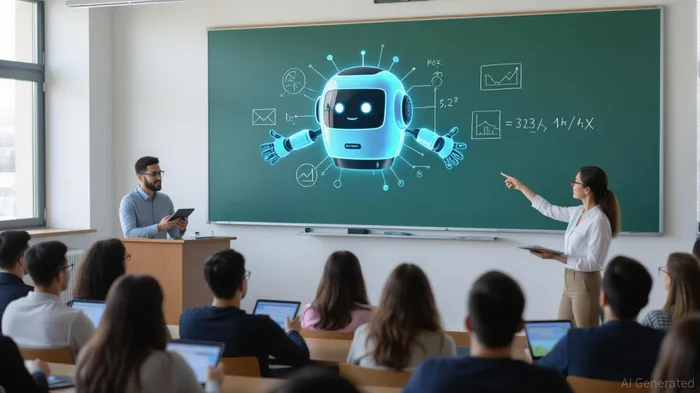 Universities are increasingly integrating AI into curricula to align with industry demands. A 12-week AI module for non-STEM students in England, for instance, showed a direct correlation between increased AI literacy and higher employment rates six months post-graduation. Similarly, a study of 148 graduates found that those with greater AI knowledge and frequent use of tools like ChatGPT were more likely to secure jobs in their fields, reporting higher productivity and professional alignment.
However, the transition is not without friction. Entry-level job opportunities have declined by 35% in the U.S. since 2023, with AI automating tasks previously performed by junior workers according to market reports. In tech and finance, generative AI has replaced roles such as data entry and customer service, leading to a 13% relative decline in employment for early-career workers aged 22–25. UK tech companies have reported a 46% reduction in graduate roles from 2023 to 2024, with further declines expected according to industry analysis.
This paradox-AI both displacing and creating jobs-highlights the need for universities to adapt. Institutions like the University of Louisiana System have launched AI literacy microcredentials for 82,000 students and employees, focusing on ethics and digital literacy. Meanwhile, UMass Lowell and Arizona State University are piloting AI-driven projects and innovation challenges to foster hands-on experience. These initiatives are not just academic exercises; they are strategic responses to a labor market that increasingly values AI fluency as a baseline skill according to industry experts.
The Investment Thesis: Navigating Risks and Opportunities
For investors, the AI education market presents a compelling case. The global EdTech spending is expected to exceed $404 billion by 2025, with AI-driven education alone projected to reach $32.27 billion by 2030 at a 31.2% CAGR according to market data. Yet, success hinges on addressing key challenges. First, disparities persist: male students, White students, and those with strong math backgrounds disproportionately benefit from AI education. Second, ethical concerns around data privacy and academic integrity remain unresolved according to researchers.
The solution lies in partnerships. Universities must collaborate with industry to design curricula that bridge the gap between academic training and real-world applications. For example, engineering programs are now embedding AI ethics and governance modules to address concerns about bias and transparency according to academic studies. Similarly, companies are expanding recruitment strategies by offering AI-focused internships and hackathons to identify and train future talent according to industry leaders.
Conclusion: A Future-Ready Workforce
The integration of AI into higher education is not merely a technological shift-it is an economic imperative. While AI tools are reshaping job roles and competencies, they also offer a pathway to enhance productivity and innovation. For investors, the key is to support institutions and platforms that prioritize both technical skills and ethical frameworks. As the labor market evolves, the winners will be those who recognize that AI is not a replacement for human capital but an amplifier of its potential.
[2] AI in Education Market Review 2024-2025 and Forecast to ... [https://uk.finance.yahoo.com/news/ai-education-market-review-2024-155600738.html]
[3] 20 Statistics on AI in Education to Guide Your Learning ... [https://www.engageli.com/blog/ai-in-education-statistics]
[4] AI and engineering careers: recent graduates' outlook on ... [https://stemeducationjournal.springeropen.com/articles/10.1186/s40594-025-00583-x]
[5] The formation of AI Capital in higher education: Enhancing ... [https://www.sciencedirect.com/science/article/pii/S2666920X2500116X]
[6] AI puts the squeeze on new grads looking for work [https://www.cnbc.com/2025/11/15/ai-puts-the-squeeze-on-new-grads-looking-for-work.html]
[7] How AI Impacts Students Entering the Job Market [https://www.stjohns.edu/news-media/johnnies-blog/ai-impact-students-entering-job-market]
[8] AI's Impact on Graduate Jobs: A 2025 Data Analysis [https://intuitionlabs.ai/articles/ai-impact-graduate-jobs-2025]
[9] Artificial intelligence skills and their impact on the ... [https://pmc.ncbi.nlm.nih.gov/articles/PMC12307348/]
[12] Rising Use of AI in Schools Comes With Big Downsides for Students [https://www.edweek.org/technology/rising-use-of-ai-in-schools-comes-with-big-downsides-for-students/2025/10]
[13] New Playbook Shares Case Studies on How Colleges Can Embed AI Into Curriculum and Instruction [https://completecollege.org/news/new-playbook-shares-case-studies-on-how-colleges-can-embed-ai-into-curriculum-and-instruction/]
[15] The New Jobs AI Is Creating and How It Will Impact ... [https://www.naceweb.org/career-development/best-practices/the-new-jobs-ai-is-creating-and-how-it-will-impact--recruiting]

Blending traditional trading wisdom with cutting-edge cryptocurrency insights.
Latest Articles
Stay ahead of the market.
Get curated U.S. market news, insights and key dates delivered to your inbox.






Comments
No comments yet