
AI Redefined as Teammate in Digital Workforce Transformation
 Aime Summary
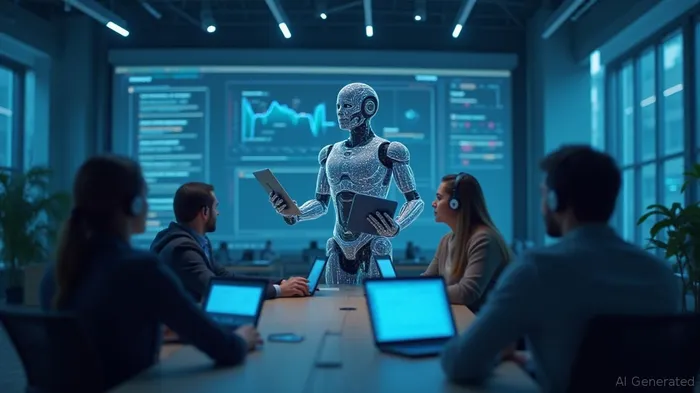
In an exclusive interview with Sandy Carter, the evolving role of artificial intelligence is redefined from a mere tool to an active teammate in today’s rapidly advancing digital landscape. Carter, in her book AI First, Human Always, argues that the future of work lies not in using AI to automate tasks but in collaborating with it to solve complex problems and drive innovation. This shift, she emphasizes, requires a fundamental change in how organizations design roles, manage workflows, and integrate AI into their teams [1].
Unlike traditional software, AI agents are now capable of taking initiative, analyzing context, and adapting to dynamic environments without human prompts. For example, AI can draft marketing content, refine it in real time based on performance, and recommend next steps autonomously. In customer support, AI can proactively identify and resolve issues before they escalate [1]. These use cases highlight how AI is no longer just an assistant but a core team member contributing to strategic decision-making.
Carter outlines the key characteristics that define AI as a true teammate: initiative, context awareness, communication, and continuous learning. An AI teammate must act proactively, understand the organizational environment, maintain transparency, and evolve with feedback and changing business needs. These traits, she argues, are achievable with current technology but require a shift from implementation to integration [1].
The organizational impact of viewing AI as a teammate is profound. Teams are becoming more fluid, with roles evolving to include collaboration between humans and AI. For instance, growth marketers are now working alongside AI analysts to interpret campaign data in real time, allowing humans to focus on creativity and customer experience. Similarly, product managers are partnering with AI agents that simulate user behavior, enabling more informed design decisions [1].
Beyond human-AI collaboration, the next phase is AI-to-AI communication. AI agents from different companies and industries can collaborate autonomously, optimizing processes without direct human intervention. Imagine a travel scenario where your personal AI agent coordinates with hotel, flight, and car rental agents to streamline your trip [1]. In business, procurement agents can negotiate with supplier agents, while sales agents can work with CRM agents to tailor proposals. This interconnected digital workforce is redefining efficiency and scalability.
However, Carter acknowledges the challenges that come with this transformation. Many organizations struggle with data quality, integration, and employee resistance. To overcome these, she emphasizes the need for cultural change—training employees to see AI as a collaborator rather than a threat. Tools with open APIs and no-code platforms are making AI more accessible, enabling teams to customize and extend its capabilities without deep technical expertise [1].
Ultimately, Carter stresses the irreplaceable value of human qualities such as judgment, empathy, and ethical reasoning. While AI can handle tasks and optimize workflows, it is humans who define its role and set its boundaries. The balance between AI and human leadership is essential to unlocking new possibilities and redefining what work looks like in the age of superintelligence [1].
The companies that will thrive, Carter argues, are not those with the most algorithms but those that build the most aligned, trusted, and collaborative teams—both human and AI. It’s time to move beyond the notion of AI as a tool and embrace it as a teammate. In this new era, leadership is less about controlling machines and more about partnering with them [1].
[1] Source: Sandy Carter Exclusive: Why AI Should Be a Teammate—Not Just a Tool (https://www.newsbtc.com/press-releases/sandy-carter-exclusive-why-ai-should-be-a-teammate-not-just-a-tool/)

Stay ahead of the market.
Get curated U.S. market news, insights and key dates delivered to your inbox.


AInvest
PRO
AInvest
PRO



Comments
No comments yet