
The AI Memory Chip Boom: SK Hynix's 30% CAGR Forecast and Implications for Tech Investors
 Aime Summary
The semiconductor industry is undergoing a seismic shift, driven by the explosive growth of artificial intelligence (AI). At the heart of this transformation lies a critical bottleneck: memory. As AI models grow in complexity, the demand for high-bandwidth memory (HBM)—a specialized chip designed to handle massive data throughput—has surged. SK Hynix, a South Korean memory giant, has positioned itself at the epicenter of this revolution, forecasting a 30% compound annual growth rate (CAGR) for the AI memory market from 2025 to 2030. For investors, this represents a rare opportunity to capitalize on a structural shift in global tech demand.
The Structural Shift in Semiconductor Demand
The AI infrastructure boom is redefining semiconductor demand. Traditional memory technologies like DRAM and GDDR are ill-suited for the data-intensive workloads of large language models (LLMs) and AI accelerators. HBM, with its 3D-stacked architecture, offers the bandwidth and efficiency required to power next-generation AI systems. By 2025, the AI semiconductor market is projected to reach $150 billion, with HBM alone expected to grow to $98 billion by 2030. This growth is not cyclical but structural, driven by the irreversible adoption of AI across cloud computing, autonomous systems, and edge devices.
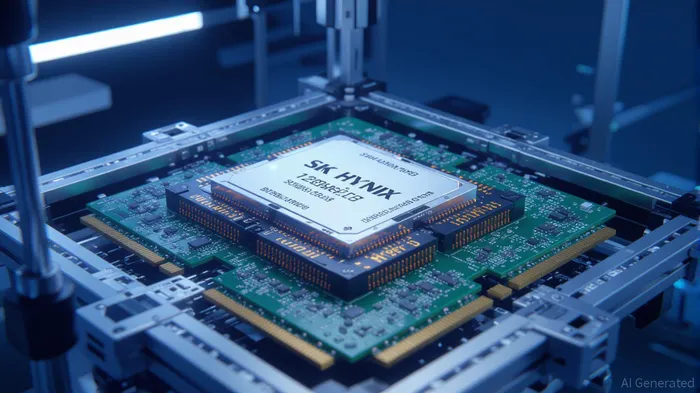
SK Hynix's dominance in HBM is underpinned by its proprietary Mass Reflow-Molded Underfill (MR-MUF) packaging technology, which ensures high yields and thermal stability in complex, multi-layered HBM stacks. The company currently supplies 70% of the global HBM market, including the 12-layer HBM3E used in NVIDIA's Blackwell Ultra GB300, the most powerful AI chip to date. This symbiotic relationship with NVIDIA—SK Hynix's largest customer—has cemented its role as a critical enabler of the AI revolution.
SK Hynix's Financial and Strategic Advantages
SK Hynix's HBM segment has become a cash-generating engine. In 2025, the company generated $20.7 billion in HBM revenue, accounting for 42% of its total DRAM revenue. Operating margins for HBM reached 42%, far outpacing the 15–20% margins typical of commodity DRAM. This margin expansion is a direct result of HBM's inelastic demand and SK Hynix's technological moat.
The company's aggressive capital allocation further strengthens its position. A $200 billion investment plan in HBM-specific fabrication and packaging facilities in South Korea and the U.S. ensures it can scale production to meet the projected $98 billion market by 2030. This contrasts sharply with competitors like Samsung and MicronMU--, which face yield challenges and oversupply in legacy DRAM.
Valuation Discrepancy and Investment Implications
Despite its leadership in HBM, SK Hynix trades at a significant discount to its peers. The stock has a P/E of 10.4x and a P/B of 1.91x, compared to Samsung's 15.2x and Micron's 18.7x. This valuation gap reflects market inertia—investors are still viewing SK Hynix through the lens of its legacy DRAM business rather than its high-growth HBM segment.
The disconnect is widening. In Q1 2025, SK Hynix reported $12.3 billion in revenue and $5.7 billion in net profit, with free cash flow projected to reach $23.6 billion in 2025. These figures suggest a company with the financial strength to reduce debt, repurchase shares, or reinvest in R&D for HBM4, the next-generation memory standard.
For investors, the key question is whether the market will eventually recognize SK Hynix's true value. The answer lies in the inelasticity of HBM demand. Unlike traditional semiconductors, HBM is a critical component for AI infrastructure, with no viable substitutes. As AI adoption accelerates, the demand for HBM will only grow, creating a compounding effect on SK Hynix's revenue and margins.
Strategic Partnerships and Policy Tailwinds
SK Hynix's strategic alliances further solidify its position. Its collaboration with NVIDIANVDA-- is not merely transactional but deeply integrated, with the two companies co-developing HBM4 to support next-generation AI platforms. Additionally, the U.S. government's $165 billion investment in TSMC's advanced packaging facilities (including CoWoS technology) ensures a robust supply chain for AI chips, indirectly benefiting SK Hynix as a key supplier of HBM.
Policy initiatives like the White House's AI Action Plan also create tailwinds. By streamlining permitting for data centers and strengthening the electric grid, the plan accelerates AI infrastructure deployment, increasing demand for HBM. South Korea's $65 billion AI push through 2027, including a $5 billion AWS-SK Group data center, further underscores the geopolitical and economic importance of HBM.
Conclusion: A High-Conviction Play in the AI Era
The AI memory chip boom is not a passing trend but a structural transformation in semiconductor demand. SK Hynix's leadership in HBM, combined with its technological innovation, financial discipline, and strategic partnerships, positions it as a prime beneficiary of this shift. While the stock's current valuation appears disconnected from its growth potential, history suggests that markets eventually correct such mispricings—especially when driven by inelastic demand.
For investors with a long-term horizon, SK Hynix offers a compelling case: a company with a dominant market position, a clear path to scaling production, and a valuation that appears to discount its role in the AI revolution. As the HBM market grows at 30% CAGR, those who recognize the structural shift early may find themselves well-positioned to capitalize on one of the most transformative trends in modern technology.

Stay ahead of the market.
Get curated U.S. market news, insights and key dates delivered to your inbox.
AInvest
PRO
AInvest
PRO



Comments
No comments yet