
Is AI Investment Still a Safe Bet Amid Growing Volatility?
 Aime Summary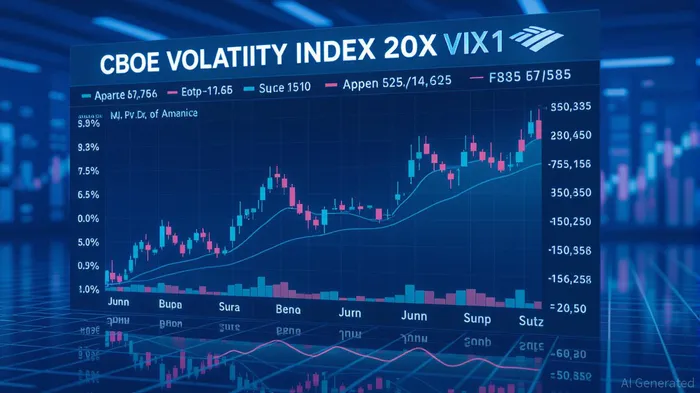
The AI sector, once a poster child for unbridled optimism, now faces a pivotal question: Is it still a safe investment amid rising volatility? In July 2025, the CBOE Volatility Index (VIX) sits at 16.65, a modest level by historical standards but a 30% annual increase. This reflects a market cautiously optimistic yet wary of shocks—trade deadlines, geopolitical tensions, and sector-specific swings. For AI equities, the picture is more nuanced. While companies like NvidiaNVDA-- (NVDA) and Quantum ComputingQUBT--, Inc. (QUBT) have delivered stratospheric returns, the sector's volatility has intensified, with pre-market surges in speculative plays like CyngnCYN-- (CYN) and LocafyLCFY-- (LCFY) underscoring the speculative nature of AI investing.
Bank of America's derivatives strategists are redefining the AI bubble debate by introducing tools that address volatility asymmetry and tail risks. Products like VarSelect variance swaps and Defensive Vol Selling (DVS) are designed to protect against sharp corrections while capturing upside potential. These innovations, combined with real-time AI-driven analytics, are reshaping how investors assess risk in a sector where earnings surprises and regulatory shifts can trigger abrupt price swings.
The AI Volatility Paradox: Growth vs. Uncertainty
The AI sector's allure lies in its dual role as both a growth engine and a volatility magnet. In Q2 2025, the S&P 500's resilience masked sharp swings in AI stocks. For example:
- Nvidia (NVDA) surged 28% in July 2025, driven by its dominance in AI chips and renewed Chinese market access.
- Quantum Computing, Inc. (QUBT) notched a 3,219.89% one-year return, reflecting speculative fervor.
- Cyngn (CYN) and Globavend (GVH) saw pre-market gains of 59.78% and 64.71%, respectively, highlighting the sector's “lottery ticket” appeal.
However, these gains come with caveats. The VIX's elevated level (16.65) and the Russell 2000's wider implied volatility spread against the S&P 500 signal a market wary of small-cap and sector-specific risks. For AI investors, this means balancing growth optimism with hedging strategies.
Bank of America's Derivatives Playbook: Mitigating AI's “Black Swan” Risks
Bank of America's derivatives team has pioneered tools to manage AI sector volatility:
1. VarSelect Variance Swaps: These re-engineered swaps dynamically adjust observation schedules during market downturns, reducing daily drawdowns by up to 20 points in extreme scenarios. This is critical for AI stocks, where earnings misses or regulatory news can trigger sharp corrections.
2. Defensive Vol Selling (DVS) Index: By weighting volatility replication to transfer risk to the upside, DVS avoids costly downside protection. During the August 2024 VIX spike (180% surge), DVS drawdowns were less than half of standard short-vol strategies.
3. Hourly Compass Volatility Targeting: This structure rebalances based on both volatility and spot price movements, ideal for AI stocks that often experience correlated swings in price and volatility.
These tools are not just theoretical. A large insurance carrier adopted the Hourly Compass for an S&P 500-tracking fixed indexed annuity, demonstrating their real-world utility. For AI investors, such strategies offer a way to lock in gains while managing the sector's inherent risks.
Options Positioning and Sector Rotation: A Data-Driven Lens
Options markets provide further insight. In July 2025, covered call strategies on AI ETFs like XLK gained traction, with traders selling premium to generate income while capping upside. Conversely, protective puts on volatile AI names (e.g., MetaMETA--, AMD) surged as investors hedged against earnings-related swings.
The VIX's 16.65 level also informs sector rotation. Defensive sectors like utilities (XLU) trade at lower implied volatility spreads against the S&P 500, making them attractive for volatility-adjusted income strategies. Meanwhile, AI's high volatility justifies a focus on volatility-adjusted position sizing—reducing exposure during spikes (e.g., $4,000 ATR for Bitcoin) and increasing it during lulls.
Regulatory Tailwinds and Headwinds
The AI sector's trajectory is also shaped by regulatory developments. New York's Responsible AI Safety and Education (RAISE) Act and Texas's Responsible Artificial Intelligence Governance Act (TRAIGA) aim to curb misuse but could also slow innovation. While these laws may not immediately derail growth, they signal a shift toward oversight, which could attract institutional investors but deter speculative retail activity.
Is Now the Time to Invest in AI?
For investors, the answer hinges on risk tolerance and time horizon.
- Long-term bullish case: AI's transformative potential remains intact. Nvidia's $4 trillion market cap and Quantum Computing's quantum hardware advancements underscore a sector with decades of growth ahead.
- Short-term caution: Elevated volatility and regulatory uncertainty demand disciplined risk management. Derivatives like VarSelect and DVS can help, but overexposure to speculative names (e.g., CYNCYN--, GVH) carries correction risks.
Investment advice:
1. Use volatility-adjusted strategies: Employ DVS and VarSelect to hedge against sharp corrections while maintaining exposure.
2. Diversify within AI: Balance high-growth names (NVDA, PLTR) with defensive AI applications (e.g., healthcare, cybersecurity).
3. Monitor regulatory trends: Stay informed on state and federal AI regulations, which could reshape sector dynamics.
In conclusion, AI remains a compelling investment but requires a nuanced approach. Bank of America's derivatives innovations offer a blueprint for managing volatility while capitalizing on the sector's upside. For those willing to navigate the risks, the AI revolution is far from over—just more complex than ever.

Stay ahead of the market.
Get curated U.S. market news, insights and key dates delivered to your inbox.




Comments
No comments yet