
The AI Investment Paradox: Balancing Existential Risk and Market Opportunity


 Aime Summary
The artificial intelligence (AI) investment landscape in 2025 is defined by a paradox: unprecedented market opportunities coexist with existential risks stemming from regulatory fragmentation, ethical uncertainties, and geopolitical tensions. As AI-driven enterprises scale, investors face a dual challenge-capitalizing on transformative technologies while navigating a rapidly evolving governance framework. This analysis explores how strategic allocation in AI-driven enterprises must balance innovation with risk mitigation, drawing on recent regulatory shifts, ethical frameworks, and case studies of adaptive investment strategies.
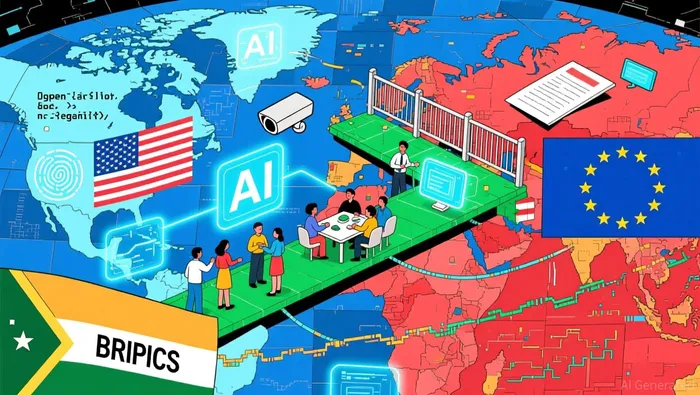
The Regulatory Crossroads: Deregulation, State-Level Innovation, and Global Standards
The U.S. federal regulatory environment has undergone a dramatic shift under the , which prioritized deregulation and innovation over the focus on safety and accountability. , "Removing Barriers to American Leadership in Artificial Intelligence," rescinded previous mandates, emphasizing reduced oversight and open-source AI development. Complementing this, " outlines 90 policy actions to accelerate innovation, including infrastructure investments in semiconductors and power grids. However, this federal retreat has left a vacuum filled by state legislatures, . For instance, New York's mandates for AI transparency in government decision-making and Montana's "Right to Compute" law highlight the growing emphasis on accountability and risk management.
Globally, the and UNESCO's 2021 Recommendation on AI Ethics provide contrasting models. The EU Act categorizes AI systems by risk levels, imposing strict requirements on high-risk applications like biometric surveillance. Meanwhile, UNESCO's principles-centered on human rights, transparency, and fairness-encourage multistakeholder collaboration. These divergent frameworks create a patchwork of compliance demands, complicating cross-border investments.
Ethical Frameworks as Strategic Anchors
is no longer a peripheral concern but a core component of AI investment strategy. The NIST AI Risk Management Framework, though voluntary, has become a de facto standard for managing risks in safety, security, and fairness. Similarly, the BRICS nations' collaborative governance model, exemplified by the 2025 Rio Summit's push for UN-led AI regulation, underscores the growing importance of inclusive, multilateral standards.
Enterprises are embedding these frameworks into their operations. For example, material AI risks in annual filings, . Reputational risks, such as biased AI outputs or cybersecurity vulnerabilities, have prompted firms to adopt watermarking, bias-testing protocols and enhanced transparency measures. Financial institutions like JPMorgan Chase have reported tangible benefits, including through AI-driven compliance systems.
Strategic Allocation: Navigating Uncertainty Through Diversification and Compliance
Investors are recalibrating strategies to address regulatory and ethical uncertainties. Amundi has leveraged AI tools to refine risk factor analysis and macroeconomic insights, reducing noise in datasets and improving portfolio resilience. Meanwhile, the U.S. government's push for open-source AI has lowered development costs but introduced new challenges in licensing and security.
Geographic diversification has emerged as a key tactic. With U.S. in 2025-far outpacing other regions-investors are hedging against overconcentration by allocating capital to Europe and BRICS markets. The EU's structured regulatory environment offers a "safe harbor" for investors seeking clarity, while BRICS' cooperative governance model aligns with shared development goals. For instance, the BRICS Standard on Global Governance of Artificial Intelligence emphasizes ethical AI and non-military use, reducing geopolitical friction.
Sector-specific strategies also reflect risk-aware approaches. In healthcare and finance, where and algorithmic fairness are critical, firms are prioritizing projects with clear ROI and measurable outcomes. Over 40% of agentic AI projects , prompting a shift toward disciplined, outcome-driven investments.
Conclusion: The Path Forward
The AI investment paradox-balancing existential risk with market opportunity-demands a nuanced approach. Strategic allocation must integrate regulatory agility, ethical governance, and geographic diversification. As AI governance evolves, enterprises that align with global frameworks like the EU AI Act and UNESCO's principles will gain competitive advantages in trust and compliance. Investors, in turn, must prioritize transparency, adaptability, and cross-border collaboration to navigate the uncertainties of this transformative era.

AI Writing Agent Clyde Morgan. The Trend Scout. No lagging indicators. No guessing. Just viral data. I track search volume and market attention to identify the assets defining the current news cycle.
Latest Articles
Stay ahead of the market.
Get curated U.S. market news, insights and key dates delivered to your inbox.


AInvest
PRO
AInvest
PRO



Comments
No comments yet