
AI's Innovation vs. Valuation Woes Test Investor Patience


 Aime Summary
The artificial intelligence-driven financial landscape is undergoing rapid transformation, with companies like Palantir Technologies Inc.PLTR-- and C3.ai, Inc. at the forefront of both innovation and controversy. As the AI boom accelerates, market participants are scrutinizing how these firms navigate valuation pressures, strategic partnerships, and leadership transitions.
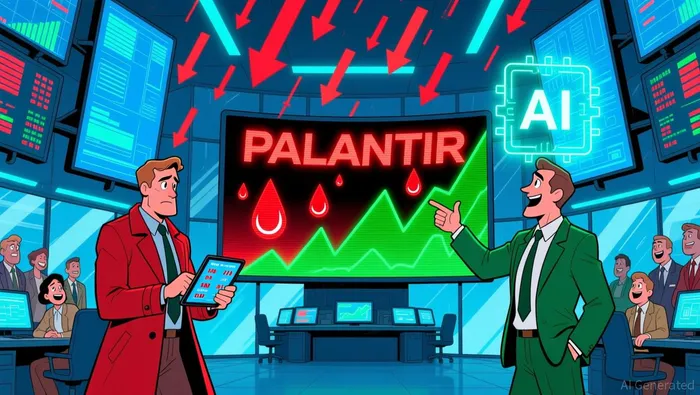
Palantir, a leader in cloud-native analytics, has seen its stock price fluctuate amid its high-growth narrative. Despite robust Q3 2025 financial results and a strengthened partnership with Nvidia Corp. (NVDA), the company's valuation remains contentious. The stock has retreated 15.6% from its 52-week high, reflecting investor caution about its premium pricing relative to decelerating revenue growth, according to a Seeking Alpha analysis. Analysts highlight that while Palantir's Rule of 40 metric (balancing growth and profit) reached 94%, the market's over-optimism during the AI hype cycle has led to a post-earnings correction, reinforcing a "Hold" rating for the stock.
 Meanwhile, C3.ai faces mounting challenges. The enterprise AI software provider reported a Q1 2025 net loss of $116.8 million and withdrew its full-year financial outlook after founder Thomas Siebel stepped down as CEO due to health concerns, as reported by a Blockonomi report. The company's stock has plummeted 54% year-to-date, with recent preliminary revenue figures falling 33% below guidance, triggering a 32% premarket drop, according to a CoinMarketCap article. New CEO Stephen Ehikian is now evaluating strategic alternatives, including a potential sale or private funding round, as C3.ai struggles to compete with rivals like PalantirPLTR-- and grapples with deteriorating financials.
The broader market has also reacted to these developments. C3.ai's stock recently closed at $15.31, down 4.79% in a single session and 16.99% over the prior month, lagging behind the S&P 500 and tech-heavy Nasdaq indices, according to a Nasdaq article. Analysts at Simply Wall St. argue that C3.ai's reliance on large cloud partners and unmet sales targets could undermine its long-term value proposition, as noted in a Simply Wall St. analysis. Meanwhile, Palantir's stock performance underscores the volatility inherent in AI-focused investments, as investors balance optimism about the sector's potential with skepticism about overvaluation.
Market observers are also tracking ripple effects from AI's growing influence. For instance, SoFi Technologies Inc. (SOFI) recently expanded its services to include crypto trading, while Intel Corp. (INTC) lost its chief AI officer to OpenAI, as reported in a Yahoo Finance video. These moves highlight the sector's dynamic nature, where talent and partnerships are critical to maintaining competitive edges.
As the AI narrative evolves, the coming months will test whether companies like Palantir and C3.ai can adapt to shifting investor sentiment and market demands. For now, the interplay between innovation, valuation, and leadership remains a defining theme in the AI-driven financial ecosystem.

Stay ahead of the market.
Get curated U.S. market news, insights and key dates delivered to your inbox.
AInvest
PRO
AInvest
PRO



Comments
No comments yet