
AI Infrastructure Spending Drives Global Memory Shortages and Market Shifts
 Aime Summary
Tech companies are spending $650 billion in 2026 on AI infrastructure, primarily for data centers and high-end computing hardware. AI memory shortages are causing DRAM contract prices to surge by 90-95% in Q1 2026, with PC DRAM prices expected to rise by over 110%. A growing portion of investor capital is shifting from AI-dependent tech firms to 'AI-resistant' sectors like construction and industrial goods. AI is enabling significant advancements in physical product innovation, particularly in manufacturing, healthcare, and consumer goods. Enterprises are struggling to govern AI at scale, with 58.2% of organizations citing unclear ownership as their primary barrier to measuring AI performance.
In early 2026, the artificial intelligence boom has moved beyond hype and into infrastructure and economic reality. What started as a race to build smarter software is now reshaping supply chains, redefining what's scarce, and shifting investor sentiment in unexpected ways. The same companies leading the AI charge are now causing ripple effects in memory markets, labor models, and even how we design products.
Why Is AI Driving Global Memory Shortages in 2026?
The AI infrastructure arms race has triggered a historic supply crunch in memory components. Major chipmakers like Samsung, SK Hynix, and MicronMU-- are shifting production away from consumer-grade DRAM and NAND to high-bandwidth memory (HBM) used in AI supercomputers according to reports. This shift is causing price surges across the board. For example, PC DRAM prices are expected to climb by over 110% in Q1 2026, while NAND flash prices are projected to rise by 55–60% according to reports.
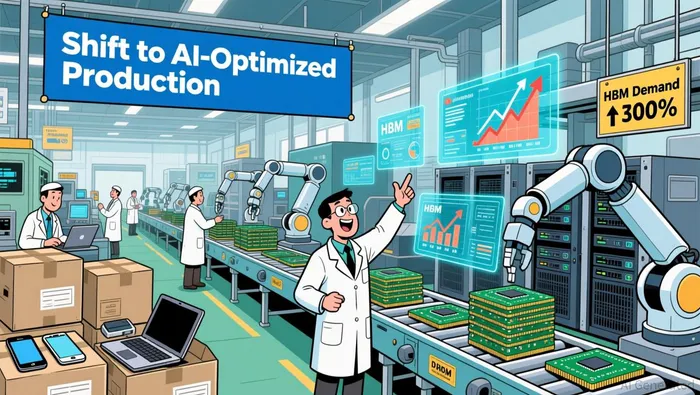
The scale of the problem is structural. For every HBM module produced, the industry loses capacity to manufacture multiple consumer DDR5 modules. That's why budget laptops that once shipped with 16GB of RAM are now being redesigned with as little as 4GB according to reports. The result is a market where memory is no longer abundant, and scarcity is reshaping the value chain.
Why Are Investors Shifting Money to 'AI-Resistant' Sectors?
As AI reshapes the software economy, investors are hedging their bets. The S&P 500 has dropped as software stocks face selling pressure, while physical goods and industrial sectors experience gains according to market analysis. This movement reflects a growing concern that AI could disrupt traditional software and digital business models, with physical industries seen as more stable and less vulnerable to rapid change.
Homebuilders, machinery producers, and consumer staples are performing well as investors seek more tangible assets according to market analysis. These industries offer predictable revenue and real-world operations, qualities that are increasingly scarce in a tech sector now dominated by high-risk, high-reward AI bets.
How Is AI Changing Product Design and Supply Chains?
The impact of AI is not limited to software. Physical industries are also being transformed by generative AI and agentic systems. For example, SAP is helping companies embed AI into supply chains to handle supplier onboarding, predictive maintenance, and disruption modeling according to SAP. These innovations are turning supply chains into strategic assets for competitive advantage, not just cost centers.
In manufacturing, AI is accelerating product design cycles and reducing R&D costs. Companies like Colgate-Palmolive are using AI to generate and test product concepts more efficiently according to Deloitte. In the aviation sector, AI is still being used to manage supply chain disruptions, but the problem is now so entrenched that it's become a "new norm" according to Reuters.
What Should Investors Watch in the Coming Months?
The key question for 2026 is how long the current AI-driven market reallocation will last. If AI infrastructure spending continues at current rates, the shortage of memory and other components will persist, creating both risk and opportunity for investors. On one hand, companies with control over critical resources—like semiconductor manufacturers or logistics providers—could see significant upside. On the other hand, AI-resistant sectors might continue to outperform as investors seek stability.
Enterprises also need to be cautious. Despite high confidence among C-suite executives, many organizations lack clear ownership and governance for AI initiatives according to a new study. This misalignment could lead to wasted investment and missed opportunities. For now, the race for AI is reshaping industries, but it's still unclear who will emerge as the true winners.

Stay ahead of the market.
Get curated U.S. market news, insights and key dates delivered to your inbox.
AInvest
PRO
AInvest
PRO



Comments
No comments yet