
AI Hardware Market Dynamics: Assessing the Competitive Threat to Nvidia's Valuation and Market Leadership


 Aime Summary
Google's Strategic Expansion: From Internal Use to Market Disruption
Google's TPUs, once confined to internal AI workloads, are now being aggressively commercialized. A pivotal development is the reported billion-dollar deal with MetaMETA--, which could see the social media giant begin renting TPUs in 2026 and transition to outright purchases by 2027. This partnership alone could capture up to 10% of Nvidia's $51 billion data center revenue in Q2 2025, translating to tens of billions in potential revenue for Google.
The strategic rationale for Google is clear: TPUs are designed as application-specific integrated circuits (ASICs) optimized for AI inference, offering 42.5 exaflops of compute per pod and a 10x performance boost over prior TPU generations. By targeting inference workloads-expected to account for 75% of AI compute demand by 2030-Google is positioning TPUs as a cost-effective and energy-efficient solution for hyperscalers like Meta. This shift is already diversifying client strategies, with Anthropic and Midjourney reporting 65% cost reductions after switching to TPUs.
Technical and Ecosystem Advantages: TPUs vs. GPUs
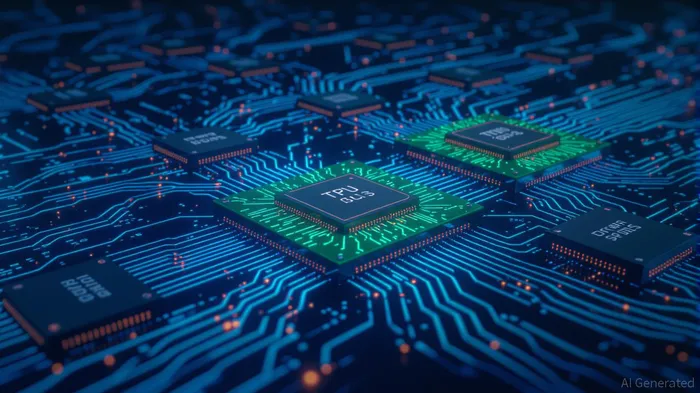
While Nvidia's Blackwell GPUs remain dominant in training large models, TPUs are gaining traction in inference-centric applications. Technically, TPUs leverage systolic array architecture to deliver superior performance per watt, making them ideal for real-time tasks like search and translation according to technical analysis. In contrast, Nvidia's GPUs, though versatile, require more power and computational resources for similar workloads according to industry benchmarks.
Ecosystem support, however, remains a key battleground. Nvidia's CUDA platform and developer tools have cemented its position as the de facto standard for AI workloads, with over 3.5 million developers locked into its ecosystem according to market data. Google's TPU ecosystem, while historically limited, is expanding through partnerships and specialized software like TensorFlow and JAX. Notably, Anthropic plans to train its Claude model on up to 1 million TPUs, signaling growing external adoption.
Financial Impact on Nvidia: Market Reactions and Valuation Shifts
The potential displacement of Nvidia's GPUs by TPUs has already triggered market volatility. Following reports of the Google-Meta deal, Nvidia's stock price fell 4%, erasing $250 billion in market value, while Alphabet shares surged toward a $4 trillion valuation. Analysts project that TPUs could redirect capital flows in the AI industry, particularly as inference workloads dominate the $255 billion market by 2030.
Nvidia has responded by emphasizing its technical superiority and ecosystem breadth, claiming its platform is the only one capable of running every AI model across all environments according to company statements. However, the growing cost efficiency of TPUs-offering 4x better cost-performance for inference tasks-poses a long-term threat to Nvidia's revenue streams. With TPUs capturing 50% of Google's internal AI training workloads in 2023, the company is demonstrating that custom ASICs can rival GPUs in even the most demanding applications.
Market Projections and Future Outlook
The AI hardware market is expected to grow from $25 billion in 2024 to $76.7 billion by 2030, with a compound annual growth rate (CAGR) of 20.5%. Within this, the ASIC segment-including TPUs and Amazon's Trainium-is projected to outpace GPU growth, driven by the need for specialized, energy-efficient solutions.
For investors, the key question is whether Nvidia's ecosystem advantages can offset the cost and performance gains of TPUs. While Nvidia's CUDA platform remains a moat, the rise of inference-centric workloads and the commoditization of training hardware may erode its market share. Google's strategy to license TPUs to smaller cloud providers further diversifies the competitive landscape, challenging Nvidia's dominance in the hyperscaler segment.
Conclusion: A Tipping Point in AI Hardware
Google's TPU expansion represents a paradigm shift in the AI hardware market, driven by technical innovation, strategic partnerships, and cost efficiency. While Nvidia retains its lead in training workloads and ecosystem breadth, the growing adoption of TPUs for inference tasks signals a structural shift in demand. For investors, the implications are clear: Nvidia's valuation and market leadership face a credible threat as the industry pivots toward specialized ASICs. The next few years will determine whether Nvidia can adapt to this new reality or cede ground to a challenger that has mastered the art of inference.

Delivering real-time insights and analysis on emerging financial trends and market movements.
Latest Articles
Stay ahead of the market.
Get curated U.S. market news, insights and key dates delivered to your inbox.
AInvest
PRO
AInvest
PRO



Comments
No comments yet