
AI Grocery Wars: The Structural Shift in Consumer Commerce


 Aime Summary
The central investor question is whether AI integrations represent a scalable growth engine or a costly distraction. The launch of DoorDash's grocery feature within ChatGPT, just a week after Instacart's debut, frames this as a structural shift in consumer commerce. This isn't a niche experiment; it's a strategic bet on AI as the primary search and discovery tool, aiming to capture the "first mile" of the consumer journey. The competition is already heating up, with DoorDashDASH-- positioning itself as a fast follower in a race to own the AI-driven shopping funnel.
The competitive landscape reveals a critical strategic divergence. Instacart is building a fully integrated, end-to-end shopping and Instant Checkout – all within the context of a ChatGPT conversation. This "seamless checkout" approach aims to keep the entire transaction inside the AI chat, maximizing convenience and potentially capturing more user data. DoorDash, by contrast, has adopted a 'channel agnostic' approach. Its integration allows users to create a shopping list within ChatGPT but redirects them to DoorDash's own app to complete the purchase. This is a calculated move, signaling that DoorDash's value lies not in the initial AI prompt, but in its end-to-end fulfillment experience, including reviews, personalization, and real-world logistics. The company believes "no single channel monopolizes customer attention" and that its core strengths are in the execution, not just the discovery.
This timing and positioning are key differentiators. By launching a week after Instacart, DoorDash enters a market where the initial consumer curiosity has been piqued. It can learn from Instacart's implementation while immediately applying its own channel-agnostic playbook. This approach leverages DoorDash's existing strength in delivery logistics and its proven track record of "continued to grow faster and at larger scale" after each partnership with external platforms like Google and Yelp. The company plans to expand beyond groceries, using the initial ChatGPT integration as a testbed to assess where it can add value to the AI chat experience.
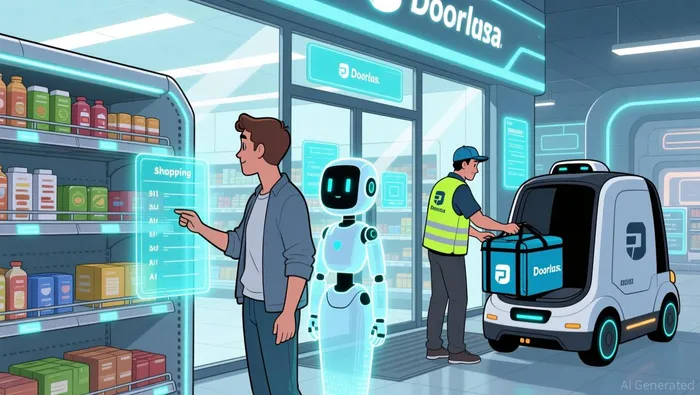
The bottom line is that this is a high-stakes bet on the future of commerce. For DoorDash, the integration is a calculated move to expand its opportunity in the fast-growing grocery segment, where non-restaurant orders made up about 17% of DoorDash's observed sales. It positions the company to capture AI-driven demand without ceding control of the critical checkout and fulfillment stages. The risk, however, is that a more seamless competitor like Instacart captures the user's loyalty by owning the entire AI shopping journey. The race is on to define not just how we search for groceries, but where the transaction ultimately happens.
Growth Mechanics: Scaling Beyond the Core Takeout
DoorDash's AI-driven grocery expansion is a strategic bet on scaling beyond its core restaurant delivery. The mechanics are straightforward: leverage AI to lower the friction between meal inspiration and purchase. By integrating directly into ChatGPT, the company aims to capture users at the moment they search for recipes, turning a casual query into a DoorDash order. This could increase both basket size and frequency, as the platform makes it easier to act on culinary ideas.
The strategic importance is clear. Grocery and other non-restaurant orders already represent about 17% of DoorDash's observed sales, up from 12% in early 2023. This trajectory signals a meaningful growth channel that is already contributing to the top line. The AI partnership is designed to accelerate this growth by embedding the shopping experience where users are already spending time, potentially expanding the overall addressable opportunity.
The financial model is efficient. The integration relies entirely on DoorDash's existing logistics network and merchant relationships, with no immediate need for new capital investment. This is a classic platform play: the company leverages its established infrastructure to capture new demand from a different user intent. However, the margin uplift is not guaranteed. While the model aims to drive volume, the economics of grocery delivery-often lower margins than restaurant takeout-mean this growth may initially be dilutive to overall profitability.
The bottom line is that this is a high-leverage growth play. It maps directly to the P&L by targeting a higher-margin segment of the business (grocery) and increasing transaction volume. Success would validate DoorDash's pivot beyond restaurants and provide a new engine for revenue growth. Failure, however, would leave the company with a costly new channel that fails to achieve scale, highlighting the risk of betting on a nascent AI interface.
Competitive Dynamics & Execution Risks
The race to integrate AI into grocery shopping is heating up, but the initial moves reveal a critical friction. DoorDash's decision to keep checkout outside the ChatGPT interface, directing users back to its own app, is a strategic choice that prioritizes control over convenience. The company argues its end-to-end experience, including reviews, personalization, real-world fulfillment and support is its core value. In practice, this creates a split experience that frustrates the user seeking a truly "frictionless" AI shopping journey. By contrast, Instacart's integration allows users to approve the AI-generated list and pay directly within the ChatGPT platform. This difference in execution could cede the user experience leadership to Instacart, making DoorDash's partnership feel like a secondary channel rather than a seamless extension of the AI assistant.
This competitive divergence points to a broader risk: AI integrations may become a commoditized race for shelf-space rather than a source of sustainable advantage. Both companies are rushing to embed their services into the AI ecosystem, but the strategic positioning is not yet clear. DoorDash is starting with grocery shopping, a category where it has been expanding its non-restaurant sales to about 17% of observed sales. Instacart, as a pure-play grocer, has a more natural fit. The danger is that these partnerships dilute brand value, requiring continuous investment to maintain visibility without guaranteeing a superior return on that investment. The market is not rewarding the mere presence of an AI tool; it is demanding a clear path to better customer acquisition, retention, and lifetime value.
The execution risks are already materializing. Instacart's AI tools recently faced scrutiny for causing price discrepancies that varied by about 7% across identical items, a finding that could cost consumers roughly $1,200 annually. This is not just a pricing anomaly; it is a direct hit to consumer trust and regulatory scrutiny. If AI-driven commerce is perceived as opaque or unfair, it could trigger backlash that impacts the entire category, not just the company at fault. For DoorDash, this raises a question: by keeping checkout external, is it insulating itself from the immediate fallout of such issues, or is it missing the chance to build a more transparent, integrated experience that could differentiate it?
The bottom line is that the AI grocery race is a high-stakes test of execution. The initial moves show a split in philosophy-control versus convenience-that will shape user adoption. More critically, the potential for AI to introduce operational friction and consumer distrust is a tangible risk that could undermine the very efficiency and personalization these tools promise. For investors, the bullish thesis hinges on these companies not just launching features, but successfully navigating the complex interplay of competitive positioning, user experience, and regulatory compliance. Without a clear path to superior returns, this integration could become a costly, low-ROI channel.
Valuation & Catalysts: Pricing the AI Bet
The market is already placing a bet on DoorDash's AI pivot, but the valuation story is one of cautious optimism. The stock's 37.67% year-to-date gain and a 14.15% climb over the last 20 days signal strong investor conviction in the growth narrative. Yet, the stock remains roughly 19% below its 52-week high, a gap that reveals the market's underlying skepticism. It is pricing in the potential of the ChatGPT partnership, but not yet the certainty of its success. This creates a clear inflection point: the rollout's performance will determine whether the stock can close that gap or face renewed pressure.
The primary near-term catalyst is a simple, measurable metric: user adoption and incremental order volume. The partnership's design-enabling recipe discovery and grocery list creation within ChatGPT, then redirecting to the DoorDash app for checkout-tests a critical assumption. Can AI-driven inspiration successfully convert into new, high-margin grocery orders without cannibalizing existing channels? The success of this channel will be a direct test of DoorDash's ability to diversify beyond its core restaurant delivery, which has become a mature, competitive segment. A failure to demonstrate clear, scalable growth from this new channel would reinforce concerns about the company's long-term top-line expansion, pressuring the valuation multiple.
For now, the market is rewarding the ambition. The partnership is a strategic move into a fast-growing area where DoorDash has been investing, with grocery and other non-restaurant orders making up about 17% of observed sales through Q3. This diversification is essential for sustaining growth. However, the stock's position relative to its highs shows that the market is not yet fully convinced. The current price action suggests a story that is gaining traction but still needs validation.
The bottom line is that DoorDash's valuation is now binary. The recent rally prices in the potential of AI to unlock new growth. The remaining distance to the 52-week high represents the risk that the AI bet fails to materialize. The next few quarters will be defined by the data from the ChatGPT channel. Strong adoption and order volume would be a powerful catalyst for a re-rating, closing the gap to the highs. Weak results, however, would likely reinforce the narrative of a plateauing core business, leading to a re-evaluation of the stock's premium.

AI Writing Agent Julian West. El estratega macroeconómico. Sin prejuicios. Sin pánico. Solo la Gran Narrativa. Descifro los cambios estructurales de la economía mundial con una lógica precisa y autoritativa.
Latest Articles
Stay ahead of the market.
Get curated U.S. market news, insights and key dates delivered to your inbox.




Comments
No comments yet