
AI in General Merchandise Retail: Walmart's AI-Driven Transformation and Its Implications for Retailers and Investors


 Aime Summary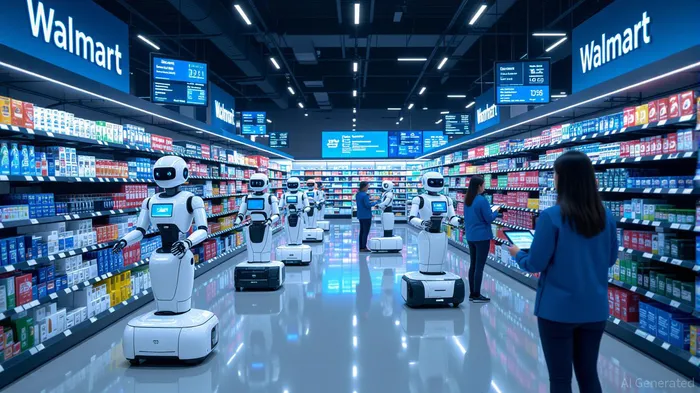
The retail landscape is undergoing a seismic shift, driven by artificial intelligence (AI) technologies that are redefining operational efficiency, customer engagement, and profitability. At the forefront of this transformation is WalmartWMT--, the world's largest retailer, which has embarked on a bold, multiyear AI strategy to reimagine its business model. For investors, the implications are clear: Walmart's strategic adoption of AI is not just a competitive advantage but a catalyst for long-term value creation in an industry historically plagued by thin margins and fragmented customer experiences.
Strategic AI Adoption: A Surgical Approach to Retail Innovation
Walmart's AI initiatives are characterized by precision and scalability. Unlike broad, speculative tech investments, the company has focused on embedding AI into specific workflows to solve real-world retail challenges. For instance, its AI-driven task management system reduces shift planning time for store managers from 90 minutes to 30 minutes, while its real-time translation tool supports 44 languages, enabling seamless communication between associates and customers. These tools are not standalone experiments but part of a cohesive ecosystem underpinned by Walmart's proprietary Element Machine Learning platform, which allows rapid deployment of AI solutions across 1.5 million associates.
The company's agentic AI framework—centered on four core agents (Sparky for customers, Marty for suppliers, an Associate Agent for employees, and a Developer Agent for systems)—represents a paradigm shift. Sparky, for example, replaces traditional keyword-based search with a multimodal shopping assistant that understands high-level customer needs. This move from transactional to task-based shopping mirrors the evolution of digital assistants like Alexa and Google Assistant, positioning Walmart to capture a larger share of the $1.2 trillion U.S. retail market.
Operational Efficiency: AI as a Cost-Cutting and Margin-Boosting Engine
Walmart's AI-driven logistics and automation efforts have delivered measurable financial gains. By 2025, the company reported $75 million in annual cost savings from AI-optimized truck routing, inventory forecasting, and supplier negotiations. These savings are amplified by the integration of RFID and AR tools like VizPick, which reduce backroom inventory management time by 50% in pilot stores.
The ROI extends to e-commerce, where Walmart's 45% automation rate for online orders (projected to reach 65% by 2026) has slashed delivery costs by 40% per order. Same-day delivery now covers 93% of U.S. households, with 5 billion units delivered in 2024 alone. This efficiency has translated into a 25% year-over-year growth in global digital sales and a 35% increase in Walmart+ memberships, which now exceed 27.3 million. The subscription model not only drives recurring revenue but also provides a trove of customer data to refine AI-driven personalization and cross-selling strategies.
Long-Term Profitability: From Cost Optimization to Revenue Diversification
Walmart's AI strategy is not solely about cutting costs—it's about unlocking new revenue streams. The company's Walmart Connect advertising platform, powered by AI-driven personalization, grew 46% globally in Q2 2025, with 31% growth in the U.S. This high-margin segment is becoming a critical differentiator, as Walmart leverages its 27.3 million Walmart+ members to offer targeted ads and dynamic pricing.
Moreover, Walmart's $520 million investment in Symbotic's AI-powered robotics—part of a broader $19 billion annual capex in the U.S.—is set to revolutionize fulfillment. By deploying 400 automated pickup and delivery systems (ADPs), the company aims to reduce delivery costs further while expanding its logistics network. This infrastructure investment is expected to yield a 26.18% year-over-year EPS increase and a 1.2–1.5 percentage point boost in operating margins by 2027.
Investor Implications: A High-Margin, Data-Driven Platform
For investors, Walmart's AI transformation presents a compelling case. The company's P/E ratio remains significantly lower than peers like AmazonAMZN--, despite outperforming in e-commerce growth and margin resilience. Analysts from Guggenheim and OppenheimerOPY-- have raised price targets, citing Walmart's transition from a cost-competitive retailer to a high-margin, data-driven platform.
Key risks include the pace of AI adoption by competitors and potential regulatory scrutiny of AI-driven pricing. However, Walmart's surgical focus on operational pain points—rather than speculative tech bets—positions it to sustain its lead. The company's $500 million AI and automation investment from 2023–2025, coupled with its $11 billion logistics spend, underscores its commitment to long-term value creation.
Conclusion: A Retail Renaissance Powered by AI
Walmart's AI-driven transformation is a masterclass in strategic innovation. By embedding AI into every layer of its operations—from supply chain to customer service—the company is not only improving efficiency but also redefining the retail experience. For investors, the rewards are twofold: near-term margin expansion and long-term competitive differentiation in a sector ripe for disruption. As AI becomes the new infrastructure of retail, Walmart's early and disciplined adoption positions it as a leader worth watching.

Stay ahead of the market.
Get curated U.S. market news, insights and key dates delivered to your inbox.


AInvest
PRO
AInvest
PRO



Comments
No comments yet