
The AI Fast-Food Revolution: Why McDonald's Tech Play Spells Profit Potential
The fast-food industry is undergoing a quiet revolution—one powered by artificial intelligence. As consumers demand speed, consistency, and personalization, companies like McDonald'sMCD-- are racing to leverage AI to cut costs, boost margins, and scale operations globally. The results? A blueprint for how technology can transform an already massive industry into a leaner, more profitable machine.
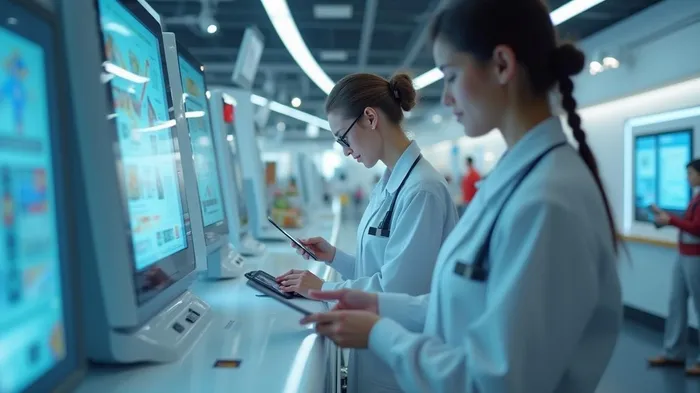
The AI Edge: How McDonald's Is Rewriting the Rules
McDonald's, the world's largest fast-food chain, has bet big on AI to address its most pressing challenges: reducing waste, optimizing labor, and maintaining consistency across 43,000 global locations. The payoff? A 81% surge in “Other Revenues” in early 2025, driven by fees from digital platforms and tech tools provided to franchisees. This category now represents a high-margin revenue stream, signaling a strategic shift toward monetizing its AI-driven operational backbone.
At the core of this transformation is edge computing, a partnership with Google Cloud that allows real-time data processing at individual restaurants. By analyzing local demand patterns, weather, and traffic, McDonald's can adjust staffing levels, ingredient orders, and even menu recommendations with pinpoint precision. For example, predictive algorithms reduce overstocking of perishables by 20%, slashing waste and procurement costs. Meanwhile, AI-powered drive-thru systems cut order errors by nearly half, improving customer satisfaction and reducing the need for costly human oversight.
The Margin Boost: Where the Money Is Made
The financial implications are clear. By automating inventory control, McDonald's has reduced food waste—a major expense in quick-service restaurants—by double-digit percentages. Labor costs are also under pressure: predictive staffing tools ensure restaurants aren't overstaffed during slow periods, while self-service kiosks and app orders minimize human error.
Analysts at Citigroup estimate these efficiencies could push McDonald's EPS to $11.00 by 2025, up from $9.50 in 2023. Meanwhile, the company's “Other Revenues” now account for $3.5 billion annually, with margins exceeding 50%—a stark contrast to the 20-30% margins on traditional burger sales.
Scaling to 50,000 Restaurants: AI as the Secret Sauce
McDonald's goal to expand its global footprint to 50,000 restaurants by 2027 hinges on AI's ability to replicate its operational excellence in new markets. By using machine learning to analyze local tastes, traffic patterns, and labor costs, the company can tailor everything from menu items to store layouts. This “plug-and-play” model slashes the risk and cost of expansion, enabling faster returns on investment in high-growth regions like China and Southeast Asia.
Navigating the Risks: Why the Bulls Still Win
Critics point to challenges: upfront AI costs, geopolitical risks (e.g., Middle East conflicts cutting into sales), and the need to maintain customer satisfaction as technology evolves. Yet McDonald's has already absorbed $300 million in restructuring costs to modernize its operations, and its $14 billion cash reserves provide a buffer against volatility.
Meanwhile, the $3.0–$3.2 billion in 2025 capital expenditures—directed toward tech and new units—underscore its commitment to long-term growth. Even in the U.S., where same-store sales dipped 3.6% in early 2025, AI-driven initiatives like personalized app promotions and faster drive-thrus are positioning McDonald's to regain market share.
The Investment Case: Buy the Future of Fast Food
Investors seeking exposure to post-pandemic recovery and tech-driven efficiency should look no further than McDonald's. Its AI investments aren't just cost-cutting tools—they're engines of scalability, customer loyalty, and new revenue streams. With a dividend yield of 2.3% and a fortress balance sheet, MCD offers both growth and stability in an uncertain economy.
The verdict? McDonald's isn't just surviving the shift to automation—it's leading it. For investors, this is a rare opportunity to bet on a company that's redefining an industry's rules. Act now: the AI fast-food revolution is here—and the smart money is already at the drive-thru.

Stay ahead of the market.
Get curated U.S. market news, insights and key dates delivered to your inbox.
AInvest
PRO
AInvest
PRO



Comments
No comments yet