
AI Ecosystems Rise: Why Vertical Integration is the New Edge in the AI Funding Boom
The AI industry is undergoing a seismic shift. As venture capital floods into startups, a clear divide is emerging: those with deep ties to infrastructure providers and quant firms are gaining an insurmountable advantage over standalone players. The $2 billion seed round secured by Thinking Machines Lab (TML) in 2025—a valuation of $12 billion—epitomizes this new reality. Backed by NVIDIANVDA-- and Jane Street, among others, TML is not just a well-funded startup but a linchpin in a vertically integrated AI ecosystem. This raises a critical question for investors: in an era of consolidation, are partnerships now more valuable than pure innovation?
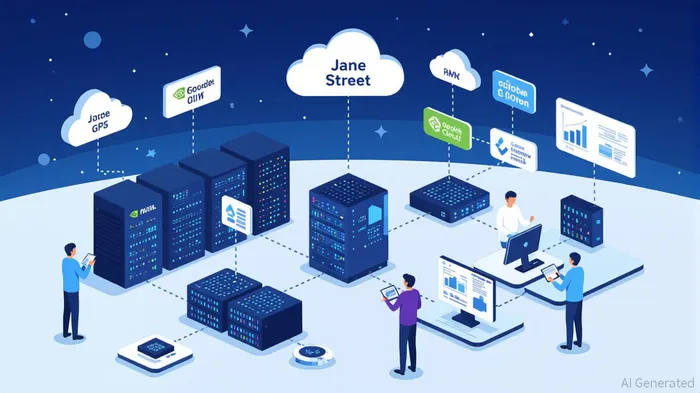
The TML Model: A Blueprint for Synergy
TML's funding round, led by Andreessen Horowitz, is notable not just for its size but for its strategic investors. NVIDIA's involvement ensures access to cutting-edge GPUs, which are essential for training large language models (LLMs). Jane Street, a quantitative trading powerhouse, brings expertise in high-performance computing (HPC) and algorithmic optimization—critical for reducing the astronomical costs of scaling AI systems. This vertical integration creates a flywheel effect: TML's multimodal AI models (designed for collaboration with humans via conversation, sight, and tasks) can leverage NVIDIA's hardware and Jane Street's computational efficiency to lower costs and accelerate innovation.
The open-source component of TML's upcoming product—targeted at researchers and startups—adds another layer. By democratizing access to tools for custom AI models, TML fosters a developer ecosystem that reinforces its ecosystem's value. This mirrors the success of open-source frameworks like TensorFlow, but with the backing of infrastructure giants. The result? A self-sustaining network where compute, data, and software are deeply interdependent.
Why Vertical Integration Wins
The AI sector is moving beyond the “idea phase.” Startups now require not just capital but infrastructure at scale. Consider the numbers: training a single advanced LLM can cost millions, and ongoing compute needs are relentless. Standalone AI companies, even those with groundbreaking algorithms, face a brutal reality: without partnerships to manage costs, they risk being outcompeted by vertically integrated rivals.
TML's model illustrates the path forward. NVIDIA's GPUs reduce compute costs; Jane Street's HPC know-how optimizes model efficiency; Google Cloud's infrastructure scales deployment. This synergy allows TML to focus on innovation rather than logistics. In contrast, standalone AI ventures—those without such ties—are forced to navigate fragmented supply chains, making them vulnerable to rising compute prices and regulatory scrutiny.
The Broader Trend: Ecosystems, Not Silos
TML's success reflects a broader industry shift. Venture capital is no longer flowing indiscriminately into “AI ideas.” Investors now prioritize ventures with built-in infrastructure access, data partnerships, and open-source scalability. The numbers back this: 64% of 2025's venture capital deals targeted AI, but only those with strategic alliances are scaling.
Consider Meta's failed attempts to acquire TML, or the Albanian government's $10 million investment—a sign of geopolitical competition for AI control. The message is clear: ecosystems, not standalone startups, are the new battlegrounds. Investors should ask: Does this startup own its compute stack? Can it scale without external partners? If not, the risks are existential.
Investment Takeaways: Bet on Ecosystems, Avoid Silos
For investors, the playbook is straightforward: prioritize ventures embedded in vertically integrated ecosystems. TML's $2B round isn't just about funding—it's about access to NVIDIA's GPUs, Jane Street's HPC, and Google's cloud. These partnerships create a moat against competitors like OpenAI and Anthropic, which lack such deep infrastructure ties.
Meanwhile, standalone AI plays—those relying solely on public cloud providers or generic algorithms—face two existential threats: rising compute costs and regulatory headwinds. The EU's AI Act and U.S. data privacy laws will penalize companies unable to demonstrate cost-effective, ethical AI. Ecosystem players, with their optimized infrastructure and open-source transparency, are better positioned to navigate this.
Risks and Considerations
Even ecosystems aren't immune to pitfalls. Execution is key: TML's upcoming product launch (expected Q3 2025) must deliver on its open-source promise. A failure to differentiate from competitors could erase its valuation. Additionally, regulatory challenges loom large; the EU's AI Act, for instance, could restrict data flows, disadvantaging firms without diversified infrastructure. Finally, tech giants like NVIDIA might prioritize their own AI ventures, creating conflicts of interest.
Conclusion: The Ecosystem Edge
The AI gold rush is over. The next era belongs to those who build ecosystems. TML's $2B raise isn't just a funding milestone—it's a blueprint for how compute, data, and software must converge to dominate. Investors should focus on ventures with these synergies, while avoiding standalone plays that lack infrastructure ties. In a consolidating industry, vertical integration isn't just an advantage—it's the only path to survival.

Delivering real-time insights and analysis on emerging financial trends and market movements.
Latest Articles
Stay ahead of the market.
Get curated U.S. market news, insights and key dates delivered to your inbox.




Comments
No comments yet