
AI-Driven Stock Selection and Sector Rotation: Harnessing Analyst Upgrades and Downgrades as Strategic Signals
 Aime Summary
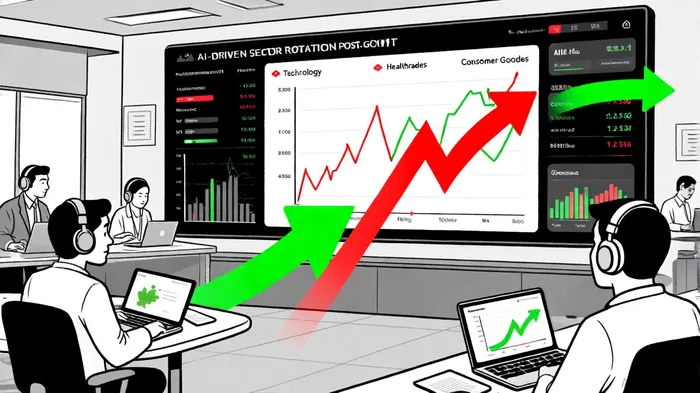
The financial markets have long relied on analyst upgrades and downgrades as barometers of institutional sentiment. Yet, recent academic research reveals that these signals are more than mere noise-they are predictive tools that, when combined with AI-driven analytics, can unlock significant alpha. From 2020 to 2025, the interplay between analyst revisions and machine learning models has reshaped investment strategies, particularly in sector rotation. This article examines how AI leverages analyst ratings to optimize stock selection and sector allocation, supported by empirical evidence and real-world case studies.
The Behavioral Finance Basis of Analyst Signals
Analyst upgrades and downgrades often reflect shifts in fundamental expectations, but their market impact is amplified by behavioral biases. A 2024 study found that stock prices exhibit delayed reactions to analyst revisions, with one- to six-month price drifts following upgrades or downgrades. For instance, if a stock experiences a downgrade after a period of strong short-term gains, the market may under-react to the negative signal, leading to prolonged downward momentum. Conversely, upgrades following weak performance tend to trigger gradual price appreciation as investors reassess valuations, the study found. This phenomenon aligns with behavioral finance theories of under-reaction, where investors take time to incorporate new information into pricing.
AI's Role in Decoding Analyst Signals
AI-driven models excel at synthesizing these behavioral patterns with macroeconomic and sectoral data. Consider I Know First's sector rotation strategy, which allocated capital across S&P 500 sectors using AI to identify the most predictable stocks. From 2020 to 2024, this approach generated a 218.03% return, far outpacing the S&P 500's 61.36%. The strategy's success hinged on monthly rebalancing and exposure to sectors like technology and healthcare, where analyst upgrades often preceded sustained growth. Similarly, Stanford's AI analyst, trained on firm size and trading volume data, outperformed 93% of mutual fund managers by an average of 600% over 30 years, according to a Stanford report. These models do not merely react to analyst ratings; they contextualize them within broader trends, such as AI adoption in industries like semiconductors or biotech, as explained in mezzi's guide.
Case Studies: AI and Analyst Ratings in Action
The integration of AI and analyst signals is evident in recent sector-specific movements. For example, Truist's upgrade of AMD to "Buy" in 2025, citing AI-driven hyperscale partnerships, coincided with a 40% surge in the stock's price over three months, according to a Techgolly article. Conversely, UBS's downgrade of Marvell Technology, due to concerns over AI growth, preceded a 15% decline in its valuation, as reported in the Techgolly article. AI models like the AnalySta paper, which combine LSTM networks and sentiment analysis, have further refined these signals by processing real-time news and earnings calls to predict sector rotations. Such systems also incorporate explainable AI (XAI) techniques, such as SHAP values, to ensure transparency in decision-making; the AnalySta paper details these approaches.
Performance Metrics and Challenges
Quantifying the efficacy of AI-driven strategies requires rigorous metrics. Classification models evaluating sector rotation accuracy use precision, recall, and F1 scores, while regression models rely on RMSE and MAE to assess prediction errors, as outlined in an AI performance guide. For instance, NikitaPatil7's project achieved a Sharpe Ratio of 1.86 by dynamically reallocating assets using LSTM and reinforcement learning. However, challenges persist. Data quality issues, such as incomplete analyst coverage for emerging AI firms, and ethical concerns around algorithmic bias remain unresolved, as highlighted in the Mercer survey. Moreover, while AI excels at pattern recognition, human oversight is critical for interpreting qualitative factors like management quality or geopolitical risks, argued in a CFA Institute blog post.
The Future of AI-Driven Sector Rotation
As AI models evolve, their ability to integrate analyst signals will likely improve. Hybrid frameworks combining large language models (LLMs) with traditional machine learning—such as the entropy-based approach in a 2025 study—have already demonstrated cumulative returns of 701%. These systems leverage semantic intelligence to parse unstructured data, such as earnings transcripts, while ML algorithms optimize for risk-adjusted returns. Yet, regulatory scrutiny and the need for standardized evaluation frameworks, as proposed by Microsoft's ADeLe model, will shape the next phase of AI adoption in finance.
Conclusion
The fusion of AI and analyst ratings represents a paradigm shift in investment strategy. By decoding behavioral biases, automating sector rotation, and generating alpha through data-driven insights, AI models have proven their mettle against traditional methods. However, their success hinges on addressing data limitations, ethical dilemmas, and the irreplaceable role of human judgment. For investors, the lesson is clear: in an era of rapid technological change, those who harness AI's analytical power while remaining grounded in fundamental analysis will navigate market cycles with unprecedented agility.

Senior Research Analyst at Ainvest, formerly with Tiger Brokers for two years. Over 10 years of U.S. stock trading experience and 8 years in Futures and Forex. Graduate of University of South Wales.
Latest Articles
Stay ahead of the market.
Get curated U.S. market news, insights and key dates delivered to your inbox.


AInvest
PRO
AInvest
PRO



Comments
No comments yet