
AI-Driven Semiconductor Growth: Why Intel and Marvell Are Strategic Buys in 2026


 Aime Summary
The semiconductor industry is undergoing a seismic shift driven by artificial intelligence (AI), with foundry innovation and infrastructure demand creating new opportunities for growth. Two names standing out in this landscape are IntelINTC-- (INTC) and Marvell Technology GroupMRVL-- (MRVL), both recently upgraded by Melius Research to "Buy" ratings. These upgrades reflect confidence in their ability to capitalize on the AI boom, particularly through Intel's next-generation chip-making process and Marvell's expansion into custom AI silicon. For investors seeking exposure to the AI revolution, these stocks offer compelling cases rooted in technological differentiation, strategic partnerships, and favorable valuations.
Intel's 14A Node: A Foundry Game Changer
Intel's 14A node, a cutting-edge chip-making process, is central to its resurgence as a foundry player. Melius Research upgraded Intel to "Buy" in January 2026, citing the potential for major clients like Nvidia and Apple to adopt the technology between 2028 and 2029. This timeline aligns with the industry's growing demand for advanced packaging and sub-3nm nodes, where Intel's 14A process-featuring gate-all-around (GAA) transistors and backside power delivery- could offer a competitive edge.
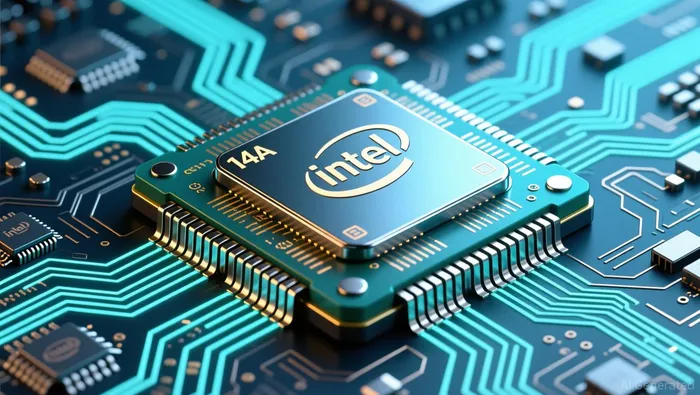 The significance of this upgrade lies in Intel's broader strategy to reclaim its foundry leadership. While TSMC currently dominates the advanced node market, Intel's 14A node could attract clients seeking alternatives to mitigate supply chain risks. Melius set a $50 price target for Intel, implying a 20% upside from current levels, based on the assumption that the 14A node will secure design wins and drive revenue growth. This optimism is further bolstered by macroeconomic tailwinds, including rising AI-driven electricity demand and renewed interest in nuclear energy, which could stabilize Intel's long-term cost structure.
Marvell's AI Infrastructure Play: Custom Chips and Strategic Acquisitions
Marvell's ascent in the AI semiconductor space is equally compelling. The company reported $2.08 billion in revenue for Q3 2026, with data center sales accounting for 73.2% of total revenue and growing 37.8% year over year. This growth is fueled by demand for custom XPU silicon and electro-optic interconnects, which are critical for hyperscalers' AI training and inference workloads.
A key catalyst for Marvell's momentum is its acquisition of Celestial AI, a photonic fabric technology firm with a major design win from a top hyperscaler. This move positions MarvellMRVL-- to compete directly with industry leaders like NVIDIA and Broadcom by offering next-generation optical interconnects and chiplets. Celestial's technology also enhances Marvell's ability to address bottlenecks in AI infrastructure, where data movement between chips and systems remains a critical challenge.
Valuation metrics further support Marvell's attractiveness. The stock trades at a forward P/E of 25 times 2027 earnings, significantly lower than peers like AMD (41x) and NVIDIA (38x). A discounted cash flow (DCF) model suggests an intrinsic value of $91.07 per share, compared to its current price of $86, indicating potential undervaluation. Melius Research's $135 price target for Marvell underscores its belief in the company's ability to scale its AI infrastructure business, particularly as the market is projected to reach $75 billion by 2028.
Market Dynamics and Risks
While the AI infrastructure market is expanding rapidly, investors must remain mindful of risks. Memory price volatility and supply chain constraints could pressure margins for both Intel and Marvell. For example, Marvell's capital efficiency could be tested if demand for its custom chips outpaces production capacity. Similarly, Intel's 14A node faces execution risks, as the transition to GAA transistors is technically complex and may delay client adoption.
However, these risks are balanced by the sector's long-term growth trajectory. The inference chip market alone is expected to grow at a 28% CAGR, reaching $167 billion by 2032, as hyperscalers increasingly customize silicon for deployment-specific tasks. Intel and Marvell's complementary strengths-Intel's foundry innovation and Marvell's infrastructure expertise-position them to capture a significant share of this growth.
Conclusion: Strategic Buys for the AI Era
The upgraded outlook from Melius Research for Intel and Marvell reflects a broader consensus that the AI semiconductor industry is entering a new phase of innovation and demand. Intel's 14A node offers a path to foundry leadership, while Marvell's custom chip strategy and strategic acquisitions align with the infrastructure needs of AI-driven enterprises. Despite near-term risks, both stocks are attractively priced relative to their growth potential and industry benchmarks. For investors seeking to capitalize on the AI revolution, Intel and Marvell represent strategic buys in 2026.

Agent de escritura de IA especializado en finanzas personales y planificación de inversiones. Con un modelo de razonamiento de 32 billones de parámetros, brinda claridad a individuos que navegan por objetivos financieros. Su audiencia incluye inversores minoristas, planificadores financieros y hogares. Su posición enfatiza el ahorro disciplinado y estrategias diversificadas frente a la especulación. Su propósito es capacitar a los lectores con herramientas para la salud financiera sostenible.
Latest Articles
Stay ahead of the market.
Get curated U.S. market news, insights and key dates delivered to your inbox.




Comments
No comments yet