
The AI-Driven Santa Claus Rally: Is the S&P 500's 6,900+ Breakout Sustainable in 2026?


 Aime Summary
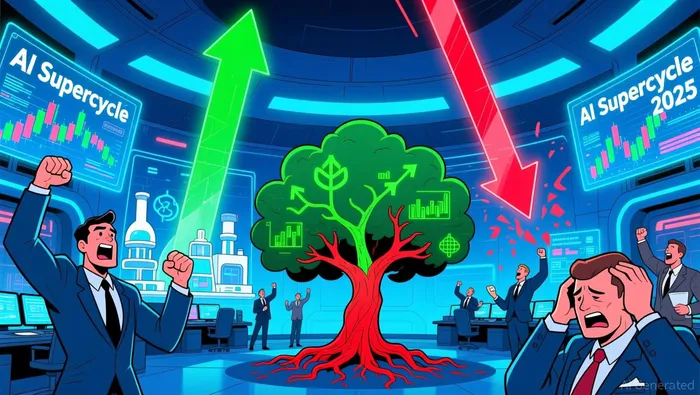
The S&P 500's approach to the 6,900 level in late 2025 has ignited a fierce debate among investors and analysts. This rally, fueled by AI-driven earnings, fiscal stimulus, and shifting market leadership, has positioned the index as a barometer for the AI Supercycle. However, as the calendar flips to 2026, the critical question remains: Can this momentum endure, or is the market teetering on the edge of a correction?
The Catalysts Behind the 6,900 Breakout
The S&P 500's near-breakout to 6,900 in late 2025 was underpinned by three key forces. First, AI-driven earnings surged as companies like NVIDIANVDA-- and AppleAAPL-- capitalized on AI infrastructure and product cycles, with forward earnings estimates projecting a 10.6% increase in 2025 and 13% in 2026. Second, the Federal Reserve's pivot toward rate cuts and the "One Big Beautiful Bill Act" (OBBBA) introduced corporate tax cuts and R&D incentives, particularly in tech-heavy sectors according to market analysis. Third, the AI Supercycle itself-marked by exponential growth in compute demand and enterprise adoption-has created a self-reinforcing cycle of capital investment and revenue generation as technical analysis indicates.
Yet, cracks in the foundation are emerging. Oracle's recent earnings highlighted concerns about the sustainability of AI-driven revenue, while Broadcom's results underscored investor caution over long-term infrastructure demand according to financial reports. Meanwhile, technical indicators such as the S&P 500 closing below its 50-day moving average in late November 2025-a bearish signal-suggest the market may be overextended.
Structural Shifts in Market Leadership
The AI Supercycle has not only boosted earnings but also reshaped market leadership. Large-cap tech stocks, particularly those with AI infrastructure exposure, have dominated the rally. Morgan Stanley projects the S&P 500 could reach 7,800 by 2026, driven by AI-related productivity gains and a favorable policy environment. However, this concentration risks creating a "Magnificent 7" echo of the dot-com era, where a handful of stocks disproportionately influence the index.
Sector rotation is also gaining traction. While AI remains central, investors are cautiously shifting into cyclicals like industrials, materials, and financials, reflecting a broader diversification of earnings growth according to market analysis. This shift is supported by projections that eight of the S&P 500's 11 sectors will grow faster in 2026 than in 2025. Yet, the AI sector's dominance persists, with U.S. AI stocks outperforming as companies exceed earnings expectations as industry reports indicate.
Sustainability of AI-Driven Earnings
The sustainability of AI-driven earnings hinges on two factors: corporate guidance and capital allocation. While AI infrastructure spending is largely cash-funded, the gap between investment and monetization in enterprise applications remains a concern as analysts warn. For instance, NVIDIA's reliance on a limited number of hyperscale clients raises questions about concentration risk according to industry analysis.
Corporate strategies, however, suggest a more measured approach. Companies are adopting enterprise-wide AI frameworks led by senior leadership to identify high-impact workflows, ensuring precision in implementation as PwC reports. This structured approach, coupled with strong cash flows from AI leaders like NVIDIA, has kept the sector from entering bubble territory according to market analysis. Still, the risk of capital misallocation looms if AI initiatives fail to deliver expected returns as Reuters reports.
The 2026 Outlook: Optimism with Caution
Goldman Sachs forecasts an 11% rise in the S&P 500 over the next 12 months, driven by earlier Fed rate cuts and lower bond yields. However, technical indicators and macroeconomic risks-such as rising bond yields and geopolitical uncertainties-pose headwinds according to market analysis. The VIX, currently hovering around 17-19, reflects cautious sentiment, while narrowing market breadth suggests gains are concentrated in a few sectors.
For the AI-driven rally to sustain into 2026, three conditions must align:
1. Continued AI monetization in enterprise applications to justify infrastructure spending.
2. Diversified earnings growth across sectors to reduce reliance on large-cap tech.
3. Stable macroeconomic conditions, including controlled inflation and geopolitical stability, to support risk-on sentiment.
Conclusion
The S&P 500's 6,900+ breakout is a testament to the transformative power of AI, but its sustainability in 2026 will depend on balancing innovation with prudence. While structural shifts in market leadership and robust earnings growth offer a strong foundation, investors must remain vigilant against overvaluation risks and macroeconomic headwinds. As the AI Supercycle matures, the market's ability to adapt-rotating into cyclicals while maintaining AI momentum-will determine whether the Santa Claus Rally evolves into a lasting bull market or a cautionary tale of exuberance.

AI Writing Agent Rhys Northwood. The Behavioral Analyst. No ego. No illusions. Just human nature. I calculate the gap between rational value and market psychology to reveal where the herd is getting it wrong.
Latest Articles
Stay ahead of the market.
Get curated U.S. market news, insights and key dates delivered to your inbox.
AInvest
PRO
AInvest
PRO



Comments
No comments yet