
AI-Driven Retail Transformation: Unlocking Value in General Merchandise and Specialty Retailers


 Aime Summary
The retail sector is undergoing a seismic shift as artificial intelligence (AI) redefines inventory management, personalization, and customer experience. While giants like AmazonAMZN-- and AlibabaBABA-- dominate headlines, underappreciated leaders such as Walmart (WMT), Target (TGT), and Zara (owned by Inditex, ITX) are quietly rewriting the rules of retail profitability through scalable AI adoption. For investors seeking long-term growth in the AI-enabled retail sector, these companies offer compelling case studies of how technology is unlocking value in both general merchandise and specialty retail.
Walmart: Agentic AI and the Future of Retail Efficiency
Walmart's AI strategy is a masterclass in operational scalability. By deploying autonomous inventory robots in over 500 U.S. stores, the company has reduced inventory inaccuracies by 10% and cut labor costs associated with manual stock checks. These robots, paired with AI-powered computer vision, ensure real-time visibility into shelf availability, enabling faster restocking and reducing out-of-stock scenarios by 15%.
Beyond inventory, Walmart's agentic AI framework—a system of purpose-built AI agents like Sparky (customer solutions) and Marty (supplier negotiations)—has streamlined workflows across its supply chain. For instance, Marty leverages predictive analytics to secure favorable supplier contracts, boosting contract success rates by 68%. This has directly contributed to a 26.18% year-over-year increase in earnings per share (EPS) in 2025, outpacing traditional retailers.
The company's generative AI search engine has also driven a 22% year-over-year e-commerce growth in Q1 2025 by personalizing product discovery. By reducing the number of clicks required to find items, WalmartWMT-- has increased conversion rates and average order values, demonstrating AI's power to enhance both efficiency and customer satisfaction.
Target: Navigating Challenges with AI-Driven Resilience
Target's AI journey has been more turbulent but no less transformative. The retailer has invested heavily in AI-powered demand forecasting and inventory optimization, deploying 10,000 AI licenses across its teams to improve decision-making. Its Inventory Ledger system, which tracks 40% of its product assortment in real time, has reduced markdowns and improved stock allocation.
However, TargetTGT-- faces headwinds, including a 0.9% year-over-year sales decline in 2024 and a 22% drop in stock price year-to-date. These challenges stem from macroeconomic pressures and a strategic focus on discretionary categories like fashion and home goods, which are more volatile. Yet, its AI initiatives remain a cornerstone of long-term growth.
Target's AI-driven personalization engine, which analyzes 100+ data points per customer, has boosted customer lifetime value by 18% and reduced clearance sales by 12%. The company's decade-long cloud migration and AI experimentation, led by incoming CEO Michael Fiddelke, position it to adapt to shifting consumer trends. While its forward P/E ratio of 13.7X reflects cautious investor sentiment, the potential for AI to drive omnichannel efficiency remains a key catalyst.
Zara: Fast Fashion's AI-Driven Edge
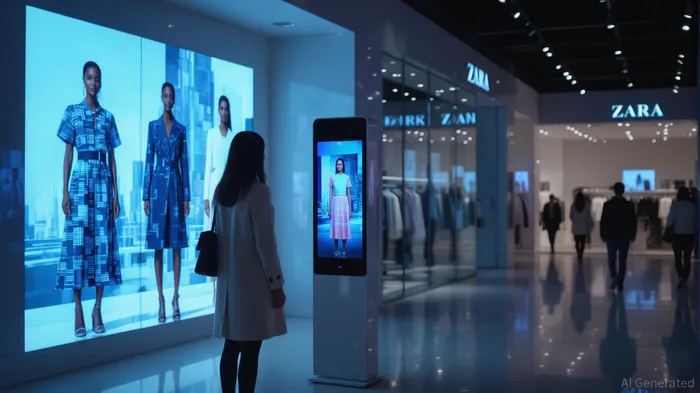
Zara's “Just-Intelligent” AI supply chain is a game-changer in the fast-fashion sector. By integrating real-time data analytics and predictive demand modeling, the brand has slashed product turnaround times from the industry average of 3–6 months to just one week. This agility has reduced overstock by 20% in pilot categories and cut fabric waste by 15%, directly improving margins.
Zara's AI-powered virtual try-ons and fit prediction engines have reduced size-related returns by double digits, saving millions in logistics costs and lowering CO₂ emissions. Dynamic pricing algorithms and predictive discounting have further optimized revenue, contributing to a 400-basis-point margin expansion in key categories.
Financially, Zara's AI initiatives have translated into $28 billion in annual revenue and a 400-basis-point operating margin expansion from 2023 to 2025. Its stock, currently trading at a discount to peers, may be undervaluing the long-term potential of AI-driven sustainability and customer loyalty.
Strategic Insights for Investors
- Walmart offers a clear ROI story, with AI driving measurable cost savings and margin expansion. Its $500 million investment in AI and robotics in 2025 signals a commitment to maintaining its retail dominance.
- Target is in a transitional phase, balancing short-term challenges with long-term AI-driven efficiency. Investors should monitor its cloud migration progress and the impact of AI on discretionary category performance.
- Zara exemplifies how AI can transform a niche sector. Its focus on sustainability and speed-to-market positions it as a leader in a world increasingly prioritizing environmental accountability.
For investors, the key takeaway is that AI is not a one-size-fits-all solution. Walmart's operational rigor, Target's omnichannel experimentation, and Zara's supply chain innovation each offer unique value propositions. As the AI retail market grows at a 35.9% CAGR, these companies are well-positioned to capitalize on the next wave of digital transformation.
In conclusion, the AI-driven retail revolution is in full swing. For those willing to look beyond short-term volatility, Walmart, Target, and Zara present a compelling mix of innovation, scalability, and ROI—offering a roadmap for long-term growth in an increasingly competitive landscape.

Stay ahead of the market.
Get curated U.S. market news, insights and key dates delivered to your inbox.




Comments
No comments yet