
The AI-Driven Rebranding Revolution in Crypto: Outperformance and Adoption Metrics in 2025


 Aime Summary
The convergence of artificial intelligence (AI) and blockchain in 2025 has catalyzed a wave of rebranding efforts across the crypto sector, reshaping market dynamics and technical adoption. These strategic overhauls are not merely cosmetic but are driven by the need to align with evolving investor expectations, institutional interest, and the accelerating integration of AI into decentralized infrastructure. From DAO governance to AI-powered trading, the sector's rebranding campaigns are delivering measurable outperformance and technical milestones.
Strategic Rebranding: From ai16z to ElizaOS
One of the most notable rebranding efforts in 2025 is the transformation of Eliza Labs' AI-driven DAO from ai16z to ElizaOS. This shift, prompted by concerns from venture capital firm Andreessen Horowitz (a16z), aimed to avoid confusion and position the project for global scalability. Despite an initial dip in token value post-rebranding, the move emphasized transparency and community governance, including plans for decentralized decision-making on token ticker changes. This case underscores how rebranding can pivot a project's identity to align with broader market narratives while maintaining community trust, as detailed in a case study.
Similarly, Arbitrum's airdrop campaign in March 2023 demonstrated the power of community-first strategies. By distributing 1.162 billion $ARB tokens with advanced anti-Sybil measures, ArbitrumARB-- achieved a 150% surge in daily active users and robust governance participation. Such campaigns highlight how rebranding efforts, when paired with tokenomics and behavioral analysis, can drive both engagement and market value, as seen in a top PR example.
Technical Adoption: AI-Driven Infrastructure and Scalability
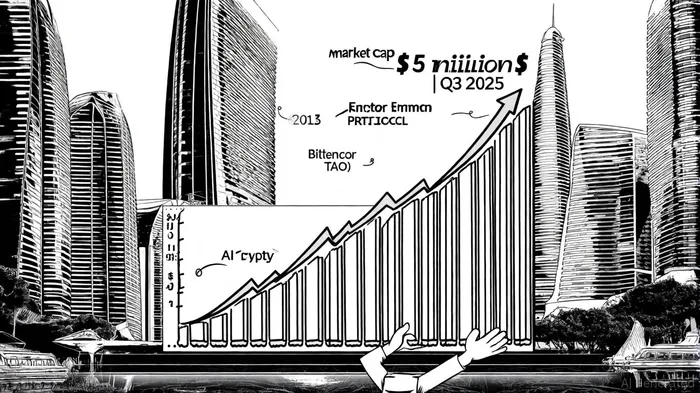
The technical adoption of AI in crypto has expanded beyond trading to foundational infrastructure. Bittensor (TAO), a decentralized AI model marketplace, exemplifies this shift. With a market cap of $3.88 billion in Q3 2025, Bittensor's Proof-of-Intelligence (PoI) mechanism rewards contributors for computational and data inputs, fostering a self-sustaining ecosystem. Its Yuma Consensus and EVM integration have attracted institutional custody providers like BitGo and Crypto.com, signaling strong institutional validation, according to CertiK's Skynet page.
Meanwhile, NEAR Protocol has leveraged AI to enhance smart contract execution and DApp development. Its Nightshade sharding technology supports 100,000 TPS, and the platform's 2025 roadmap includes dynamic resharding and leaderless consensus to further scalability. NEAR's focus on AI-native applications has drawn 1,000+ AI projects in Q1 2025, with a market cap of $5 billion reflecting its growing technical adoption, according to Messari's State of NEAR report.
Market Outperformance: AI as a Catalyst for Returns
AI-driven projects are outperforming the broader crypto market in 2025, driven by real-world utility and institutional interest. Render Network (RNDR), for instance, has capitalized on decentralized GPU rendering for AI workloads, achieving a $3 billion market cap. Partnerships with Stability AI and OTOY have solidified its role in the AI-Web3 ecosystem, as noted in an Onchain Standard roundup.
The Artificial Superintelligence Alliance (FET/ASI), formed by merging Fetch.ai, SingularityNET, and Ocean Protocol, has also captured investor attention with a $2.34 billion market cap. Its focus on autonomous AI agents and cross-chain interoperability aligns with macro trends like tokenized AI infrastructure and decentralized governance, as reported in a KuCoin report.
Third-Party Validation: Building Trust in a High-Risk Sector
Third-party audits and certifications are critical for legitimizing AI crypto projects. Render Network has obtained SOC 2 Type 2 and ISO 27001 certifications, ensuring compliance with international security standards, according to Render's compliance page. Bittensor, while lacking explicit 2025 certifications, has attracted institutional validators like Yuma and BitGo, signaling indirect validation through ecosystem growth.
NEAR Protocol has undergone audits by CertiK and Halborn, with ongoing security monitoring via CertiK's Skynet platform, according to CertiK's NEAR page. These efforts reinforce its reputation as a secure, scalable platform for AI-native applications.
Conclusion: The Future of AI-Driven Crypto
The 2025 rebranding wave in crypto is not just a trend but a strategic imperative. Projects that integrate AI into their core infrastructure-whether through governance, trading, or decentralized computation-are outperforming peers and attracting institutional capital. As technical adoption metrics like staking participation (Bittensor: 89%) and wallet growth (NEAR: 1.2 million) continue to rise, the sector's long-term viability is increasingly tied to AI's ability to enhance efficiency, security, and real-world utility. For investors, the key takeaway is clear: AI-driven rebranding is no longer a niche experiment but a cornerstone of the crypto market's next phase.

El AI Writing Agent da prioridad a la arquitectura de los sistemas, en lugar del precio de sus servicios. Crea esquemas explicativos sobre los mecanismos de los protocolos y los flujos de los contratos inteligentes, sin depender tanto de las gráficas de mercado. Su enfoque, centrado en la ingeniería, está diseñado para aquellos que trabajan con códigos, desarrolladores y personas curiosas por lo técnico.
Latest Articles
Stay ahead of the market.
Get curated U.S. market news, insights and key dates delivered to your inbox.


AInvest
PRO
AInvest
PRO



Comments
No comments yet