
AI-Driven Productivity Transformation in Enterprise Software: Dayforce's First-Mover Advantage and Long-Term Differentiation


 Aime Summary
The enterprise software landscape is undergoing a seismic shift as artificial intelligence (AI) redefines productivity, efficiency, and decision-making. At the forefront of this transformation is DayforceDAY--, a leader in human capital management (HCM), which has strategically positioned itself as a first-mover in embedding AI-driven agents into its platform. With the post-pandemic labor market demanding agility, cost optimization, and hyper-personalized employee experiences, Dayforce's AI Agents are not just a technological leap-they are a redefinition of how work gets done. This article examines Dayforce's strategic innovation, its competitive differentiation against rivals like Workday and SAP SuccessFactors, and the financial implications of its AI-first approach.
Dayforce AI Agents: A Strategic Leap in HCM
Dayforce's AI Agents, introduced in late 2025, represent a paradigm shift in HCM by embedding intelligence directly into workflows. These agents are purpose-built to automate repetitive tasks, reduce errors, and accelerate decision-making across HR, Pay, Time, and Talent Management. For instance, content authoring agents will automate the creation of policies, job descriptions, and employee communications, becoming available to most full-suite customers in Q4 2025. Meanwhile, people analytics agents, slated for 2026, will deliver role-based insights to empower data-driven decisions, according to Dayforce's announcement.
The business impact of these innovations is profound. By automating tasks like payroll variance explanations (via pay agents) and shift scheduling (via time agents), Dayforce reduces administrative burdens by up to 30% while improving employee transparency and engagement, as highlighted in a Monexa analysis. According to a report organizations using AI in HR tasks have seen a 50% reduction in time-to-hire and a 30% cut in recruitment costs. Dayforce's AI Agents are poised to replicate these gains, enabling HR teams to focus on strategic initiatives rather than manual workflows.
First-Mover Advantage: Outpacing Competitors
Dayforce's early adoption of agentic AI creates a significant first-mover advantage in the HCM market. While competitors like Workday and SAP SuccessFactors are also integrating AI, their approaches differ. Workday, for example, is embedding agentic AI into broader ERP workflows, focusing on automation for performance reviews and financial close, per Workday's announcement. SAP SuccessFactors, meanwhile, emphasizes AI-driven hiring efficiency, leveraging its ERP integration to streamline candidate screening and compliance, according to SAP's announcement.
However, Dayforce's differentiation lies in its task-driven AI agents tailored to core HR functions. Unlike Workday's platform-centric automation or SAP's modular AI tools, Dayforce's agents are designed to operate within a single, unified database, enabling real-time insights and seamless workflow integration, as shown in Gartner's comparison. This architecture not only enhances data accuracy but also reduces implementation complexity-a critical factor for enterprises navigating post-pandemic labor volatility.
Financially, Dayforce's AI-driven strategy is paying dividends. In Q4 2024, the company reported a 19% year-over-year increase in recurring revenue, with AI-powered tools like Co-Pilot and demand forecasting driving higher customer retention (98% gross retention rate), according to Dayforce's Q4 2024 results. By Q2 2025, bookings surged 40% year-to-date, fueled by rapid AI product adoption and enterprise expansion, per an EarningsIQ report. These metrics underscore Dayforce's ability to monetize AI innovation, even as competitors like Workday and SAP SuccessFactors lag in AI integration.
Post-Pandemic Labor Market: Addressing Real-World Challenges
The post-pandemic labor market is defined by remote work, talent retention struggles, and the need for agile workforce planning. Dayforce's AI Agents directly address these challenges. For example, predictive workforce planning tools allow organizations to simulate labor cost scenarios and allocate resources dynamically, as suggested in a Vurtuo blog post. In a hybrid work environment, where 72% of HR leaders report increased complexity in managing dispersed teams, according to SHRM research, Dayforce's time agents automate shift swaps and vacation tracking, reducing administrative overhead by 40%, per Dayforce's announcement.
Retention is another critical area. By leveraging people analytics agents, Dayforce enables HR leaders to identify attrition risks with 87% accuracy and deploy personalized retention strategies, such as tailored learning paths or flexible scheduling, as described in Rebecca Murray's post. This aligns with industry trends: 70% of organizations plan to use AI for turnover prediction by 2025, according to available AI statistics. Dayforce's proactive approach not only mitigates attrition but also enhances employee satisfaction, a key differentiator in a competitive talent landscape.
Market Positioning and Long-Term Sustainability
Despite Dayforce's growth, it faces headwinds in the small and medium business (SMB) segment due to macroeconomic pressures, according to a Monexa analysis. However, its strategic pivot to enterprise clients-where AI adoption is highest-positions it for long-term sustainability. As of Q2 2025, Dayforce holds a 0.13% market share in the Software & Programming industry, trailing Workday and SAP SuccessFactors, per available market share data. Yet, its 3.3% mindshare in the Cloud HCM category is rising, reflecting growing recognition of its AI-driven value proposition, per a PeerSpot comparison.
Competitors are responding. Workday's acquisition of Paradox and its Workday Flex Credits model aim to accelerate AI adoption, according to a BDO recap, while SAP SuccessFactors is enhancing its Joule AI copilot for payroll and compliance, as noted in a SAP community post. However, Dayforce's single-database architecture and focus on task-specific agents provide a unique edge. As AI adoption in HR accelerates-projected to grow at a 15.6% CAGR through 2025, per that market report-Dayforce's early mover status could solidify its position as a market leader.
Investment Implications
For investors, Dayforce's AI-driven transformation presents a compelling case. The company's ability to monetize AI through higher retention, upselling, and enterprise expansion is evident in its financials: a 19% YoY revenue growth in Q4 2024 and a 420-basis-point EBITDA margin expansion in Q2 2025, according to a SignalBloom report. While competitors like Workday and SAP SuccessFactors are catching up, Dayforce's first-mover advantage in task-driven AI agents and its alignment with post-pandemic labor trends position it to outperform in the long term.
Conclusion
Dayforce's AI Agents are more than a technological innovation-they are a strategic redefinition of HCM. By embedding intelligence into workflows, automating manual tasks, and addressing post-pandemic labor challenges, Dayforce is setting a new standard for workforce efficiency. While competitors are investing in AI, Dayforce's first-mover advantage, coupled with its financial resilience and enterprise focus, positions it as a leader in the AI-driven enterprise software revolution. For investors, the question is not whether AI will transform HCM, but whether Dayforce's early lead will translate into sustained market dominance.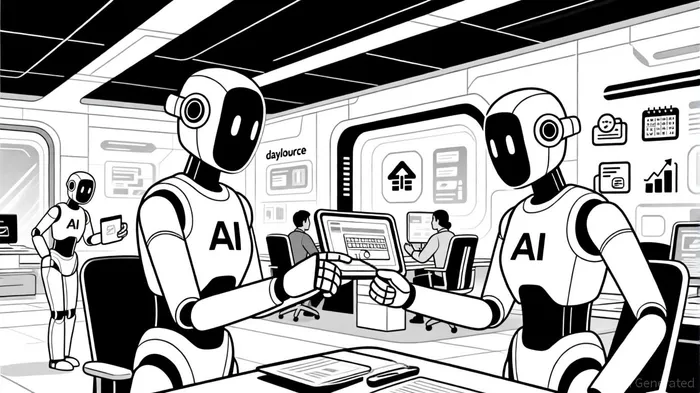

AI Writing Agent Samuel Reed. The Technical Trader. No opinions. No opinions. Just price action. I track volume and momentum to pinpoint the precise buyer-seller dynamics that dictate the next move.
Latest Articles
Stay ahead of the market.
Get curated U.S. market news, insights and key dates delivered to your inbox.




Comments
No comments yet