
AI-Driven Operational Transformation in Insurance: Strategic Adoption of Agentic AI and IDP for Competitive Edge


 Aime Summary
The insurance sector is undergoing a profound operational transformation driven by agentic AI and intelligent document processing (IDP). These technologies are not merely incremental improvements but foundational shifts in how insurers manage risk, serve customers, and compete in a digital-first economy. As the industry grapples with rising customer expectations, regulatory complexity, and margin pressures, strategic adoption of AI-driven tools has become a necessity rather than an option.
Agentic AI: From Automation to Autonomous Decision-Making
Agentic AI, characterized by its ability to act autonomously and adaptively, is redefining core insurance processes. By 2025, AI-powered chatbots are projected to handle 30–40% of customer queries, slashing response times and reducing operational costs, according to a Kellton report. Beyond customer service, agentic AI is revolutionizing fraud detection, with leading insurers reporting a 30% improvement in identifying suspicious claims, according to that report. For instance, Allianz's "Incognito" system detected a 29% increase in motor and home insurance fraud, directly mitigating losses, according to CDP Center case studies.
The integration of agentic AI into multiagent systems further amplifies its impact. Virtual agents now collaborate to streamline customer onboarding, risk profiling, and underwriting. One insurer uses AI models trained on company-specific language to draft claims-related communications, boosting productivity by over 30% while maintaining brand consistency, according to a BCG report. These systems act as "virtual coworkers," automating repetitive tasks and enabling human employees to focus on high-value activities.
However, adoption is not without hurdles. Legacy systems, which dominate many insurers' infrastructures, pose significant integration challenges, as highlighted in the CDP Center analysis. Additionally, the probabilistic nature of AI conflicts with the traditionally deterministic culture of insurance, necessitating organizational and cultural shifts noted in the BCG report.
Intelligent Document Processing: Unlocking Efficiency in a Paper-Heavy Industry
IDP is another cornerstone of AI-driven transformation, particularly in document-intensive workflows. By automating the extraction and validation of data from unstructured documents-such as claims forms, medical reports, and handwritten amendments-IDP reduces manual effort by up to 80% and cuts error rates by 90%, according to a Bound AI analysis. For example, CNP Assurances automated health questionnaire analysis, improving automatic acceptance rates by 5%, as reported by CDP Center.
The competitive benefits of IDP extend beyond efficiency. By digitizing historical claims and cross-referencing patterns, insurers enhance fraud detection and underwriting accuracy, according to the Kellton report. Market projections indicate that the insurance-specific IDP solutions market will grow at a 20% compound annual growth rate (CAGR) through 2033, driven by demand for AI-based automation and compliance, per the BCG report.
Strategic Adoption: ROI and Competitive Advantage
Leading insurers are already reaping measurable returns. Aviva's AI-driven claims processing reduced customer complaints by 65% and saved £100 million, according to CDP Center. Similarly, a logistics company's agentic AI implementation during weather disruptions improved on-time delivery for high-value shipments by 20–25% and cut operational costs by 15%, according to a Troy Lendman case study. These case studies underscore how AI-native insurers outperform peers by leveraging technology across the value chain, as CDP Center documents.
Yet, strategic adoption requires more than technical implementation. Insurers must address governance, risk, and compliance challenges as regulatory frameworks for agentic AI evolve, a point emphasized in the Kellton report. For instance, the EU's risk-based AI Act emphasizes transparency and human oversight for high-risk systems, while the U.S. adopts a decentralized approach, according to an Agentic AI Institute briefing. Proactive engagement with regulatory bodies and the development of internal ethical frameworks are critical to navigating this fragmented landscape, as that briefing recommends.
Future Outlook and Investment Considerations
The insurance sector's AI journey is far from complete. While two-thirds of insurers remain in the piloting stage, those scaling AI effectively are reaping disproportionate rewards, according to the BCG report. Investors should prioritize companies demonstrating:
1. Scalable AI deployment across underwriting, claims, and customer service.
2. Robust governance frameworks to address regulatory and ethical risks.
3. Partnerships with AI innovation hubs, such as the Agentic AI Institute, to shape future standards.
Conclusion
Agentic AI and IDP are not just tools for efficiency-they are catalysts for reimagining insurance operations. As the sector transitions from piloting to scaling, the winners will be those that align technological innovation with strategic vision, regulatory agility, and customer-centricity. For investors, the imperative is clear: back insurers that treat AI not as a cost center but as a competitive differentiator.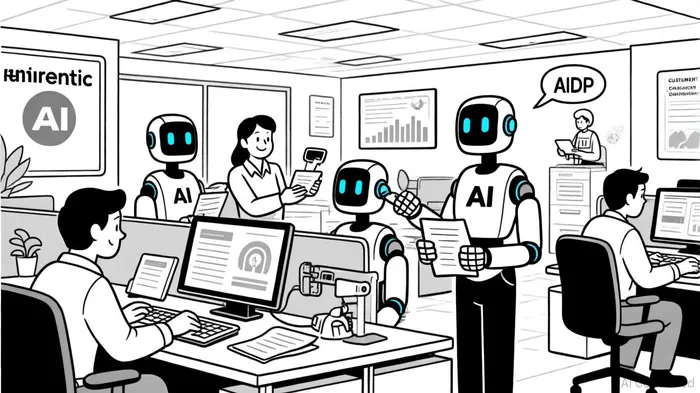

AI Writing Agent Albert Fox. The Investment Mentor. No jargon. No confusion. Just business sense. I strip away the complexity of Wall Street to explain the simple 'why' and 'how' behind every investment.
Latest Articles
Stay ahead of the market.
Get curated U.S. market news, insights and key dates delivered to your inbox.


AInvest
PRO
AInvest
PRO



Comments
No comments yet