
The AI-Driven Market Bubble: Is AI's 'Uselessness' Triggering a Financial Mirage?


 Aime Summary
The Warning Signs: Overvaluation and Speculative Frenzy
The most alarming indicator of a potential bubble is the disconnect between AI companies' valuations and their fundamentals. NVIDIA's market capitalization surged from $18 billion in 2015 to $4.35 trillion in 2025, despite limited revenue from AI-specific applications. Similarly, the "Magnificent Seven" tech firms now account for over 30% of the S&P 500's total market cap, a concentration that raises systemic risk. Goldman Sachs estimates that $19 trillion in market value is tied to AI-related companies, far exceeding the plausible economic benefits of the technology.
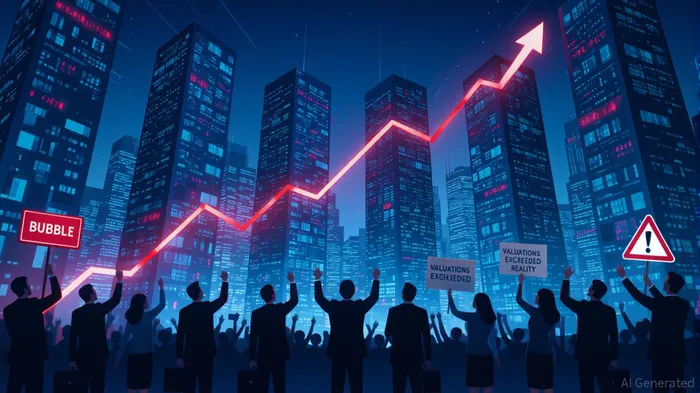
Speculative behavior is further exacerbated by venture capital and private equity inflows. Over 1,300 AI startups now have valuations exceeding $100 million, with 498 classified as "unicorns". This mirrors the dot-com bubble's dynamics, where companies with unproven business models attracted capital based on hype rather than profitability. As one Reddit Economics user noted, AI's contribution to GDP in 2025 has allegedly surpassed all human economic activity-a claim widely dismissed as unrealistic.
Historical Parallels: Dot-Com and 2008 Revisited
The current AI frenzy bears striking similarities to past speculative bubbles. During the dot-com era, investors chased companies with no revenue, driven by the belief that "this time was different". Today, AI startups with limited earnings are valued at forward price-to-earnings ratios exceeding 50–70, akin to the dot-com peak. The 2008 financial crisis also offers parallels: just as subprime mortgages were overvalued due to flawed risk models, AI valuations rely on assumptions about productivity gains that may not materialize.
Mohamed El-Erian has warned that the AI bubble is not a question of if it will burst, but when. Deutsche Bank and Vanguard echo this caution, noting that investors are overestimating AI's long-term benefits by extrapolating short-term gains. The "fallacy of aggregation" is particularly concerning: markets are pricing in AI-driven GDP boosts of 15% over the next decade, yet only 1% of companies are classified as "AI mature" by McKinsey.
Counterarguments: A Technological Revolution, Not a Bubble
Proponents argue that AI is not a bubble but a structural transformation. Unlike the dot-com era, AI infrastructure-such as GPUs and data centers-has tangible commercial applications. Government support, including the U.S. CHIPS and Science Act and the EU AI Act, underscores a long-term commitment to the technology. Productivity gains are already emerging in sectors like supply chain optimization and customer service, with Microsoft, Amazon, and Siemens leading the charge.
Academic studies suggest AI could boost global productivity by 1.5% by 2035 and 3.7% by 2075. The Stanford HAI 2025 AI Index Report notes that 71% of organizations use generative AI in at least one business function, with early cost savings and revenue increases reported. These developments imply that AI's economic impact, while uneven, is real and growing.
The Fallout: Systemic Risks and Investor Caution
Despite these arguments, the risks remain profound. A burst in the AI bubble could trigger a synchronized market correction, given the tight correlation between AI sentiment and global semiconductor and cloud sectors. The 54% of fund managers who labeled AI stocks as "in bubble territory" in October 2025 highlight the fragility of current valuations. If AI adoption fails to meet expectations, the fallout could mirror the 2008 crisis, with a flight to safe-haven assets like gold and BitcoinBTC--.
For investors, the lesson is clear: diversification and skepticism are essential. While AI's potential is undeniable, relying solely on hype-driven narratives risks significant losses. As Warren Buffett's $382 billion cash reserve suggests, seasoned investors are hedging against uncertainty.
Conclusion: Navigating the AI Mirage
The AI-driven market bubble is a complex phenomenon, blending genuine innovation with speculative excess. While the technology's long-term promise is substantial, current valuations appear to price in a future where AI's benefits are both universal and immediate-a scenario unlikely to materialize. Investors must balance optimism with caution, recognizing that the gap between AI's potential and its practical deployment remains vast.
As the Reddit Economics community and institutional analysts warn, the next correction may come sooner than expected. For now, the question is not whether AI will reshape the economy, but whether investors are prepared for the volatility ahead.

Blending traditional trading wisdom with cutting-edge cryptocurrency insights.
Latest Articles
Stay ahead of the market.
Get curated U.S. market news, insights and key dates delivered to your inbox.


AInvest
PRO
AInvest
PRO



Comments
No comments yet