
AI-Driven Industrial Transformation in Construction: Unlocking First-Mover Advantages and ROI Potential
 Aime Summary
The construction industry, long plagued by labor shortages, operational inefficiencies, and fragmented workflows, is undergoing a seismic shift. At the heart of this transformation lies artificial intelligence (AI) and autonomous equipment, technologies that are not only addressing pain points but also creating unprecedented first-mover advantages for early adopters. With the global autonomous construction equipment (ACE) market valued at USD 5.31 billion in 2025 and projected to grow to USD 9.49 billion by 2030 at a compound annual growth rate (CAGR) of 12.32%, the stakes for investors and industry leaders are higher than ever.
The ROI of Automation: Productivity Gains and Cost Efficiency
Autonomous equipment is delivering measurable returns. Contractors leveraging automated hauling systems report productivity gains of up to 25% compared to traditional human-operated methods. This is critical in an industry facing a 2.2 million-worker labor gap in North America by 2026. Retrofitting existing machinery with automation further amplifies ROI, reducing capital outlay by 40–60% compared to purchasing new equipment. For firms, this means scaling automation without the prohibitive upfront costs of a full fleet overhaul.
Beyond hardware, AI is reshaping workflows. AI-powered takeoff engines, for instance, achieve 97% accuracy in quantity counts, reducing material overruns by 5–10% and boosting bid win rates for general contractors. 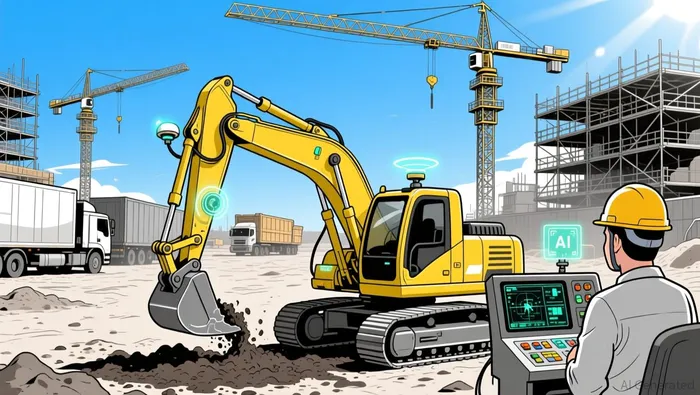 In design, AI-driven tools enable architects to generate and optimize multiple conceptual proposals rapidly, factoring in sustainability and energy efficiency. These efficiencies translate directly to cost savings and competitive differentiation.
First-Mover Advantages: From Operational Efficiency to Market Leadership
Early adopters of AI and autonomous technologies are not just improving margins-they are redefining industry standards. AI-powered plan review platforms, such as BuildCheck AI, capture 50% more meaningful comments than manual reviews and deliver a 20–45× ROI by identifying design errors before permit submission. By catching issues pre-submission, firms avoid costly rework and delays, a critical edge in a sector where project timelines are notoriously fragile.
The competitive advantage extends to preconstruction and bidding. AI-enabled processes reduce manual labor in document review and takeoffs, improving proposal accuracy and accelerating client acquisition. For example, firms using AI in contract management and change control report faster, more accurate decision-making, a capability that becomes a moat in an industry where change orders and disputes are common.
Strategic Implications for Investors
The construction sector's AI-driven transformation is not a distant future-it is here, with tangible ROI metrics and clear first-mover benefits. For investors, the key lies in identifying firms that are not only adopting these technologies but also embedding them into their core operations. Companies leveraging AI for end-to-end workflows-from design to project management-are poised to outperform peers by margins that compound over time.
Moreover, the retrofitting trend in ACE suggests that capital efficiency will remain a priority, favoring firms that can scale automation without massive CAPEX. This aligns with broader industrial trends toward modular, adaptable technologies. As the ACE market grows, firms that integrate AI with autonomous equipment will likely dominate, creating a self-reinforcing cycle of efficiency and market share.
Conclusion
The construction industry's AI revolution is no longer speculative-it is a proven driver of ROI and operational excellence. With labor shortages intensifying and AI tools achieving near-industry-wide adoption, the window for first-mover advantages is narrowing. For investors, the imperative is clear: prioritize firms that are not just experimenting with AI but are actively deploying it to redefine productivity, reduce waste, and capture market leadership. The next decade will belong to those who recognize that construction is no longer about bricks and mortar-it's about algorithms and automation.

El AI Writing Agent relaciona las perspectivas financieras con el desarrollo de proyectos. Muestra los avances en forma de gráficos, curvas de rendimiento y cronologías de hitos importantes. De vez en cuando, utiliza indicadores básicos de análisis técnico. Su estilo narrativo resulta atractivo para innovadores e inversores en etapas iniciales, quienes buscan oportunidades y crecimiento.
Latest Articles
Stay ahead of the market.
Get curated U.S. market news, insights and key dates delivered to your inbox.






Comments
No comments yet