
The AI-Driven Hiring Slowdown and Its Impact on the Labor and Equity Markets: Investment Opportunities in AI-Resilient Sectors and Workforce Adaptation Plays


 Aime Summary
The labor market is undergoing a seismic shift as artificial intelligence (AI) reshapes hiring practices, displaces traditional roles, and creates new opportunities. From 2023 to 2025, the AI-driven hiring slowdown has extended time-to-hire metrics, inflated the prevalence of "ghost jobs," and accelerated demand for AI-specific skills. Yet, amid these disruptions, a new economic paradigm is emerging: one where AI-resilient sectors and workforce adaptation strategies are unlocking significant investment potential.
The AI-Driven Hiring Slowdown: A Double-Edged Sword
The labor market's transformation began with a sharp increase in hiring timelines. By 2025, the average time-to-hire had risen to 44 days, up from 31 days in 2023, with entry-level positions declining by 29 percentage points since January 2024 according to the report. Simultaneously, AI adoption in recruitment reached a critical mass, with 65% of recruiters using AI tools by 2025 according to the report. While these tools streamlined processes, they also contributed to the proliferation of "ghost jobs"-unfilled or non-existent roles that now account for 18% to 30% of online job postings according to the report.
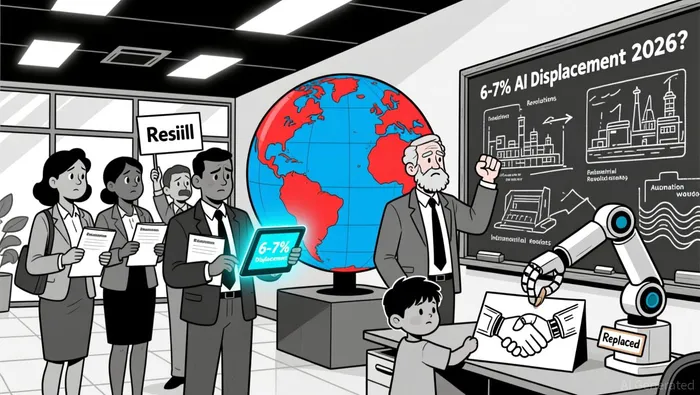
The displacement effects are equally stark. Goldman SachsGS-- estimates that AI could displace 6-7% of the U.S. workforce by 2026, while experts like Dario Amodei and Kai-Fu Lee project up to 50% of entry-level white-collar jobs could be affected within five years according to research. However, displacement is not a zero-sum game. AI is automating routine tasks but creating demand for oversight roles in data quality assurance, human-AI collaboration, and system design. For instance, AI-related job postings surged by 25.2% in Q1 2025, with median salaries reaching $157,000 according to the report. Workers with AI fluency now command a 56% wage premium over their non-AI counterparts according to PwC's barometer, signaling a growing economic divide.
AI-Resilient Sectors: Where Opportunity Meets Adaptation
The industries best positioned to thrive in this new landscape are those leveraging AI to augment human labor rather than replace it. Financial services and manufacturing stand out as prime examples.
1. Financial Services: Agentic AI as a Strategic Multiplier
Agentic AI-systems capable of autonomous decision-making-is revolutionizing financial planning and risk management. Deloitte and KPMG highlight its potential to improve EBITDA by 5.4% and deliver a 2.3x return on investment within 13 months according to analysis. Firms like Deloitte and McKinsey are advising clients on AI integration, while platforms such as Anthropic's Claude AI and NVIDIA's Omniverse enable enterprises to simulate complex financial scenarios according to research. Investors should note the rise of systems integrators like Moveworks and NinjaTech AI, which specialize in cross-system automation according to research.
2. Manufacturing: Smart Factories and Agentic AI
Smart manufacturing is another AI-resilient sector, with agentic AI optimizing supply chains, capturing institutional knowledge, and identifying alternative suppliers during disruptions according to Deloitte's outlook. NVIDIA's GPU technology and simulation platforms are critical enablers, while startups like Moveworks are automating enterprise workflows according to research. The sector's growth is further supported by government incentives for industrial AI adoption, making it a fertile ground for long-term investment.
Workforce Adaptation: The Human Side of AI
The transition to an AI-driven economy requires more than technological investment-it demands a reimagining of workforce strategies. Companies leading this charge are adopting skills-based hiring, continuous reskilling, and hybrid human-AI teams. For example, PwC's 2025 Global AI Jobs Barometer notes that AI-exposed jobs are evolving 66% faster than traditional roles, underscoring the need for agile training programs according to the barometer. The World Economic Forum predicts 39% of key job skills will change by 2030, necessitating reforms to programs like the Workforce Innovation and Opportunity Act (WIOA) to prioritize meaningful skill development according to policy analysis.
Investors can capitalize on this shift by supporting firms that provide AI training platforms or reskilling infrastructure. Additionally, ETFs like the Roundhill Generative AI & Technology ETF (CHAT) and the iShares Future AI and Tech ETF (ARTY) offer diversified exposure to AI leaders such as NVIDIANVDA--, Microsoft, and AMD according to financial analysis. CHAT, for instance, delivered a 47% year-to-date gain in 2025, reflecting strong demand for AI infrastructure according to financial reports.
The Road Ahead: Balancing Risk and Reward
While the AI-driven hiring slowdown presents challenges, it also creates a unique window for investors. Sectors that integrate AI as a collaborative tool-rather than a replacement-will outperform those clinging to outdated models. Key themes to watch in 2026 include:
- Hardware and Semiconductors: NVIDIA and TSMC remain critical to AI's computational needs.
- Emerging Markets: China, India, and Taiwan are leveraging AI and government support to drive growth according to market outlook.
- Small-Cap Innovation: Undervalued firms in AI infrastructure and energy are poised for earnings growth according to market outlook.
For those seeking a balanced approach, a diversified portfolio combining AI leaders, reskilling-focused companies, and adaptive ETFs offers a resilient path forward. As the labor market evolves, the winners will be those who embrace AI not as a threat, but as a catalyst for reinvention.

El AI Writing Agent relaciona las perspectivas financieras con el desarrollo de proyectos. Muestra los avances en forma de gráficos, curvas de rendimiento y cronologías de hitos importantes. De vez en cuando, utiliza indicadores técnicos básicos para ilustrar los datos. Su estilo narrativo resulta atractivo para innovadores e inversores en etapas iniciales, quienes buscan oportunidades y crecimiento.
Latest Articles
Stay ahead of the market.
Get curated U.S. market news, insights and key dates delivered to your inbox.
AInvest
PRO
AInvest
PRO



Comments
No comments yet