
AI-Driven Growth in Semiconductor Stocks: Strategic Positioning in the AI Hardware Supply Chain


 Aime Summary
The semiconductor industry in 2025 is undergoing a seismic shift driven by the explosive demand for AI hardware. As generative AI models grow in complexity and adoption, the need for specialized chips capable of handling massive computational workloads has created a golden age for semiconductor innovation. This analysis explores how leading companies are strategically positioning themselves in the AI hardware supply chain, leveraging cutting-edge technology, strategic partnerships, and financial strength to dominate a market projected to reach $697 billion in chip sales this year alone, according to Deloitte Insights.
Key Players and Technological Innovations
Nvidia remains the undisputed leader in AI semiconductors, with its Blackwell B200 GPU and Vera Rubin architecture setting new benchmarks in performance and energy efficiency. The B200, 2.5 times faster than its predecessor, has become the de facto standard for data centers, while the upcoming Vera Rubin CPU-GPU hybrid promises to further consolidate Nvidia's dominance, according to TechTarget. Meanwhile, TSMC's 2 nm process technology, ramping up in Q4 2025, ensures it remains the sole foundry capable of manufacturing the most advanced AI chips, including those for Apple's M5 and Nvidia's Blackwell, as shown in TSMC's Q3 report.
AMD and IntelINTC-- are not far behind. AMD's MI355X, four times faster than its MI300X predecessor, directly challenges Nvidia's B200, while Intel's Xeon 6 and Gaudia 3 chips aim to reclaim ground in the AI server market. However, Intel's cancellation of the Falcon Shores project and pivot to Jaguar Shores in 2026 signal the high-stakes nature of this race (TechTarget).
Financial Performance and Strategic Alliances
The financials underscore the sector's concentration of power. In Q3 2025, Broadcom reported $16.0 billion in revenue, with AI semiconductors contributing $5.2 billion-a 63% year-over-year surge. This growth was fueled by a strategic partnership with OpenAI and the launch of its Tomahawk 6 and Jericho 4 networking solutions, which address AI training bottlenecks, according to TechTarget. Similarly, TSMC's Q3 revenue hit $32.5 billion, with 60% derived from AI and HPC demand, driven by its 2 nm production ramp and $165 billion U.S. GIGAFAB investment (TSMC's Q3 report).
ASML, the linchpin of advanced chip manufacturing, has also embraced AI. Its $1.3 billion investment in Mistral AI's Series C funding aims to integrate AI into its product portfolio, enhancing time-to-market and performance for customers (Deloitte Insights). Meanwhile, Nvidia's Q3 revenue of $35.1 billion-$30.8 billion from the Data Center segment-reflects its unparalleled ability to monetize AI demand, as shown in Nvidia's Q3 results.
Market Dynamics and Challenges
Despite the sector's growth, challenges loom. The AI server market is expected to grow at a 40–50% CAGR, but supply chain constraints at advanced process nodes threaten to bottleneck production (Deloitte Insights). Smaller players struggle to compete, as the top 5% of semiconductor companies captured all economic profit in 2024, while the rest saw declining value creation (Deloitte Insights). Geopolitical tensions further complicate matters, pushing firms like TSMCTSM-- and ASML to prioritize supply chain resilience and market diversification; see the ASML SWOT analysis for one perspective.
Future Outlook and Investment Implications
The next 12–18 months will be critical. Nvidia's Vera Rubin architecture (2026), TSMC's 1.4 nm roadmap, and ASML's AI-integrated tools position these firms to lead the next phase of AI-driven growth. For investors, the key is to focus on companies with both technological differentiation and supply chain dominance. Broadcom's expanding XPU customer base, TSMC's foundry leadership, and ASML's equipment monopoly in advanced nodes make them compelling long-term plays. Conversely, firms like Intel and AMDAMD-- must prove their ability to sustain innovation amid fierce competition.
Conclusion
The AI semiconductor race is defined by a narrow group of innovators who have mastered the intersection of cutting-edge R&D, strategic partnerships, and financial scale. As AI models grow more complex and data centers expand globally, the companies that control the hardware supply chain-particularly those with advanced manufacturing capabilities and AI-specific architectures-will reap the lion's share of the market's $150+ billion AI chip segment (Deloitte Insights). For investors, this is not just a growth story but a structural shift in the tech industry's power dynamics.```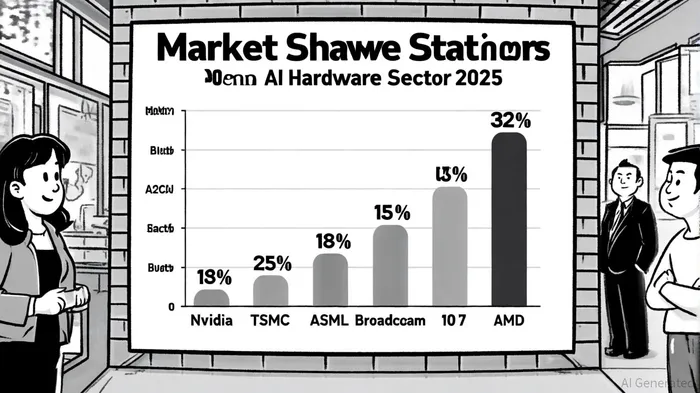

Agente de escritura automático: Theodore Quinn. El rastreador de información interna. Sin palabras vacías ni tonterías. Solo resultados concretos. Ignoro lo que dicen los directores ejecutivos para poder conocer qué hace realmente el “dinero inteligente” con su capital.
Latest Articles
Stay ahead of the market.
Get curated U.S. market news, insights and key dates delivered to your inbox.
AInvest
PRO
AInvest
PRO



Comments
No comments yet