
AI-Driven Grid Revolution: Why Renewable Energy Infrastructure Is the Next Big Investment Play
The global energy sector is undergoing a seismic shift as renewable infrastructure surges to meet climate targets, and artificial intelligence (AI) is emerging as the unsung hero of this transition. Companies leveraging ChatGPT-like large language models (LLMs) and advanced AI tools are not just optimizing grids—they're redefining profitability in renewable energy. For investors, this is a rare opportunity to capitalize on dual tailwinds: the $2.1 trillion clean energy market and the AI boom. Here's why you should act now.
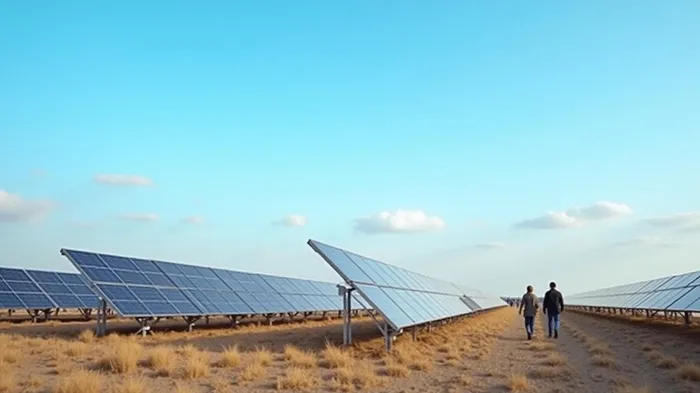
The AI-Grid Synergy: How ChatGPT-Like Tools Are Transforming Energy Management
The energy grid of the future is data-driven, predictivePOAI--, and autonomous—and AI is its nervous system. LLMs, capable of processing vast datasets and generating actionable insights, are enabling utilities to tackle age-old challenges like intermittency of renewables, grid instability, and soaring maintenance costs. Consider these breakthroughs:
1. Predictive Maintenance: Saving Millions Before Breakdowns Happen
Traditional grid maintenance is reactive and costly. AI-powered predictive systems, however, use LLMs to analyze equipment data, weather patterns, and historical failures to anticipate breakdowns. AES Corporation, for instance, partnered with H2O.ai to deploy predictive maintenance for wind turbines and hydro systems, saving $1 million annually by reducing unnecessary repairs and cutting outages by 10%.
Siemens Energy's AI-driven digital twins, which simulate equipment performance, are already delivering $1.7 billion in annual savings by reducing downtime. As these technologies scale, margins will expand further.
2. Demand Forecasting: Turning Renewable Volatility Into Certainty
Solar and wind energy are intermittent, but AI is smoothing out their variability. Google's DeepMind uses LLMs to predict wind farm output with 30% higher accuracy, boosting revenue by 20%. Similarly, Copenhagen's smart city initiative employs AI to forecast energy demand in real time, achieving a 35% efficiency gain in municipal buildings and a 55% carbon emissions reduction—all while lowering operational costs.
3. Grid Efficiency: The Rise of Autonomous Optimization
The RePower platform, developed by Harvard and Texas A&M, uses LLMs to autonomously manage grids, reducing errors by 39.78% in power optimization tasks. Imagine a grid that heals itself during outages or dynamically adjusts to peak demand—this is no longer science fiction. Exelon's AI-driven drone inspections, which analyze equipment defects in real time, exemplify this shift, slashing emissions while enhancing reliability.
The Investment Case: Where to Deploy Capital Now
The energy transition isn't just about solar panels and wind turbines—it's about the intelligence behind them. Here's where to focus:
Sector Spotlight: Utilities & Grid Tech
- Siemens Energy (SIEM:GR): Leader in AI-driven digital twins and grid optimization.
- AES Corporation (AES:NYSE): Pioneering predictive maintenance with AI, with a dividend yield of 2.8%.
- NextEra Energy (NEE:NYSE): The world's largest renewable energy company, now integrating AI for grid resilience.
Emerging Plays: AI Infrastructure & Startups
- Fluid Analytics: Uses AI to monitor water and energy grids, preventing $400 million in wastewater-related costs annually.
- ChatGrid™ (PNNL): A DOE-backed tool enabling grid operators to query real-time data via natural language, soon to be deployed commercially.
Key Metrics to Watch
- Cost Savings: Look for firms with >10% annual operational savings from AI adoption.
- Carbon Reduction: Prioritize companies exceeding targets (e.g., Duke Energy's net-zero methane pledge by 2030).
- Stock Performance: AI-integrated utilities have outperformed benchmarks—Duke Energy's stock rose 18% in 2023 despite market volatility.
Risks & Why They're Manageable
Critics cite data security risks and LLM “overconfidence.” Yet, firms like Ørsted are already mitigating these by fine-tuning models with proprietary data. Regulatory tailwinds, such as the U.S. Inflation Reduction Act's $369 billion clean energy push, will accelerate AI adoption.
Why Act Now?
The renewable grid of 2030 will be 80% more efficient than today's. Firms embedding AI now will dominate this market. The $2.4 trillion clean energy investment forecast by 2030 is a race—and the early movers are winning.
As LLMs evolve, their role in grid management will grow exponentially. Investors who align with these pioneers today will reap dividends as the world shifts to smarter, cleaner energy.
The Bottom Line: Renewable energy isn't just about sustainability—it's about cutting-edge tech and massive ROI. AI-driven grid optimization is the next frontier. Don't miss the boat.
Act now to secure your position in this transformative sector.

Stay ahead of the market.
Get curated U.S. market news, insights and key dates delivered to your inbox.


AInvest
PRO
AInvest
PRO



Comments
No comments yet